
Official statement
Other statements from this video 12 ▾
- □ Does Google really follow every HTTP status code in a chain, or does it stop at the first one?
- □ Does a CDN really improve your Google rankings?
- □ Should you block API endpoint crawling to optimize your crawl budget?
- □ Should you really ban nofollow from your internal links?
- □ Should you stop relying on the site: command to measure indexation?
- □ Should you really care about the difference between 301 and 302 redirects for SEO?
- □ Should you really isolate your archived content to boost your SEO performance?
- □ Can you really force Google to display sitelinks in search results?
- □ Should you really abandon PDFs and iframes if you want your text content to rank properly?
- □ Is it really worth blocking or hiding external links to protect your PageRank?
- □ Does Google really favor certain CMS platforms for SEO rankings?
- □ Does Google really crawl URLs found in your structured data?
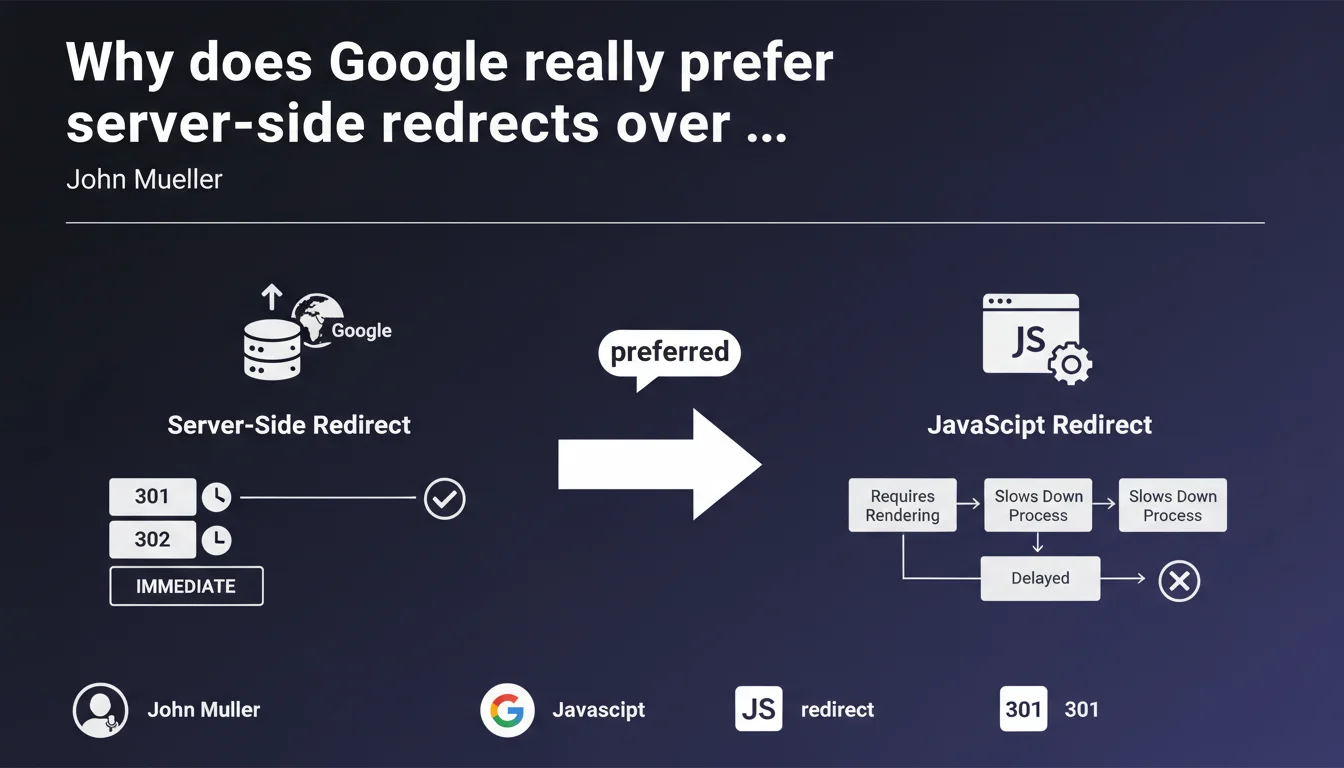
Google clearly favors server-side redirects (301, 302) over JavaScript redirects. JavaScript redirects require rendering beforehand, which significantly slows down Googlebot's processing. Always use server-side redirects whenever technically feasible.
What you need to understand
What's the actual difference in how server redirects and JavaScript redirects are handled?
Server-side redirects (301, 302, 307, 308) are processed immediately by Googlebot, even before HTML is downloaded. The crawler receives the HTTP status code, understands the redirect, and directly follows the destination URL.
JavaScript redirects, on the other hand, require Googlebot to download the HTML, add it to the rendering queue, execute the JavaScript, detect the redirect, and then crawl the target URL. This multi-step process consumes time and crawl budget.
Why is this processing delay so problematic?
JavaScript rendering isn't instantaneous at Google. There can be a delay of hours or even days between the initial crawl and when Googlebot actually executes the JavaScript to discover the redirect.
During this time, the source URL remains in the index with its old content, or worse, generates indexing errors. For migrations or urgent URL changes, this is problematic.
When does this recommendation apply as a priority?
This directive specifically targets site migrations, URL restructuring, and permanent redirects. Whenever you want to quickly transfer PageRank and ranking signals from one URL to another.
For temporary redirects or client-side A/B tests, the context may differ, but the general rule remains: server-side whenever possible.
- Server redirects are processed instantly by Googlebot
- JavaScript redirects require rendering, with potentially significant delays
- Crawl budget is preserved with server-side redirects
- Ranking signals are transmitted faster with 301/302
- This recommendation primarily targets URL migrations and restructuring
SEO Expert opinion
Is this position consistent with real-world observations?
Yes, completely. Tests on actual migrations consistently show a time gap when using JavaScript redirects. Source URLs remain indexed well after deployment.
I've seen cases where JS redirects took 2-3 weeks to be fully processed, whereas standard 301s transfer signals in days. Mueller's guidance reflects technical reality.
Are there cases where JavaScript is acceptable?
Let's be honest: in an ideal world, everything would be server-side 301. But certain architectures—particularly SPAs or entirely client-side rendered sites—make server redirects complex to implement.
In these contexts, a JavaScript redirect remains better than nothing. But it should be viewed as a last resort, never as an optimal solution. [To verify]: Google has never provided exact figures on the negative ranking impact, just on processing delays.
What nuance should we add regarding temporary redirects?
Mueller discusses 301 and 302, but doesn't detail whether the JavaScript handling difference also applies to 307/308 redirects. In practice, all server-side 3xx codes benefit from the same speed advantage.
However, for conditional redirects (based on device, geolocation, etc.), JavaScript might seem tempting. Be careful: even in this case, server-side solutions (Vary, dynamic redirect) remain preferable to avoid mobile/desktop indexing issues.
Practical impact and recommendations
What should you check first on your site?
Start by auditing your existing redirects. Use Screaming Frog or an equivalent tool to identify all JavaScript redirects. Look for URLs that change destination via window.location, meta refresh, or client-side routing frameworks.
Next, check Search Console for signs of delayed crawling or duplicate indexing (both source and destination URLs present simultaneously).
How do you migrate from JS redirects to server-side?
The method depends on your technical stack. On Apache, use .htaccess with mod_rewrite. On Nginx, use return 301 or rewrite directives. On modern CDNs (Cloudflare Workers, Vercel Edge Functions), you can handle this with edge computing.
For complex sites, the migration may require partial architectural refactoring. This is especially true for SPAs where routing is entirely client-side. In these cases, consider SSR or pre-rendering.
What mistakes should you avoid during the transition?
Don't remove JavaScript redirects before verifying that server redirects work properly. Test in parallel first, then gradually switch over.
Also avoid redirect chains: switching from a JS redirect to a 301 that itself points to another 301 is counterproductive. Redirect directly to the final URL.
- Audit all existing JavaScript redirects on your site
- Prioritize migrating redirects on strategic pages
- Implement server-side 301 redirects for permanent changes
- Use 302 only for truly temporary redirects
- Test with curl or network tools to verify the HTTP code is properly returned
- Monitor Search Console for any crawl regressions
- Avoid redirect chains (maximum 1 hop)
- Document redirects to facilitate future maintenance
❓ Frequently Asked Questions
Les redirections JavaScript transmettent-elles le PageRank ?
Peut-on mélanger redirections serveur et JavaScript sur un même site ?
Les meta refresh sont-elles considérées comme des redirections serveur ?
Comment tester qu'une redirection est bien côté serveur ?
Les frameworks SPA comme React peuvent-ils faire des redirections serveur ?
🎥 From the same video 12
Other SEO insights extracted from this same Google Search Central video · published on 08/06/2022
🎥 Watch the full video on YouTube →
💬 Comments (0)
Be the first to comment.