
Official statement
Other statements from this video 21 ▾
- □ Faut-il créer une nouvelle URL ou mettre à jour la même page pour du contenu quotidien ?
- □ Faut-il arrêter d'utiliser l'outil de soumission manuelle dans Search Console ?
- □ Les balises H2 dans le footer posent-elles un problème pour le référencement ?
- □ Les balises <header> et <footer> HTML5 améliorent-elles vraiment le SEO ?
- □ Faut-il vraiment se fier au validateur schema.org pour optimiser ses données structurées ?
- □ Google crawle-t-il tous les sitemaps au même rythme ?
- □ Google continue-t-il vraiment de crawler un sitemap supprimé de Search Console ?
- □ Pourquoi Google n'indexe-t-il pas une page crawlée régulièrement si elle ne présente aucun problème technique ?
- □ Peut-on utiliser des canonical bidirectionnels entre deux versions d'un site sans risque ?
- □ Les structured data peuvent-elles remplacer le maillage interne classique ?
- □ Pourquoi un seul x-default suffit-il pour toute votre configuration hreflang multi-domaines ?
- □ Faut-il vraiment éviter le structured data produit sur les pages catégories ?
- □ Faut-il vraiment choisir une langue principale pour chaque page si vous visez plusieurs marchés ?
- □ Pourquoi Google ignore-t-il complètement votre version desktop en mobile-first indexing ?
- □ Le contenu 'commodity' peut-il vraiment survivre dans les résultats Google ?
- □ Faut-il isoler ses FAQ dans des pages séparées pour mieux ranker ?
- □ Pourquoi Google réduit-il drastiquement l'affichage des FAQ dans les résultats de recherche ?
- □ Pourquoi Google n'indexe-t-il qu'une infime fraction de vos URLs ?
- □ Peut-on héberger son sitemap XML sur un domaine différent de son site principal ?
- □ Les Core Web Vitals : pourquoi le passage de « Bad » à « Medium » change tout pour votre ranking ?
- □ La vitesse serveur impacte-t-elle vraiment le crawl budget des gros sites ?
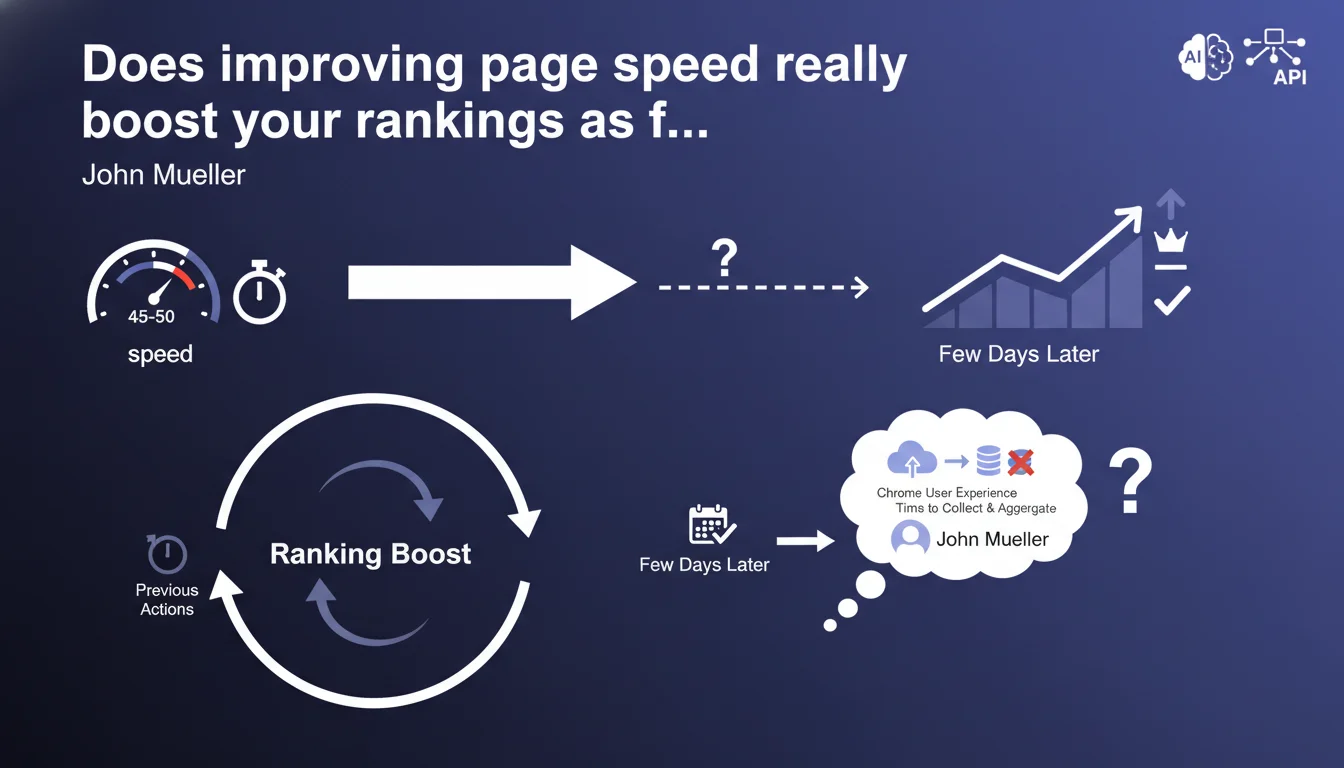
A quick ranking improvement after a PageSpeed Insights boost is probably not speed-related. CrUX data takes time to collect and aggregate — if your site jumps in a few days, look elsewhere for the real cause.
What you need to understand
Why does Google emphasize the data collection delay?
Core Web Vitals are measured via the Chrome User Experience Report (CrUX), which aggregates real user data over a rolling 28-day period. In practice, a technical improvement doesn't instantly reflect in the metrics that Google's algorithm considers.
If you jump from 30 to 50 on PageSpeed Insights on a Monday and your rankings climb by Wednesday, it's mathematically impossible for speed to be the direct cause. Google simply doesn't have enough field data yet to account for it.
What could explain a rapid ranking boost then?
Probably a modification made a few weeks earlier: fixing an indexation issue, adding relevant content, improving internal linking, revamping a key page. The timing makes you attribute it to speed, but the real lever lies elsewhere.
This is a classic cognitive bias: you correlate the most recent event with the observed result, when the real driver has actually been incubating for a while.
Is PageSpeed Insights useless for SEO?
No, but you need to distinguish between the lab score (Lighthouse) and field data (CrUX). The Lighthouse score gives you technical optimization hints, but it's the CrUX data that actually counts for ranking.
If your site doesn't have enough Chrome traffic, CrUX data may be missing or unrepresentative. In that case, the direct SEO impact of speed will be nearly zero, even with a perfect score.
- Core Web Vitals are measured via CrUX, with a 28-day aggregation delay.
- A quick ranking improvement after a speed change is a coincidence, not causation.
- The PageSpeed Insights score (Lighthouse) is a diagnostic tool, not the ranking signal.
- Sites with low Chrome traffic may not have usable CrUX data.
- Find the real causes of a ranking boost: content, indexation, backlinks, internal linking.
SEO Expert opinion
Does this explanation match real-world observations?
Absolutely. I've seen dozens of cases where a client improves speed, sees an immediate ranking bump, and sends me a triumphant email attributing the result to Core Web Vitals. Except when you dig deeper, they'd also fixed a canonicalization error three weeks prior, or added structured content that Google had just finished processing.
The reverse is equally true: sites with terrible PageSpeed scores that rank extremely well because their authority and content more than compensate. Speed is one factor among many, and its relative weight is often overstated.
Is Google transparent about the real weight of speed?
Not really. We know Core Web Vitals are a ranking signal, but Google never quantifies their relative impact. [To verify]: to what extent does an LCP of 1.5s vs 3s actually change your ranking, all else being equal? No one has a precise answer.
This ambiguity fuels a kind of panic among some clients who over-invest in technical optimization at the expense of more profitable levers. Let's be honest: if your content is mediocre, a perfect LCP won't change a thing.
When does speed become a real SEO lever?
When you're in an ultra-competitive sector where gaps in authority and content are minimal. If you and your main competitor have similar link profiles, equivalent content, and you're targeting the same query, then yes, Core Web Vitals could make the difference.
But that's an arbitrage at the margins, not a primary lever. Prioritize content, architecture, and backlinks first. Speed is the cherry on top — not the cake itself.
Practical impact and recommendations
What should you do concretely after improving speed?
Stop monitoring your rankings daily hoping for a miracle. Wait at least 4 to 6 weeks before drawing conclusions about real SEO impact. During that time, CrUX data will accumulate and Google will have enough material to potentially adjust your ranking.
In the meantime, focus on other levers: publish content, optimize existing pages, fix indexation errors, improve internal linking. These actions often deliver much better short-term ROI.
How do you verify if Core Web Vitals actually impact my site?
Use Search Console (Core Web Vitals section) to check whether your URLs are rated as "Good," "Needs Improvement," or "Poor." If you have no data, your Chrome traffic is too low — SEO impact will be negligible.
Then compare your performance against direct competitors using tools like the CrUX Dashboard (Data Studio) or Treo.sh. If you're in line with your sector's average, no need to panic. If you're significantly behind, that could become a handicap.
What mistakes should you avoid when interpreting speed data?
Don't confuse Lighthouse score with CrUX data. Lighthouse tests from a Google server under lab conditions — useful for diagnosis, but doesn't reflect real user experience. CrUX measures what people actually experience on Chrome.
Another mistake: automatically attributing every ranking fluctuation to your latest technical change. SEO is multivariate, and Google continuously tests algorithmic adjustments that have nothing to do with your site.
- Wait 4 to 6 weeks after a technical improvement before measuring SEO impact.
- Check your CrUX data in Search Console — if it's absent, impact will be minimal.
- Compare your performance against direct competitors in your sector.
- Don't overestimate speed's weight relative to content, backlinks, and architecture.
- Use Lighthouse for diagnosis, CrUX for measuring real impact.
- Monitor behavioral signals (bounce rate, time on site) which are often more revealing.
❓ Frequently Asked Questions
Combien de temps faut-il attendre pour que les Core Web Vitals impactent le classement ?
Un bon score PageSpeed Insights garantit-il un meilleur classement ?
Mon site a un faible trafic Chrome, les Core Web Vitals sont-ils importants pour moi ?
La vitesse est-elle plus importante que le contenu pour le SEO ?
Comment savoir si une remontée de classement est due à la vitesse ou à autre chose ?
🎥 From the same video 21
Other SEO insights extracted from this same Google Search Central video · published on 05/03/2022
🎥 Watch the full video on YouTube →
💬 Comments (0)
Be the first to comment.