
Official statement
Other statements from this video 19 ▾
- □ Should you panic if your hreflang disappears temporarily during a migration?
- □ Should you block GoogleOther or risk disrupting your Google services?
- □ Do local domains (ccTLD) really offer an SEO advantage for local search rankings?
- □ Why does Google keep displaying your old site name in search results long after a rebrand?
- □ Should you really fix every single indexation error Google reports in Search Console?
- □ How can you leverage the Google Search Status Dashboard API to supercharge your SEO tools?
- □ Why aren't your product structured data appearing in Google's rich results?
- □ Why does Google refuse to grant unlimited indexation request quotas in Search Console?
- □ Is your brand really stuck being confused with a common word? How long does Google actually need to figure it out?
- □ What's the only way to hide text from Google without using HTML tags?
- □ Is Schema Recipe really restricted to food recipes only, or can you use it creatively?
- □ Can Google actually transfer your SEO rankings during a domain migration?
- □ Does the noindex tag really only affect individual pages, or can it impact your entire site?
- □ Do you really need to fill in every single field of structured data for Google to actually use it?
- □ Does Google really use RSS feeds to discover and index new content on your site?
- □ Why is your new favicon taking so long to appear in Google search results?
- □ Does the order of H1, H2, H3 tags really affect your Google rankings?
- □ Do links on crawl-blocked pages really lose all their SEO value?
- □ Does Google really require a specific sitemap structure, or can you organize them however you want?
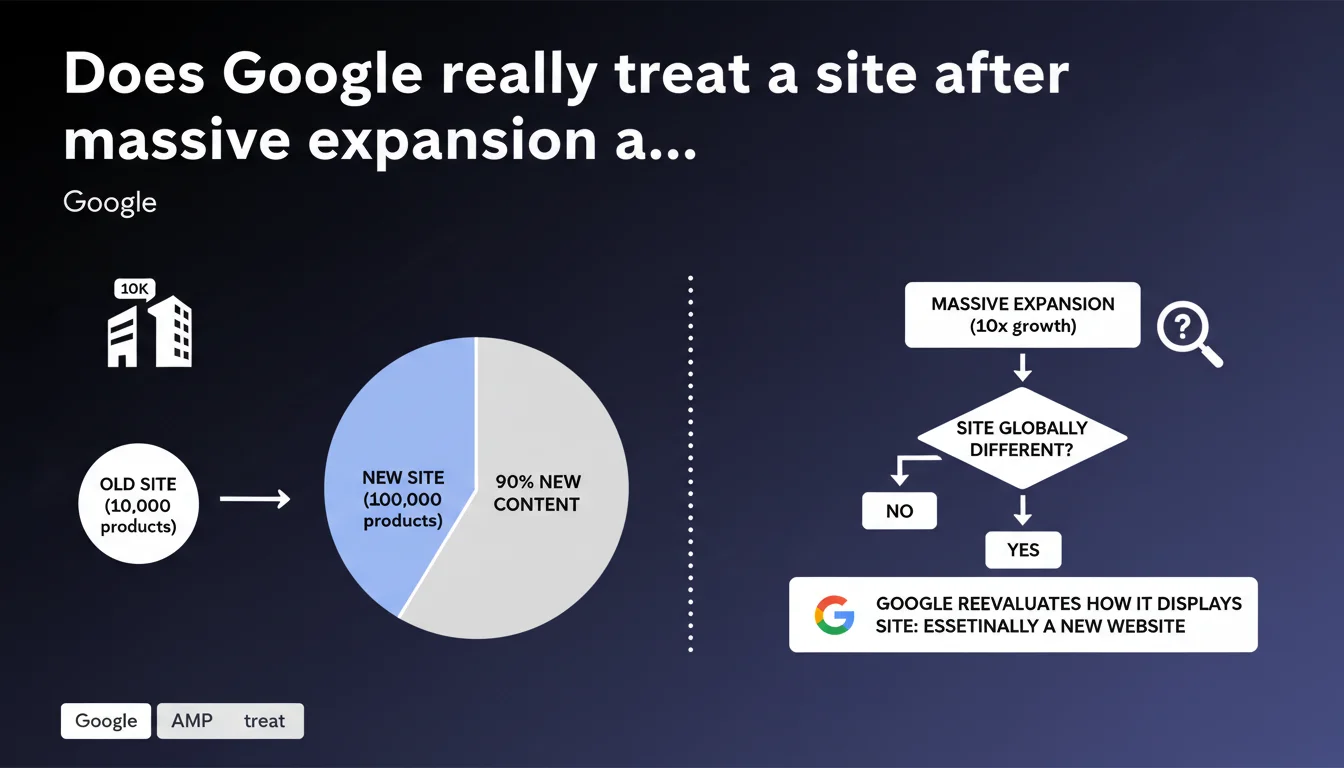
Google completely reevaluates a site that grows, for example, from 10,000 to 100,000 products, because the old site now represents only 10% of the new one. In concrete terms, this means that massive content expansion triggers a global site reevaluation, as if it were a new domain. Historical quality signals are diluted and the site must prove its legitimacy again.
What you need to understand
What does Google mean by "complete reevaluation" after massive expansion?
When a site multiplies its content volume by 10, Google doesn't just index the new pages. The algorithm recalculates all trust signals: thematic authority, average content quality, internal linking patterns, crawl depth. The old site becomes a minority — statistically drowned in the new mass.
What was true for 10,000 pages (editorial coherence, depth of expertise) no longer applies mechanically to 100,000. Google must verify that this growth isn't large-scale spam, that new sections maintain the quality standard, that the architecture supports this volume.
Is this reevaluation systematically negative?
Not necessarily. If the expansion is organic, thematically coherent and well-structured, the site can gain in overall authority. But the risk exists: dilution of relevance, drop in average quality, explosion of crawl budget without added value. Google must make a decision.
The reevaluation timeline varies. Some sites see an immediate effect (positive or negative), while others experience a lag of several months before new metrics stabilize rankings. [To verify]: Google doesn't specify exact thresholds or typical duration of this observation period.
What are the signals Google prioritizes during reevaluation?
- Average content quality: does the new corpus push the overall score up or down?
- Thematic coherence: do new pages reinforce expertise or scatter the site?
- Architecture and crawlability: does internal linking support the new volume without creating depth pitfalls?
- External link profile: does the expansion attract natural backlinks or remain invisible?
- User engagement: do new sections generate qualified traffic or massive bounce rates?
SEO Expert opinion
Is this statement consistent with real-world observations?
Yes, and examples are plentiful. E-commerce sites that move from niche catalogs to generalist marketplaces often see visibility drop dramatically — even if the old pages performed well. The problem: dilution of thematic authority temporarily outweighs the raw value of new content.
Conversely, sites that gradually expand their ranges (adding product variations, enriched content, buying guides) maintain or even strengthen their trajectory. The difference? The speed of expansion and editorial coherence. Google clearly distinguishes controlled growth from massive content dumps.
What nuances should be applied to this rule?
Google doesn't precisely define the "significant" threshold. Moving from 10,000 to 15,000 pages triggers this reevaluation? Probably not. But from 10,000 to 50,000? Very likely. [To verify]: the lack of concrete numbers makes anticipation difficult.
Another nuance: the nature of content matters as much as volume. Adding 90,000 nearly-identical product variations (colors, sizes) doesn't have the same impact as adding 90,000 unique product sheets with enriched descriptions. Google evaluates information density, not just the number of URLs.
In what cases doesn't this rule fully apply?
Sites with historically massive domain authority (major media, institutional brands) often traverse these expansions with fewer disruptions. Google grants them preliminary trust that average sites must rebuild.
Launches of isolated new sections (separate subdomains or subdirectories) can also escape this logic if Google treats them as semi-autonomous entities. But it's a gamble — nothing guarantees this algorithmic segmentation.
Practical impact and recommendations
What should you do concretely before massive expansion?
Before launching 90,000 new pages, prepare the ground. Audit your current architecture: can it absorb this volume without creating monstrous depth levels? Are your templates qualitatively scalable? Poor content duplicated 90,000 times is SEO suicide.
Plan the expansion in phases. Rather than a big bang, deploy by thematic clusters of 10,000-20,000 pages spaced several weeks apart. This allows Google to progressively evaluate each wave and maintain a visible quality curve. And it gives you time to correct if the first wave tanks your metrics.
- Complete audit of current architecture and internal linking
- Validation of template scalability (unique content, added value per page)
- Planning by thematic phases rather than massive deployment
- Close monitoring of Core Web Vitals (crawling will explode)
- Implementation of distinct Analytics segments for new content
- Preparation of a Plan B: ability to quickly deindex if things go wrong
What errors must you absolutely avoid?
Don't launch massive expansion thinking "more = better". If your new pages don't provide differentiated value, they'll cannibalize existing content and lower average quality. Google detects this through user signals: time spent, bounce rate, returns to SERPs.
Another classic mistake: neglecting crawl budget. Moving from 10,000 to 100,000 pages without optimizing your robots.txt file, XML sitemap and pagination directives condemns new pages to invisibility for months. Google will crawl, but won't necessarily index if signals are weak.
How do you verify your site is traversing this reevaluation well?
Monitor the evolution of actual indexation via Search Console (not just submitted sitemap). If Google quickly indexes new pages and maintains or improves old page positions, that's a good sign. If indexation stalls or old pages drop, reevaluation is underway — and not in your favor.
Monitor overall quality metrics: average CTR, average position, pages per session. A successful expansion must elevate these indicators, not dilute them. If your average CTR drops while adding content, Google is now showing less relevant pages — sign of dilution.
❓ Frequently Asked Questions
À partir de quel volume d'expansion Google considère-t-il un site comme "nouveau" ?
Cette réévaluation affecte-t-elle les pages déjà bien positionnées ?
Combien de temps dure cette période de réévaluation ?
Peut-on éviter cette réévaluation en déployant progressivement ?
Les sous-domaines permettent-ils d'isoler le nouveau contenu ?
🎥 From the same video 19
Other SEO insights extracted from this same Google Search Central video · published on 18/07/2024
🎥 Watch the full video on YouTube →
💬 Comments (0)
Be the first to comment.