
Official statement
Other statements from this video 19 ▾
- □ Faut-il paniquer si votre hreflang disparaît temporairement pendant une migration ?
- □ Faut-il bloquer GoogleOther ou risquer d'impacter ses services Google ?
- □ Les domaines locaux (ccTLD) offrent-ils vraiment un avantage SEO pour le référencement local ?
- □ Pourquoi Google traite-t-il un site après expansion massive comme un tout nouveau site web ?
- □ Pourquoi Google continue-t-il d'afficher l'ancien nom de votre site après un rebranding ?
- □ Faut-il vraiment corriger toutes les erreurs d'indexation signalées dans la Search Console ?
- □ Comment exploiter l'API du tableau de bord de statut Google Search pour vos outils SEO ?
- □ Pourquoi vos données structurées produits n'apparaissent-elles pas dans les résultats enrichis ?
- □ Pourquoi Google refuse-t-il les requêtes d'indexation illimitées dans Search Console ?
- □ Marque confondue avec un mot courant : faut-il vraiment attendre des mois sans rien faire ?
- □ Comment masquer du texte à Google en bloquant le JavaScript qui le contient ?
- □ Peut-on vraiment utiliser le Schema Recipe pour n'importe quel type de recette ?
- □ Google peut-il transférer vos rankings SEO lors d'une migration de domaine ?
- □ Comment la balise noindex fonctionne-t-elle réellement page par page ?
- □ Faut-il vraiment remplir tous les champs des données structurées pour que Google les prenne en compte ?
- □ Les flux RSS sont-ils vraiment exploités par Google pour l'exploration et l'indexation ?
- □ Pourquoi votre nouveau favicon met-il autant de temps à apparaître dans les résultats Google ?
- □ Les liens sur pages bloquées au crawl perdent-ils vraiment toute leur valeur SEO ?
- □ Faut-il vraiment structurer ses sitemaps selon des règles précises ou peut-on faire n'importe quoi ?
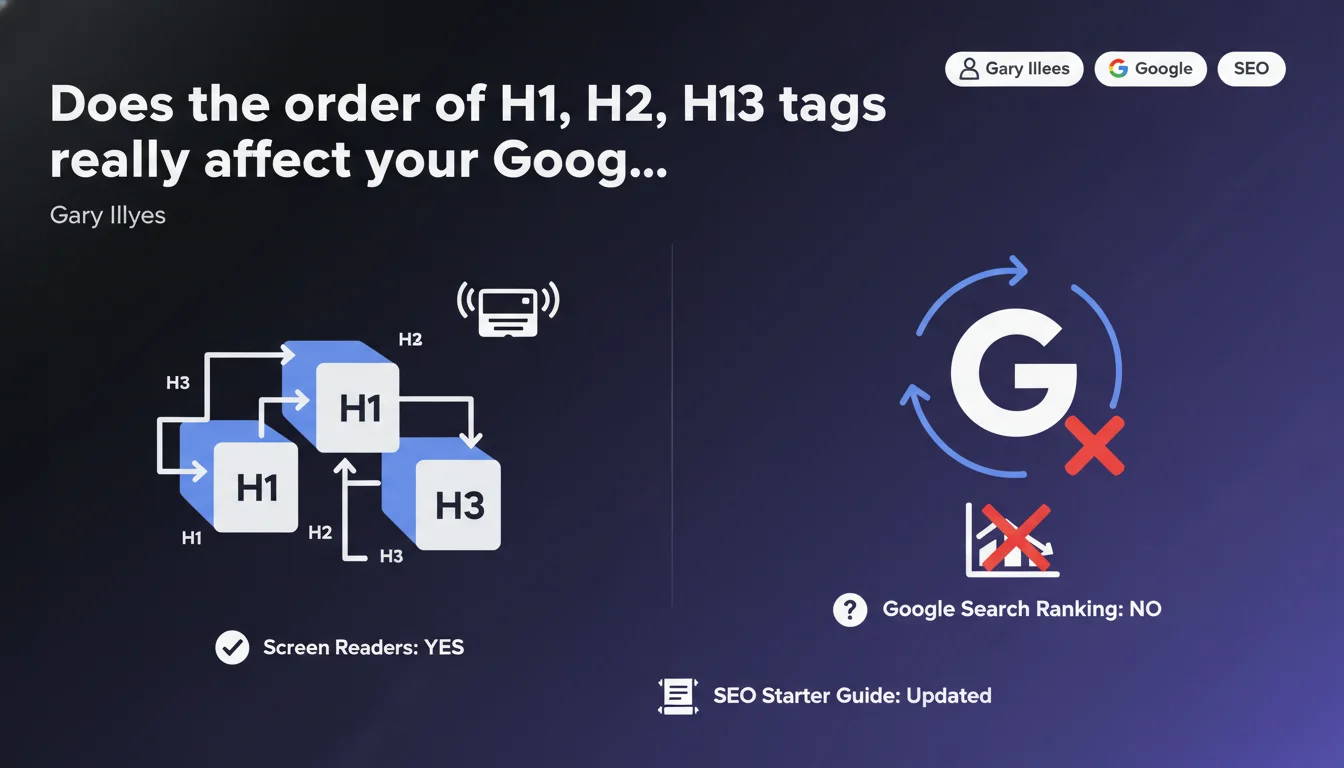
Google confirms that the semantic order of heading tags (H1, H2, H3...) has no impact on search rankings. You can have an H3 before an H2 without penalty. Only screen reader accessibility is affected by disordered markup.
What you need to understand
This statement from Gary Illyes helps debunk a persistent belief: the idea that you absolutely must respect a strict H1 > H2 > H3 hierarchy to please Google.
For years, SEO audits have flagged sites with H3 tags before H2, or multiple H1 tags on the same page. Google is now saying that this rigor only serves accessibility, not ranking.
Why has this misconception lasted so long?
Because accessibility recommendations and SEO best practices got mixed up. A site that's well-structured semantically is often better crawled, better understood — but not because of heading tag order, rather thanks to content clarity.
The W3C recommends a logical hierarchy for assistive technologies. SEOs extrapolated by thinking Google used this structure as a relevance signal. That's not the case.
Does Google still use Hn tags to understand content?
Yes, but differently. Google uses headings to extract information — notably to generate featured snippets or identify page sections.
But it doesn't penalize an H3 placed before an H2. The algorithm is capable of understanding the contextual hierarchy of content without relying on the strict order of HTML tags.
What's the practical takeaway from this statement?
- The semantic order of Hn tags is not a ranking factor
- Google still extracts information from headings, but tolerates non-compliant markup
- A site with H3 before H2 will not be penalized by the algorithm
- Accessibility remains a valid reason to respect the hierarchy, but it's a topic separate from SEO
- The official SEO Starter Guide has been updated to reflect this position
SEO Expert opinion
Is this statement consistent with real-world observations?
Yes, and that's good news. Tests I've conducted on sites with chaotic Hn structures have never shown a correlation between semantic disorder and ranking drops.
On the other hand, sites without any headings at all or with empty headings perform worse. It's not the order that matters, it's the presence of descriptive and relevant headings.
Should you abandon all hierarchy logic then?
No. Let's be honest: clean markup makes maintenance easier, improves UX, and makes content more scannable for your users.
If you're developing a new site, respect semantic hierarchy. Not for Google, but for your teams and visitors. However, if an audit reveals H3 before H2 on an existing site that performs well, don't waste time refactoring everything.
In what cases does this rule deserve to be nuanced?
Google says there's no impact, but pay attention: [To be verified] — featured snippets and people also ask sometimes rely on headings to structure answers. Coherent markup can indirectly improve your chances of being selected.
Second nuance: screen readers use Hn tags for navigation. If your audience includes people with disabilities, accessibility becomes a business criterion, not just a compliance question.
Practical impact and recommendations
What should you actually do with this information?
If you're auditing a site and see poorly ordered headings, don't prioritize this task in your SEO backlog. Focus on higher-impact levers: content, internal linking, speed.
However, if you're developing a new page or redesigning a template, you might as well do things properly. One unique H1 followed by H2, then H3 — it's simple, clean, and costs nothing.
What mistakes should you avoid after this announcement?
Don't swing to the opposite extreme. Some will interpret "no impact" as "I can do whatever I want." A site without any headings or with H5 tags everywhere will still be hard for Google to understand.
Another mistake: neglecting accessibility on the grounds that "Google doesn't care." Your users do. And crawlers too, to some extent, because well-structured content is easier to parse.
How can you verify your site stays optimized despite this tolerance?
- Check that each page has at least one descriptive and relevant H1
- Make sure your headings contain strategic keywords, regardless of their order
- Test your pages with a screen reader to identify major inconsistencies
- Only correct Hn order if you're already redesigning the page structure for other reasons
- Focus your SEO efforts on content, internal linking, and technical aspects (Core Web Vitals, indexability)
In summary: stop stressing about Hn tag order. Google is capable of understanding your content even if your markup isn't academically perfect.
That said, restructuring dozens of pages with chaotic markup can prove more complex than it appears, especially if your CMS doesn't facilitate this type of intervention. If you want to optimize your site structure while keeping an eye on priority SEO levers, calling on a specialized agency can save you valuable time and prevent costly mistakes.
❓ Frequently Asked Questions
Peut-on avoir plusieurs H1 sur une même page sans être pénalisé ?
Faut-il corriger les erreurs de hiérarchie Hn détectées dans un audit SEO ?
Google utilise-t-il encore les balises Hn pour comprendre le contenu ?
Cette tolérance s'applique-t-elle aussi aux balises H4, H5, H6 ?
Un site sans aucun titre Hn est-il pénalisé ?
🎥 From the same video 19
Other SEO insights extracted from this same Google Search Central video · published on 18/07/2024
🎥 Watch the full video on YouTube →
💬 Comments (0)
Be the first to comment.