
Official statement
Other statements from this video 19 ▾
- □ Faut-il paniquer si votre hreflang disparaît temporairement pendant une migration ?
- □ Faut-il bloquer GoogleOther ou risquer d'impacter ses services Google ?
- □ Les domaines locaux (ccTLD) offrent-ils vraiment un avantage SEO pour le référencement local ?
- □ Pourquoi Google traite-t-il un site après expansion massive comme un tout nouveau site web ?
- □ Pourquoi Google continue-t-il d'afficher l'ancien nom de votre site après un rebranding ?
- □ Faut-il vraiment corriger toutes les erreurs d'indexation signalées dans la Search Console ?
- □ Comment exploiter l'API du tableau de bord de statut Google Search pour vos outils SEO ?
- □ Pourquoi Google refuse-t-il les requêtes d'indexation illimitées dans Search Console ?
- □ Marque confondue avec un mot courant : faut-il vraiment attendre des mois sans rien faire ?
- □ Comment masquer du texte à Google en bloquant le JavaScript qui le contient ?
- □ Peut-on vraiment utiliser le Schema Recipe pour n'importe quel type de recette ?
- □ Google peut-il transférer vos rankings SEO lors d'une migration de domaine ?
- □ Comment la balise noindex fonctionne-t-elle réellement page par page ?
- □ Faut-il vraiment remplir tous les champs des données structurées pour que Google les prenne en compte ?
- □ Les flux RSS sont-ils vraiment exploités par Google pour l'exploration et l'indexation ?
- □ Pourquoi votre nouveau favicon met-il autant de temps à apparaître dans les résultats Google ?
- □ L'ordre des balises H1, H2, H3 influence-t-il vraiment le classement Google ?
- □ Les liens sur pages bloquées au crawl perdent-ils vraiment toute leur valeur SEO ?
- □ Faut-il vraiment structurer ses sitemaps selon des règles précises ou peut-on faire n'importe quoi ?
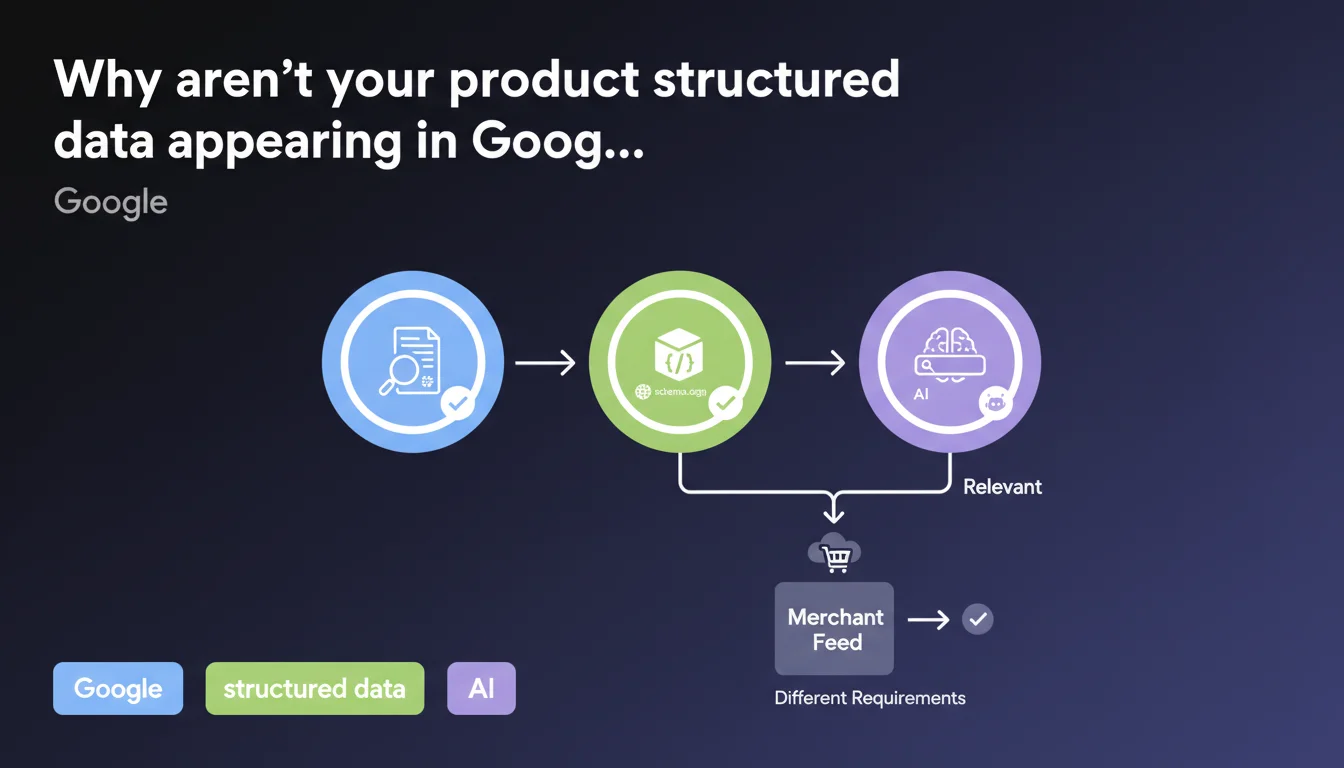
Google sets three cumulative conditions for displaying product rich results: page indexing, valid structured data, and a relevance judgment by Google's systems. This third criterion is vague and undocumented, leaving significant room for interpretation by Google's algorithms, independently of your markup's technical quality.
What you need to understand
What are the three official conditions for obtaining product rich results?
Google establishes a clear hierarchy: first indexing, then the technical validity of structured data, and finally a subjective criterion — the relevance evaluated by Google's systems. This last point is crucial because it completely escapes SEO control.
Concretely, even if your Schema.org markup is perfect and the page is indexed, nothing guarantees the display of rich snippets. Google reserves the right to ignore your markup if its algorithms determine it's not relevant to the user.
What does "relevance" mean in this context?
Google doesn't define what it means by relevance. Is it related to product sheet quality? To merchant popularity? To price? To stock availability? No documentation clarifies this.
This ambiguity suggests that Google applies multifactorial filters, possibly linked to competition on the query, site authority, or behavioral signals. In other words, technique alone isn't enough — you also need to pass opaque quality filters.
What's the difference with the Merchant Center feed?
Google explicitly mentions an alternative route: submitting a product feed to Merchant Center. This system operates with different requirements and is primarily aimed at e-commerce businesses that want to appear in Google Shopping.
The Merchant Center feed is not a substitute for on-page structured data, but a complementary option that offers more control over the information transmitted to Google, particularly for advertising campaigns.
- Mandatory indexing: no rich result without an indexed URL, even with perfect markup
- Technical validation: use Search Console to check for syntax errors
- Opaque relevance criterion: Google alone decides on display, independent of code validity
- Merchant Center: distinct option with its own rules, useful for Shopping and paid campaigns
SEO Expert opinion
Is this statement consistent with real-world observations?
Yes and no. In principle, it's consistent: we indeed observe that sites with impeccable markup don't get rich results, while others with minor errors benefit from them. The relevance criterion is very real.
But the problem is that Google refuses to document this criterion. Result: we're working blind. Do customer reviews play a role? Click-through rate? Price consistency with competitors? No one knows precisely. [To verify]: the exact impact of each quality signal on rich results eligibility.
Why does Google insist on this distinction with Merchant Center?
Because Google pushes e-commerce businesses toward its advertising ecosystem. Merchant Center is the gateway to Google Shopping and Performance Max campaigns. By mentioning this alternative, Google subtly reminds everyone that organic SEO is just one option among many.
This distinction raises a strategic question: should you prioritize on-page structured data or Merchant Center feed? The answer depends on your model: if you actively sell online, the feed is nearly mandatory. If you're building editorial authority or working with comparison sites, structured data is sufficient.
What are the limitations of this official communication?
Google provides no actionable criteria to improve "relevance." This is frustrating because you don't know what to work on once indexing and technical validation are OK.
Furthermore, Google doesn't specify whether this relevance criterion applies uniformly to all product types or varies across verticals (fashion, electronics, food…). [To verify]: do sectorial differences exist in how these rules are applied?
Practical impact and recommendations
What should you do concretely to maximize product rich results display?
First obvious step: make sure your product pages are indexed. Check in Search Console that Google is crawling and indexing your URLs properly. If you have thousands of products, prioritize pages with high traffic potential.
Next, validate your structured data with Google's test tool. Fix all syntax errors and critical warnings. Use the Product type with mandatory properties: name, image, offers (with price and availability).
But let's be honest: the real challenge starts after. To satisfy the relevance criterion, work on overall product sheet quality — unique descriptions, HD images, customer reviews, up-to-date stock, competitive pricing. Google probably evaluates these signals to decide on display.
How do you know if the problem is indexing, validation, or relevance?
Simple methodology:
- Check indexing with a site:yourdomain.com/product-url search
- Test your structured data in Google's Rich Results Test tool
- Review the Enhancements report in Search Console to detect markup errors
- If everything is green but no rich result appears, it's the relevance criterion blocking you
If you're stuck at the relevance stage, compare your product sheets to those of competitors who get rich results. Identify gaps: content, reviews, images, delivery information, pricing.
Should you consider Merchant Center as a backup solution?
If you're an active e-commerce business, Merchant Center shouldn't be a backup solution but a mandatory parallel strategy. It offers more control over the data transmitted and allows you to appear in Google Shopping.
Be careful though: the Merchant Center feed doesn't replace on-page structured data for organic SEO. The two systems are complementary but serve different purposes.
❓ Frequently Asked Questions
Peut-on obtenir des rich results produits sans flux Merchant Center ?
Que faire si mes données structurées sont valides mais n'apparaissent pas en rich results ?
Les erreurs mineures dans les données structurées empêchent-elles l'affichage des rich results ?
Le Merchant Center remplace-t-il les données structurées Schema.org ?
Combien de temps faut-il pour qu'un rich result produit apparaisse après ajout du balisage ?
🎥 From the same video 19
Other SEO insights extracted from this same Google Search Central video · published on 18/07/2024
🎥 Watch the full video on YouTube →
💬 Comments (0)
Be the first to comment.