
Official statement
Other statements from this video 19 ▾
- □ Faut-il paniquer si votre hreflang disparaît temporairement pendant une migration ?
- □ Faut-il bloquer GoogleOther ou risquer d'impacter ses services Google ?
- □ Les domaines locaux (ccTLD) offrent-ils vraiment un avantage SEO pour le référencement local ?
- □ Pourquoi Google traite-t-il un site après expansion massive comme un tout nouveau site web ?
- □ Faut-il vraiment corriger toutes les erreurs d'indexation signalées dans la Search Console ?
- □ Comment exploiter l'API du tableau de bord de statut Google Search pour vos outils SEO ?
- □ Pourquoi vos données structurées produits n'apparaissent-elles pas dans les résultats enrichis ?
- □ Pourquoi Google refuse-t-il les requêtes d'indexation illimitées dans Search Console ?
- □ Marque confondue avec un mot courant : faut-il vraiment attendre des mois sans rien faire ?
- □ Comment masquer du texte à Google en bloquant le JavaScript qui le contient ?
- □ Peut-on vraiment utiliser le Schema Recipe pour n'importe quel type de recette ?
- □ Google peut-il transférer vos rankings SEO lors d'une migration de domaine ?
- □ Comment la balise noindex fonctionne-t-elle réellement page par page ?
- □ Faut-il vraiment remplir tous les champs des données structurées pour que Google les prenne en compte ?
- □ Les flux RSS sont-ils vraiment exploités par Google pour l'exploration et l'indexation ?
- □ Pourquoi votre nouveau favicon met-il autant de temps à apparaître dans les résultats Google ?
- □ L'ordre des balises H1, H2, H3 influence-t-il vraiment le classement Google ?
- □ Les liens sur pages bloquées au crawl perdent-ils vraiment toute leur valeur SEO ?
- □ Faut-il vraiment structurer ses sitemaps selon des règles précises ou peut-on faire n'importe quoi ?
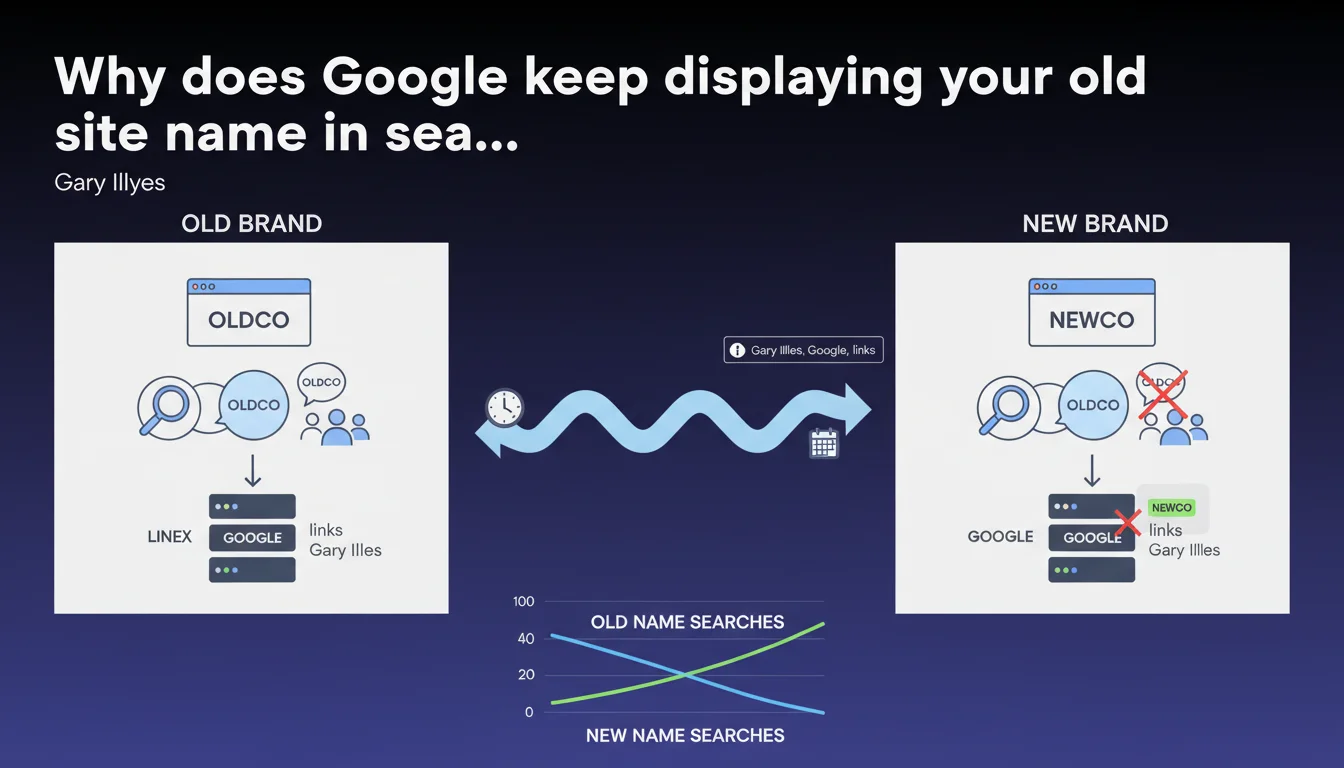
Google deliberately maintains old site names in its search results after a brand change because users continue searching with the old nomenclature. The search engine reflects actual search behavior, not your marketing strategy. This persistence is a feature, not a bug.
What you need to understand
Is Google deliberately ignoring your redirects after a name change?
No, but it's not treating them as an absolute instruction either. When you rename a site or product, Google observes the actual queries users make in Google Search Console. If thousands of people are still searching for "Facebook" after a hypothetical rebrand to "Meta", the engine will continue associating that term with your entity.
Illyes' statement clarifies a persistent source of confusion: technical signals (301 redirects, name changes in tags) aren't enough to immediately erase the old naming. User behavior takes priority over your technical directives. This is the logic of an answer engine, not just a simple indexer.
How long does this transition period typically last?
Illyes gives no specific timeframe — and that's telling. The duration depends on the speed at which your audience adopts the new name. A mainstream product with strong awareness of the old name? Expect months, even years. A niche B2B site? Maybe a few weeks.
The problem: you have no direct leverage to accelerate this process on Google's side. You can educate your audience, but you don't control the relevance model that decides when to switch.
What specific signals does Google use to maintain the old name?
The statement remains vague. We can reasonably assume: search volume using the old name, click-through rates on results mentioning old branding, Knowledge Graph signals (particularly mentions in third-party sources that Google aggregates). But Illyes doesn't detail the weighting.
What's certain: your title tags and meta descriptions aren't enough. If your entire ecosystem of inbound links, press mentions, and brand searches heavily use the old name, Google will maintain it prominently in results — regardless of what your on-page signals say.
- Google prioritizes actual search patterns over your technical directives after a rebrand
- How long the old name persists depends on user adoption, not a fixed timeline
- Your tags and redirects inform Google, but don't force an immediate switch
- External mentions and historical search volume play a major role
SEO Expert opinion
Is this statement consistent with real-world observations?
Yes, but it masks an uncomfortable asymmetry. In cases of positive rebranding (a startup moving upmarket), Google does indeed maintain the old name for a long time — sometimes longer than marketing teams would prefer. However, during reputation crises or hostile acquisitions, we sometimes see much faster switches.
Concrete example: a French e-commerce site renamed after acquisition saw its old name disappear from SERPs in 3 weeks, even though brand search volume remained high. [Needs verification]: the speed of updates could depend on factors not mentioned here — content freshness, domain authority, or manual interventions in certain sensitive cases.
What nuances does Illyes deliberately omit?
He only discusses "user searches" but ignores the negative business consequences. If your old name is associated with a scandal, bankruptcy, or hostile acquisition, maintaining this link in search results can destroy your repositioning strategy. Google makes no distinction between "nostalgic old name" and "toxic old name".
Another blind spot: ambiguous entities. If your old name now belongs to another company (common after brand sales), Google may create confusion by associating the two. Illyes presents this behavior as user-friendly — but it's often a major commercial obstacle.
In what cases does this logic become problematic?
Three critical situations: legally mandated brand migrations (where you have no time to "educate" your audience), radical positioning pivots (B2C to B2B, for example), and mergers where one of the two brands must disappear quickly.
In these contexts, the "reflection of searches" logic becomes an obstacle. You want Google to forget the old name, but the engine is waiting for users to forget it first. It's a vicious circle: as long as Google displays the old name, people keep searching for it, which legitimizes Google maintaining it.
Practical impact and recommendations
What should you do concretely before a name change?
Anticipate re-educating your audience several months before the technical switch. Display campaigns, social media, PR — everything that generates search queries for the new name in Google Search. The more search volume you generate on the new branding before migration, the faster Google will switch.
On the technical side: implement clean 301 redirects, update your Google Business Profile, deploy Organization schema with alternateName pointing to the old name (yes, it's counterintuitive, but it helps Google understand the relationship between the two entities).
- Launch an awareness campaign for the new name 3-6 months before the technical migration
- Update all third-party profiles (social networks, directories, Wikipedia if applicable)
- Deploy schema.org Organization with alternateName mentioning the old branding
- Monitor Google Search Console for brand queries: track the shift between old and new name
- Prepare a crisis management plan if the old name is associated with negative content
What mistakes should you avoid during transition?
Don't brutally remove all mentions of the old name from your site. Google needs this semantic continuity to understand the connection. Keep at minimum a page explaining "We were formerly known as [old name]" with clear context.
Also avoid launching a new domain without redirecting from the old one. Even if you want to break ties, Google will interpret this as two separate entities — and will maintain the old one in results as long as people search for it, but without linking to your new site.
How can you speed up the transition in search results?
Work on your active backlinks. Contact your partners, clients, and referring sites to update their anchor text and mentions. The more your external ecosystem adopts the new name, the more Google registers this as a legitimate signal.
Also use paid search (Google Ads) on the old name to redirect traffic and generate click signals toward the new branding. This is a short-term lever that accelerates the engine's learning curve.
A successful SEO rebrand plays out on two simultaneous fronts: technical AND behavioral. Redirects and tags are necessary but not sufficient. You must orchestrate a change in user perception for Google to follow.
The complexity of this orchestration — especially for high-visibility sites or multi-country migrations — often requires structured support. If your rebrand carries significant strategic stakes, working with a specialized SEO agency enables you to effectively coordinate technical, editorial, and off-site levers to minimize the period of uncertainty in the SERPs.
❓ Frequently Asked Questions
Combien de temps Google garde-t-il l'ancien nom d'un site dans ses résultats ?
Les redirections 301 ne suffisent-elles pas à signaler un changement de nom à Google ?
Peut-on forcer Google à oublier un ancien nom de marque plus rapidement ?
Faut-il garder des mentions de l'ancien nom sur le nouveau site ?
Cette logique s'applique-t-elle aussi aux changements de nom de produits ?
🎥 From the same video 19
Other SEO insights extracted from this same Google Search Central video · published on 18/07/2024
🎥 Watch the full video on YouTube →
💬 Comments (0)
Be the first to comment.