
Official statement
Other statements from this video 19 ▾
- □ Faut-il paniquer si votre hreflang disparaît temporairement pendant une migration ?
- □ Faut-il bloquer GoogleOther ou risquer d'impacter ses services Google ?
- □ Pourquoi Google traite-t-il un site après expansion massive comme un tout nouveau site web ?
- □ Pourquoi Google continue-t-il d'afficher l'ancien nom de votre site après un rebranding ?
- □ Faut-il vraiment corriger toutes les erreurs d'indexation signalées dans la Search Console ?
- □ Comment exploiter l'API du tableau de bord de statut Google Search pour vos outils SEO ?
- □ Pourquoi vos données structurées produits n'apparaissent-elles pas dans les résultats enrichis ?
- □ Pourquoi Google refuse-t-il les requêtes d'indexation illimitées dans Search Console ?
- □ Marque confondue avec un mot courant : faut-il vraiment attendre des mois sans rien faire ?
- □ Comment masquer du texte à Google en bloquant le JavaScript qui le contient ?
- □ Peut-on vraiment utiliser le Schema Recipe pour n'importe quel type de recette ?
- □ Google peut-il transférer vos rankings SEO lors d'une migration de domaine ?
- □ Comment la balise noindex fonctionne-t-elle réellement page par page ?
- □ Faut-il vraiment remplir tous les champs des données structurées pour que Google les prenne en compte ?
- □ Les flux RSS sont-ils vraiment exploités par Google pour l'exploration et l'indexation ?
- □ Pourquoi votre nouveau favicon met-il autant de temps à apparaître dans les résultats Google ?
- □ L'ordre des balises H1, H2, H3 influence-t-il vraiment le classement Google ?
- □ Les liens sur pages bloquées au crawl perdent-ils vraiment toute leur valeur SEO ?
- □ Faut-il vraiment structurer ses sitemaps selon des règles précises ou peut-on faire n'importe quoi ?
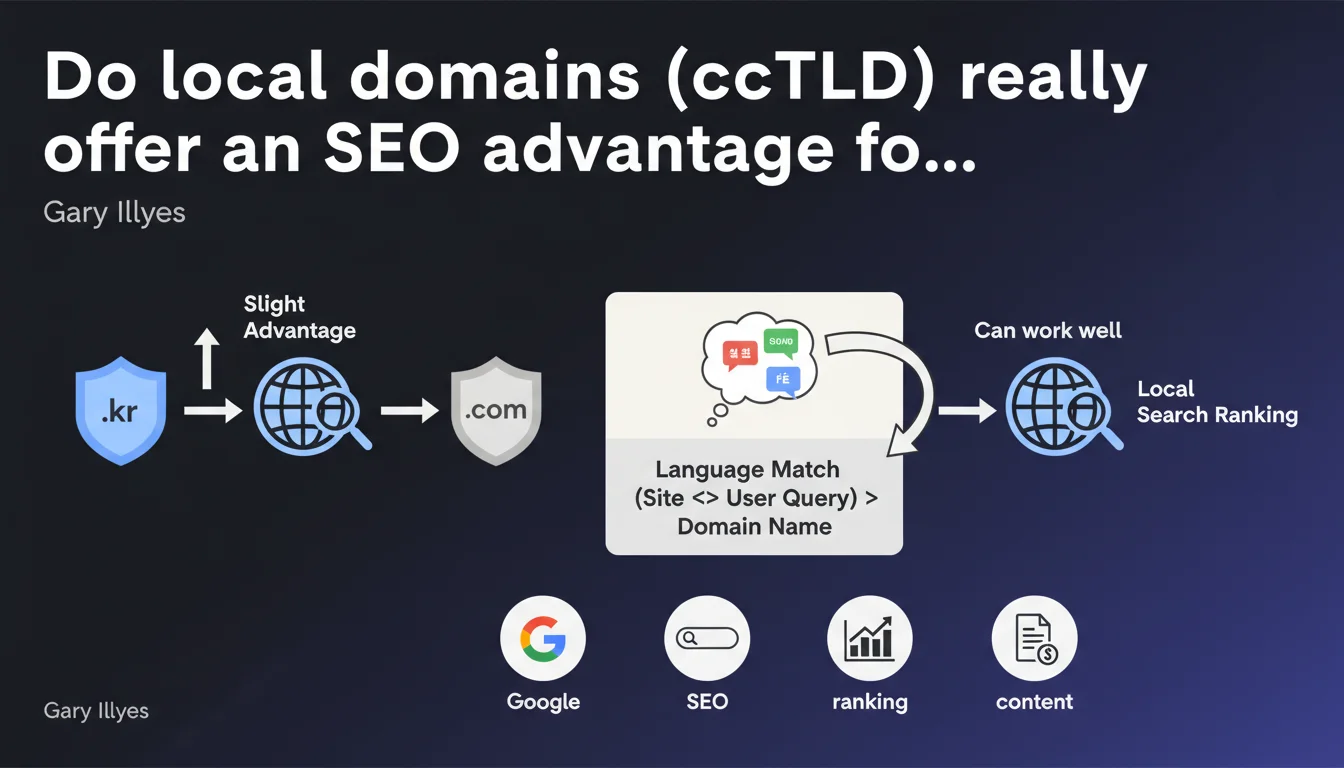
ccTLDs like .fr or .kr provide a slight advantage for local SEO because Google favors content close to the user. A .com can rank just as well, but the local ccTLD simplifies the work. However, the language of the content remains more determining than the domain extension itself.
What you need to understand
Why does Google favor local domains?
Google's primary goal is to serve geographically relevant content to its users. A ccTLD (.fr, .kr, .de) sends a clear signal of localization without ambiguity. The search engine interprets the extension as an indicator of local relevance.
This preference follows a logic of proximity and contextual relevance. When a user in Korea searches for a local service, Google assumes that a .kr has a better chance of meeting their need than a generic .com. It's a heuristic — not an absolute rule.
Is a .com really at a disadvantage?
No, and this is crucial to understand. A well-configured .com with consistent geolocation signals (Google Search Console, local address, local language content) can rank just as well as a ccTLD. The difference comes down to margins.
The real problem with .com domains: they require more work to establish local legitimacy. You must multiply signals — language, GSC localization, NAP citations, local backlinks — whereas a ccTLD benefits from an initial presumption.
Does the site's language really weigh more heavily?
Yes, and this is where it gets interesting. Google states that the match between site language and search query language probably has more impact. A .com in Korean will often beat a poorly translated .kr or one in English.
This nuance changes the game for multi-country strategies. Rather than buying 15 ccTLDs, a .com with well-structured language subdirectories can do the job — provided you care for the language quality and geolocation signals.
- ccTLDs provide a slight advantage for local SEO through presumption of geographic relevance
- A well-configured .com can achieve the same results with more effort on localization signals
- Content language trumps domain extension in the relevance algorithm
- The difference is marginal — don't overhaul your entire ecosystem for a ccTLD if your .com is already performing
SEO Expert opinion
Does this statement align with real-world observations?
Overall, yes. We do see that ccTLDs rank more easily and faster on local queries without particular effort. But the performance delta remains modest — we're not talking about a magic boost.
What stands out is the weight of language. A German-language site on a .com with good local backlinks and rich content regularly outperforms lightweight .de domains. The extension alone saves nothing.
What nuances should be added?
First point: Google never quantifies the advantage. "Slight advantage" remains deliberately vague. Does it mean 5% more rankings? 10% better chances? No hard data. [Verify] with your own A/B tests if you're torn between ccTLD and .com.
Second point — the statement ignores multi-country sites. With a .com + subdirectories (/en/, /fr/, /de/), you centralize SEO juice. With 10 separate ccTLDs, you dilute your efforts. The math isn't as simple as "ccTLD = better".
When does this rule not apply?
Established international brands don't care at all. Amazon.com dominates everywhere, including in France, because domain authority crushes the micro-advantage of a ccTLD. Same logic applies to Booking, Airbnb, etc.
For local pure players or SMBs, the ccTLD remains a smart choice — if only to reassure users. But if your .com has existed for 10 years with good history, don't migrate on a whim.
Practical impact and recommendations
What should you do concretely if you're targeting local search?
If you're launching a local project, take the ccTLD. You save time and avoid multiplying geolocation signals. It's the easy route, and it works.
If you already have a .com that's running, don't touch anything until you've exhausted all standard optimizations: flawless language, GSC targeting, local backlinks, geotagged content. You have 80% of the battle to win before thinking about extensions.
How do you maximize your chances with a .com on a local market?
Precisely target the local language in Search Console and ensure the content is written by native speakers. Google detects machine translations or approximations — and it kills your relevance.
Multiply geographic coherence signals: address in footer, NAP (Name Address Phone) consistency, LocalBusiness Schema, backlinks from recognized local sites. Each signal reinforces legitimacy.
- Choose a ccTLD if you're launching a local project from scratch — save time and get an initial boost
- Keep your existing .com if you already have traffic and authority — optimize before migrating
- Configure Search Console with proper country/language targeting for a .com
- Write content in native language, not machine translation
- Structure a LocalBusiness Schema with accurate address and contact information
- Acquire quality local backlinks to strengthen geographic legitimacy
- Monitor NAP (name, address, phone) consistency across all channels
❓ Frequently Asked Questions
Dois-je migrer mon .com vers un ccTLD si je cible principalement un pays ?
Un ccTLD suffit-il pour bien ranker localement sans autre effort ?
Vaut-il mieux un .com avec sous-répertoires ou des ccTLD séparés pour une stratégie multi-pays ?
La langue du site prime-t-elle vraiment sur l'extension de domaine ?
Peut-on utiliser un ccTLD pour cibler plusieurs pays de même langue ?
🎥 From the same video 19
Other SEO insights extracted from this same Google Search Central video · published on 18/07/2024
🎥 Watch the full video on YouTube →
💬 Comments (0)
Be the first to comment.