
Official statement
Other statements from this video 19 ▾
- □ Faut-il bloquer GoogleOther ou risquer d'impacter ses services Google ?
- □ Les domaines locaux (ccTLD) offrent-ils vraiment un avantage SEO pour le référencement local ?
- □ Pourquoi Google traite-t-il un site après expansion massive comme un tout nouveau site web ?
- □ Pourquoi Google continue-t-il d'afficher l'ancien nom de votre site après un rebranding ?
- □ Faut-il vraiment corriger toutes les erreurs d'indexation signalées dans la Search Console ?
- □ Comment exploiter l'API du tableau de bord de statut Google Search pour vos outils SEO ?
- □ Pourquoi vos données structurées produits n'apparaissent-elles pas dans les résultats enrichis ?
- □ Pourquoi Google refuse-t-il les requêtes d'indexation illimitées dans Search Console ?
- □ Marque confondue avec un mot courant : faut-il vraiment attendre des mois sans rien faire ?
- □ Comment masquer du texte à Google en bloquant le JavaScript qui le contient ?
- □ Peut-on vraiment utiliser le Schema Recipe pour n'importe quel type de recette ?
- □ Google peut-il transférer vos rankings SEO lors d'une migration de domaine ?
- □ Comment la balise noindex fonctionne-t-elle réellement page par page ?
- □ Faut-il vraiment remplir tous les champs des données structurées pour que Google les prenne en compte ?
- □ Les flux RSS sont-ils vraiment exploités par Google pour l'exploration et l'indexation ?
- □ Pourquoi votre nouveau favicon met-il autant de temps à apparaître dans les résultats Google ?
- □ L'ordre des balises H1, H2, H3 influence-t-il vraiment le classement Google ?
- □ Les liens sur pages bloquées au crawl perdent-ils vraiment toute leur valeur SEO ?
- □ Faut-il vraiment structurer ses sitemaps selon des règles précises ou peut-on faire n'importe quoi ?
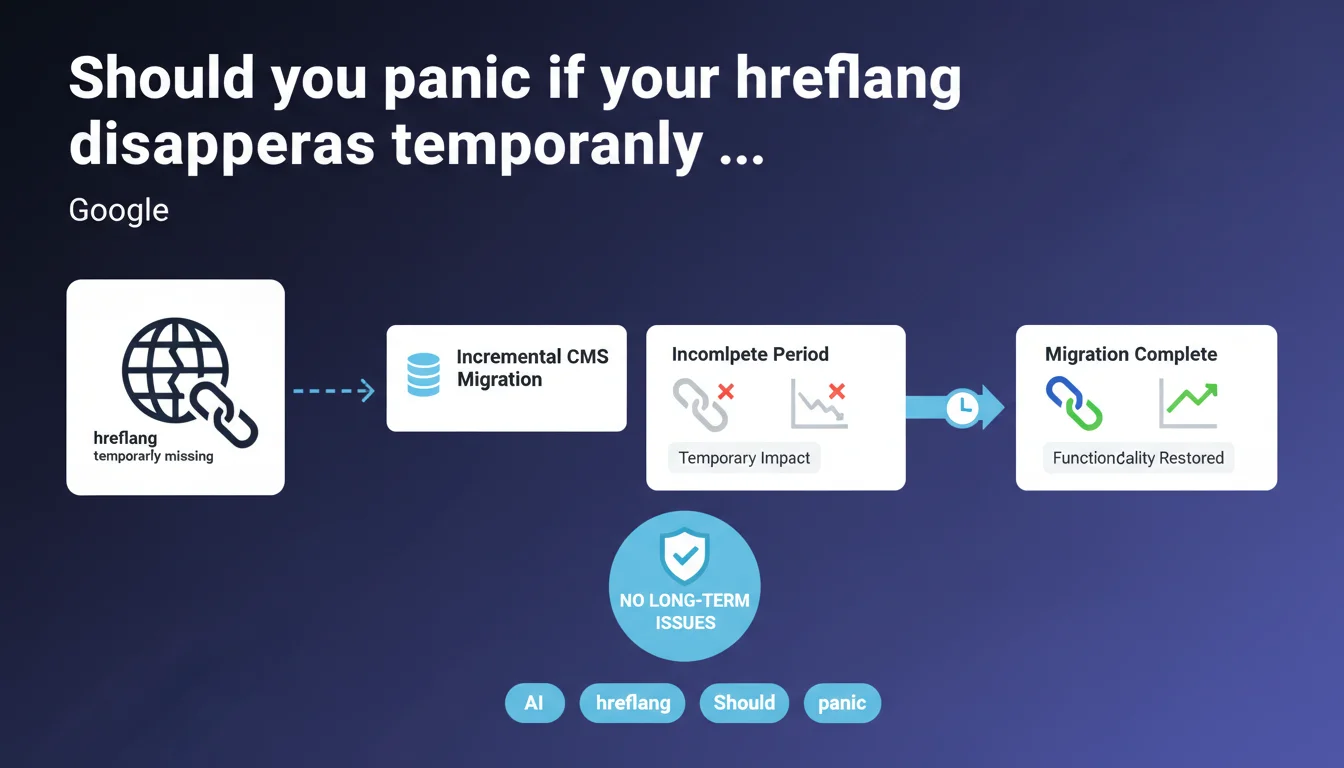
Google confirms that a temporary absence of hreflang markup during an incremental CMS migration causes no lasting SEO damage. The search engine simply ignores missing connections during the transition, then resumes accounting for them once the migration is complete. No long-term penalty to fear.
What you need to understand
What exactly is an incremental CMS migration?
An incremental migration consists of gradually transferring a site from one CMS to another, in batches of pages or sections. Unlike a hard cutover where everything migrates at once, this approach allows you to limit risks by testing and adjusting as you go.
During this period, some pages remain on the old system while others move to the new one. The problem? Non-migrated pages can end up without functional hreflang markup if it's managed differently between the two environments.
What actually happens when hreflang is missing?
Google temporarily stops accounting for multilingual or multiregional connections for the affected pages. The search engine treats each language version as an independent entity without understanding that they belong to the same set.
This situation can lead to less precise geographic targeting during the migration. A French user might land on the English version, or vice versa. But — and this is the crucial point of the statement — no permanent degradation is to be feared.
Why does Google insist there are no long-term issues?
The message aims to reassure webmasters who might postpone a migration out of fear of irreversible SEO impact. Google affirms that the system is designed to handle these imperfect transitions without penalizing the site.
As soon as the markup is restored, the search engine recalculates associations and restores the multilingual logic. No negative memory, no trace in the site's history.
- A temporary absence of hreflang = connections ignored, not penalized
- Restoring the markup immediately reactivates consideration
- No lasting impact on rankings or indexation
- The incremental approach remains valid despite these transitory imperfections
SEO Expert opinion
Is this statement consistent with field observations?
Broadly speaking, yes. The incremental migrations I've managed show that hreflang disruptions do clear up quickly once the markup is corrected. No visible stigma in Search Console or lasting international traffic drops.
But — and this is an important but — the transitional period can last longer than expected. Google speaks of a restoration "once the migration is complete," but in practice, the recrawl and reevaluation of multilingual signals can take several weeks. [To verify]: Google provides no specific timeline.
What nuances should be added to this optimistic view?
Google downplays the impact during the incomplete phase by saying the site will be affected "appropriately." Translation: your international traffic can fluctuate, sometimes significantly. If you have a multilingual e-commerce site with seasonal peaks, poorly timed migration can cost you dearly.
Second point: this statement assumes the rest of your technical infrastructure is solid and stable. If you compound errors with redirects, canonical issues, or duplicate content between language versions, the temporary absence of hreflang can amplify the chaos. Google won't penalize you for missing hreflang, but it might struggle to interpret your contradictory signals.
In what cases does this rule not apply?
If your hreflang was already partially broken before the migration, Google won't perform miracles after. The statement presupposes correct markup that disappears temporarily, then returns intact. If you use this opportunity to restructure your international URLs or change your language strategy, returning to normal will be more complex.
Finally, this benevolent approach from Google only concerns hreflang. Other critical technical elements (URL structure, response time, redirects) must be managed with much greater care during an incremental migration.
Practical impact and recommendations
What should you concretely do before an incremental migration?
First reflex: precisely map your current hreflang structure. Identify all pages that depend on it and document existing associations. This will let you quickly verify whether the markup is properly restored after each migrated batch.
Next, plan specific monitoring during the transition. Configure alerts in Search Console to detect hreflang errors and monitor your positions on strategic international queries. A dedicated dashboard will save you from unpleasant surprises.
What errors should you avoid during the transitional phase?
Don't let an incremental migration drag on for months. The longer the period of inconsistency, the more you risk diluting your international traffic. Set yourself a tight timeline and stick to it.
Also avoid modifying your hreflang strategy mid-course. This isn't the time to switch from a subdomain approach to a subdirectory approach, or to add new languages. Reproduce identically what existed before, you'll optimize later.
How do you verify everything is back to normal?
After the migration is complete, run an exhaustive crawl with Screaming Frog or an equivalent tool. Verify that each page has its hreflang markup and that bidirectional associations are respected (if the FR page points to the EN page, the reverse must be true).
Then check the "International Targeting" report in Search Console. Errors should disappear within weeks of migration completion. If they persist beyond 4-6 weeks, a structural problem remains — not just a recrawl delay.
- Map the existing hreflang structure before migration
- Plan a short, tight migration timeline
- Continuously monitor Search Console and international positions
- Don't modify language strategy during the transition
- Crawl the site post-migration to validate markup
- Check the "International Targeting" report 4-6 weeks after
- Prepare a rollback plan in case of major issues
❓ Frequently Asked Questions
Combien de temps faut-il à Google pour reprendre en compte le hreflang après une migration ?
Une absence temporaire de hreflang peut-elle faire chuter mes positions internationales ?
Dois-je prévenir Google avant une migration incrémentale via Search Console ?
Que se passe-t-il si j'oublie de rétablir le hreflang sur certaines pages après la migration ?
Une migration incrémentale est-elle toujours préférable à une migration en big bang ?
🎥 From the same video 19
Other SEO insights extracted from this same Google Search Central video · published on 18/07/2024
🎥 Watch the full video on YouTube →
💬 Comments (0)
Be the first to comment.