
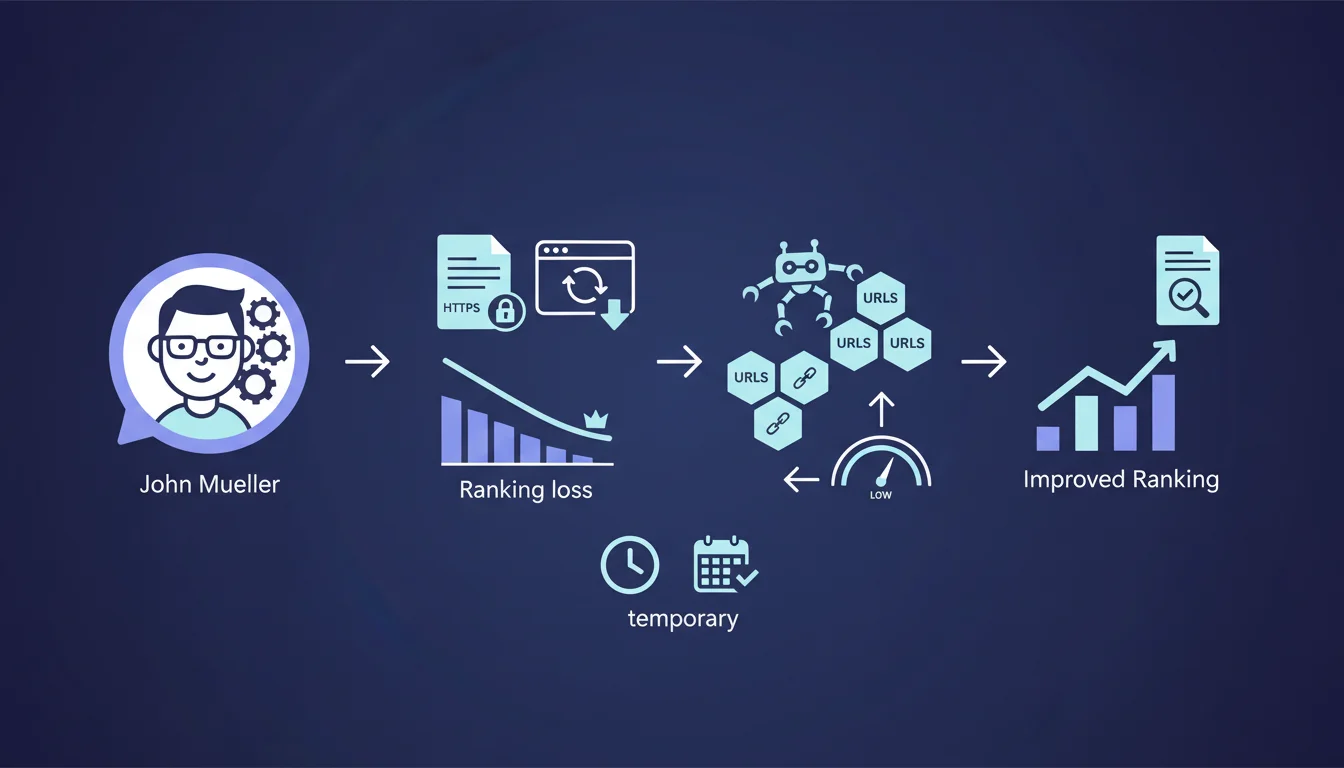
Official statement
John Mueller explains that an HTTPS migration is equivalent to a complete site migration. Each URL must be individually recognized, recrawled and reprocessed by Google. You simply need to be patient. Incidentally, he also warns against using the URL removal tool, which could also hide the new HTTPS URLs.
Une migration HTTPS entraîne systématiquement une perte temporaire de positions dans les résultats Google. Chaque URL doit être recrawlée et retraitée individuellement par le moteur, ce qui prend du temps. La patience est la meilleure stratégie : ne revenez jamais en arrière vers HTTP et n'utilisez surtout pas l'outil de suppression d'URL qui aggraverait la situation.
What you need to understand
What Actually Happens Technically During an HTTPS Migration?
An HTTPS migration doesn't simply consist of activating an SSL certificate. From Google's perspective, it's a complete site migration. Each URL fundamentally changes: http://example.com becomes https://example.com.
Google must therefore recrawl the entire site, recognize each new URL individually and reevaluate all ranking signals. This process takes time, typically several weeks depending on the site's size and its crawl budget.
Why Do Rankings Temporarily Drop?
During the transition phase, Google progressively indexes the new HTTPS URLs while deindexing the old HTTP URLs. This period of partial dual indexing creates temporary ranking instability.
The search engine must also transfer trust signals (backlinks, history, authority) from the old URLs to the new ones. This PageRank and authority transfer doesn't happen instantaneously.
- An HTTPS migration equals a complete site migration in Google's eyes
- Each URL must be individually recognized and reprocessed
- Ranking loss is normal and temporary during the transition phase
- The complete process can take several weeks or even a few months
- The URL removal tool should NEVER be used during a migration
What Factors Can Worsen or Extend This Transition Period?
In the mentioned case, the site owner had combined several changes: HTTPS migration, WordPress theme change and content updates. This accumulation of modifications makes it difficult to identify the exact cause of fluctuations.
The more simultaneous changes you make, the more you complicate Google's reevaluation work and risk extending the instability period. It's always preferable to isolate major modifications.
SEO Expert opinion
Does This Statement Match What We Actually See in the Field?
Absolutely. In my 15 years of practice, I systematically observe ranking fluctuations for 3 to 8 weeks after a properly executed HTTPS migration. Sites with good history and established authority generally recover their rankings, or even improve them slightly thanks to the HTTPS boost.
However, recovery duration strongly depends on the crawl budget allocated to the site. A 15-year-old site with good authority should normally benefit from rapid recrawling, unless technical errors slow down the process.
What Nuances Should We Add to This "Simply Be Patient" Recommendation?
John Mueller's passive approach is correct in theory, but insufficient in practice. Yes, you need to be patient, but no, you shouldn't remain inactive. Rigorous technical monitoring is essential throughout the transition period.
I've observed numerous cases where undetected technical errors (redirect chains, mixed content, incorrect canonicals) transformed a temporary drop into a permanent disaster. Patience shouldn't mean inaction.
In What Cases Might Rankings Never Recover?
If 301 redirects aren't properly implemented page by page, Google may consider the new URLs as entirely new content, thus losing all accumulated history and authority. This is irreversible without immediate correction.
Similarly, if the HTTPS migration is accompanied by significant structural changes (URLs modified beyond the protocol, content significantly rewritten), Google may legitimately reevaluate the site's relevance. In this case, the decline isn't related to the HTTPS migration itself but to the substantive modifications.
Practical impact and recommendations
What Should You Concretely Do Before, During and After an HTTPS Migration?
Before the migration, establish a complete baseline: current rankings, organic traffic by page, indexed URLs, backlink profile. This baseline is essential to measure real impact and identify potential problems.
During the transition, monitor Search Console daily to detect crawl errors, SSL certificate issues or blocked pages. Verify that Google is progressively discovering and indexing the new HTTPS URLs.
After the migration, maintain weekly monitoring for at least 3 months. Analyze the ranking recovery curve and intervene quickly if the trend doesn't reverse after 6 to 8 weeks.
What Critical Mistakes Must You Absolutely Avoid?
Never use the URL removal tool in Search Console to accelerate deindexing of old HTTP URLs. This tool would also hide the new HTTPS URLs, considerably worsening the situation.
Avoid combining several major changes simultaneously. An HTTPS migration alone is already complex: adding a CMS change, structure modification or content overhaul multiplies failure risks and makes diagnosis impossible.
Don't panic and especially don't revert back to HTTP after a few weeks. Rolling back would create a second migration, worsening the chaos and indefinitely extending instability.
- Document complete initial state (rankings, traffic, indexation) before any action
- Implement permanent 301 redirects from each HTTP URL to its exact HTTPS equivalent
- Verify absence of mixed content (HTTP resources on HTTPS pages)
- Update all internal links to point directly to HTTPS URLs
- Submit the new HTTPS sitemap in Search Console
- Monitor coverage and indexing reports daily for at least 2 months
- Verify that major external backlinks properly follow 301 redirects
- Wait 6 to 8 weeks before drawing definitive conclusions
- Never use the URL removal tool during a migration
- Avoid any other major changes during the transition period
How Can You Ensure the Migration Proceeds Optimally?
Set up a monitoring dashboard combining Search Console data, Analytics and ranking tracking tools. Define alert thresholds to react quickly if metrics fall outside expected ranges.
Test a representative sample of URLs with tools like Screaming Frog to verify that redirects work correctly, that canonical tags point to HTTPS versions and that the SSL certificate is valid on all pages.
💬 Comments (0)
Be the first to comment.