
Official statement
Other statements from this video 19 ▾
- □ Should you panic if your hreflang disappears temporarily during a migration?
- □ Do local domains (ccTLD) really offer an SEO advantage for local search rankings?
- □ Does Google really treat a site after massive expansion as a brand new website?
- □ Why does Google keep displaying your old site name in search results long after a rebrand?
- □ Should you really fix every single indexation error Google reports in Search Console?
- □ How can you leverage the Google Search Status Dashboard API to supercharge your SEO tools?
- □ Why aren't your product structured data appearing in Google's rich results?
- □ Why does Google refuse to grant unlimited indexation request quotas in Search Console?
- □ Is your brand really stuck being confused with a common word? How long does Google actually need to figure it out?
- □ What's the only way to hide text from Google without using HTML tags?
- □ Is Schema Recipe really restricted to food recipes only, or can you use it creatively?
- □ Can Google actually transfer your SEO rankings during a domain migration?
- □ Does the noindex tag really only affect individual pages, or can it impact your entire site?
- □ Do you really need to fill in every single field of structured data for Google to actually use it?
- □ Does Google really use RSS feeds to discover and index new content on your site?
- □ Why is your new favicon taking so long to appear in Google search results?
- □ Does the order of H1, H2, H3 tags really affect your Google rankings?
- □ Do links on crawl-blocked pages really lose all their SEO value?
- □ Does Google really require a specific sitemap structure, or can you organize them however you want?
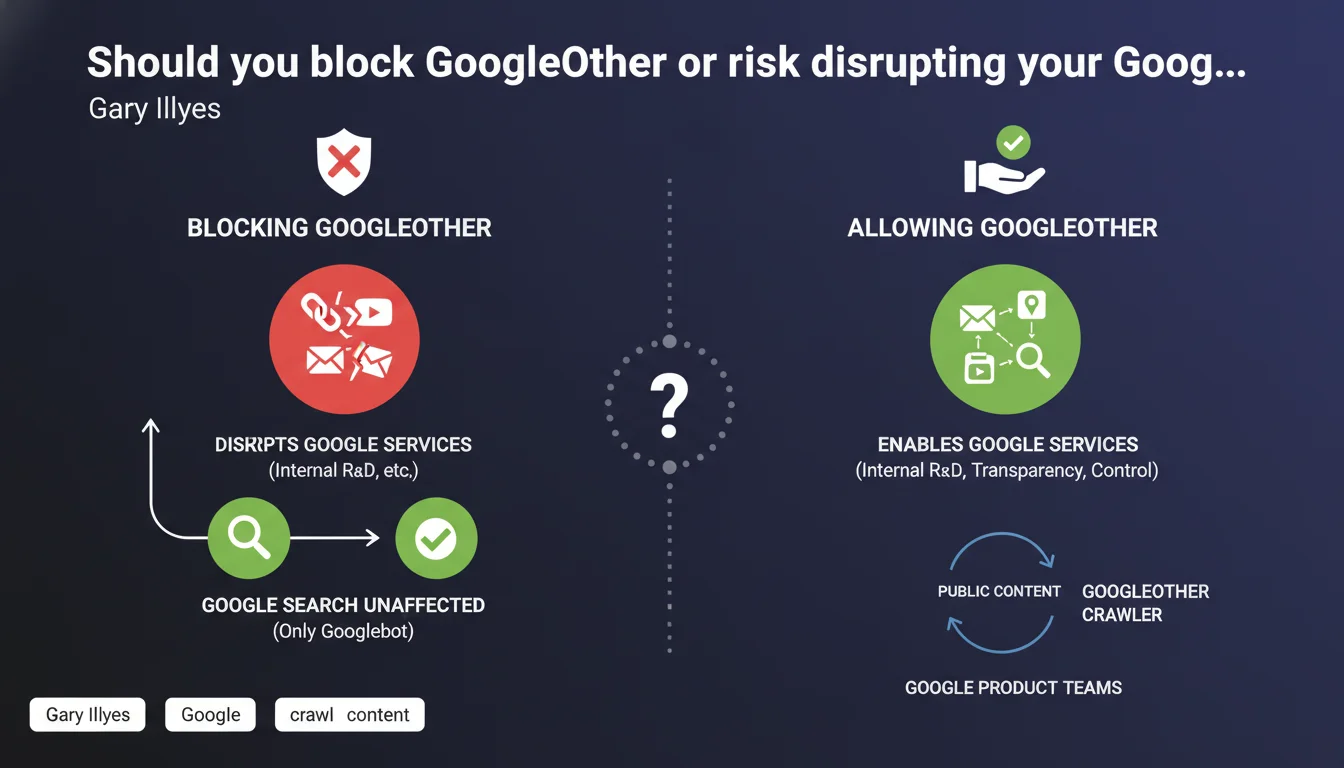
Google launched GoogleOther, a generic crawler separate from Googlebot used for R&D and various product teams. Blocking GoogleOther does not affect Search rankings (managed only by Googlebot), but may disrupt other Google services. Increased transparency enables granular control via robots.txt.
What you need to understand
Why did Google create a separate crawler from Googlebot?
GoogleOther addresses a need for operational transparency. Historically, Google used undocumented internal crawlers to feed its R&D and product teams. Website owners had no visibility into these accesses, which generated confusion in server logs.
By isolating these activities under an identifiable user-agent, Google allows site administrators to clearly distinguish between crawling intended for Search (Googlebot) and crawling intended for internal experiments. This is a step toward greater control on the publisher side.
Can GoogleOther really affect my search rankings?
No. The statement is clear: only Googlebot is used for Search. GoogleOther serves other product teams — development, publicly accessible content analysis, internal testing. Blocking GoogleOther via robots.txt has no impact on your organic rankings.
However, blocking this crawler can disrupt ancillary Google services whose exact nature is not detailed. Google remains vague about which products are affected — a typical gray area.
What are the practical implications for a site administrator?
- A new user-agent to monitor in server logs and robots.txt files
- The ability to selectively block GoogleOther without direct SEO risk
- A gain in visibility over Google's non-Search crawl activity
- A persistent uncertainty about which Google services are impacted by blocking
SEO Expert opinion
Is this statement consistent with observed practices?
Yes, overall. Server logs have shown unidentified Google crawlers or those with generic user-agents for years. GoogleOther formalizes what already existed opaquely. In the field, no documented cases link GoogleOther blocking to a drop in Search positions — confirming the announced separation.
However, Google remains deliberately vague about the "various services" that could be impacted. No exhaustive list, no concrete examples. [To verify]: the lack of transparency about which products are affected raises a strategic question — is it Google Ads, Analytics, Discovery, something else? Impossible to know for certain.
What nuances should be added to this message?
First nuance: "publicly accessible" does not mean "indexable". GoogleOther may crawl content you've chosen to deindex via noindex or robots.txt, as long as it remains technically accessible via URL. If you have sensitive but public pages, IP blocking may be necessary.
Second nuance: even if GoogleOther doesn't directly serve Search, it feeds development and R&D teams. This data can indirectly influence future ranking algorithms or product evolutions. Blocking this crawler means potentially removing yourself from a continuous improvement loop — each site owner must decide if that's desirable.
When should you consider blocking GoogleOther?
If your infrastructure has limited bandwidth or you manage a high-traffic site with tight server margins, blocking GoogleOther can reduce load with no SEO consequences. Some news publishers or high-volume e-commerce sites make this choice pragmatically.
Conversely, if you heavily use the Google ecosystem (Ads, Analytics, Search Console), blocking could theoretically degrade the quality of data reported or user experience on certain products — again, Google provides no guarantees either way.
Practical impact and recommendations
What should you concretely do with GoogleOther?
First step: audit your server logs to identify the frequency and sections crawled by GoogleOther. If the volume is marginal and doesn't overload your infrastructure, let it through — there's no benefit to blocking it.
If you notice intensive crawling that strains your resources, add a specific rule in your robots.txt. GoogleOther respects standard directives — that's precisely what makes its clear identification valuable.
What errors should you avoid when managing GoogleOther?
Don't confuse GoogleOther and Googlebot in your robots.txt rules. A blanket block of all Google user-agents would also impact Googlebot, with catastrophic consequences for indexation. Be granular.
Also avoid blocking blindly out of fear. If your site has no particular technical constraints, letting GoogleOther access public content presents no SEO risk — and could even feed future improvements across the Google ecosystem.
How can you verify that your site is properly configured?
- Analyze server logs to identify GoogleOther access (user-agent:
GoogleOther) - Ensure Googlebot and GoogleOther are treated separately in robots.txt
- Test robots.txt directives via Search Console (Googlebot) and manually (GoogleOther)
- Monitor server load before and after any potential GoogleOther blocking
- Document which sections are allowed/blocked and the strategic reasons
❓ Frequently Asked Questions
GoogleOther peut-il impacter mon référencement sur Google Search ?
Comment bloquer GoogleOther sans impacter Googlebot ?
Quels services Google sont affectés si je bloque GoogleOther ?
GoogleOther respecte-t-il les directives robots.txt et crawl-delay ?
Dois-je surveiller GoogleOther dans mes logs serveur ?
🎥 From the same video 19
Other SEO insights extracted from this same Google Search Central video · published on 18/07/2024
🎥 Watch the full video on YouTube →
💬 Comments (0)
Be the first to comment.