
Official statement
Other statements from this video 19 ▾
- □ Faut-il paniquer si votre hreflang disparaît temporairement pendant une migration ?
- □ Faut-il bloquer GoogleOther ou risquer d'impacter ses services Google ?
- □ Les domaines locaux (ccTLD) offrent-ils vraiment un avantage SEO pour le référencement local ?
- □ Pourquoi Google traite-t-il un site après expansion massive comme un tout nouveau site web ?
- □ Pourquoi Google continue-t-il d'afficher l'ancien nom de votre site après un rebranding ?
- □ Faut-il vraiment corriger toutes les erreurs d'indexation signalées dans la Search Console ?
- □ Comment exploiter l'API du tableau de bord de statut Google Search pour vos outils SEO ?
- □ Pourquoi vos données structurées produits n'apparaissent-elles pas dans les résultats enrichis ?
- □ Pourquoi Google refuse-t-il les requêtes d'indexation illimitées dans Search Console ?
- □ Marque confondue avec un mot courant : faut-il vraiment attendre des mois sans rien faire ?
- □ Comment masquer du texte à Google en bloquant le JavaScript qui le contient ?
- □ Google peut-il transférer vos rankings SEO lors d'une migration de domaine ?
- □ Comment la balise noindex fonctionne-t-elle réellement page par page ?
- □ Faut-il vraiment remplir tous les champs des données structurées pour que Google les prenne en compte ?
- □ Les flux RSS sont-ils vraiment exploités par Google pour l'exploration et l'indexation ?
- □ Pourquoi votre nouveau favicon met-il autant de temps à apparaître dans les résultats Google ?
- □ L'ordre des balises H1, H2, H3 influence-t-il vraiment le classement Google ?
- □ Les liens sur pages bloquées au crawl perdent-ils vraiment toute leur valeur SEO ?
- □ Faut-il vraiment structurer ses sitemaps selon des règles précises ou peut-on faire n'importe quoi ?
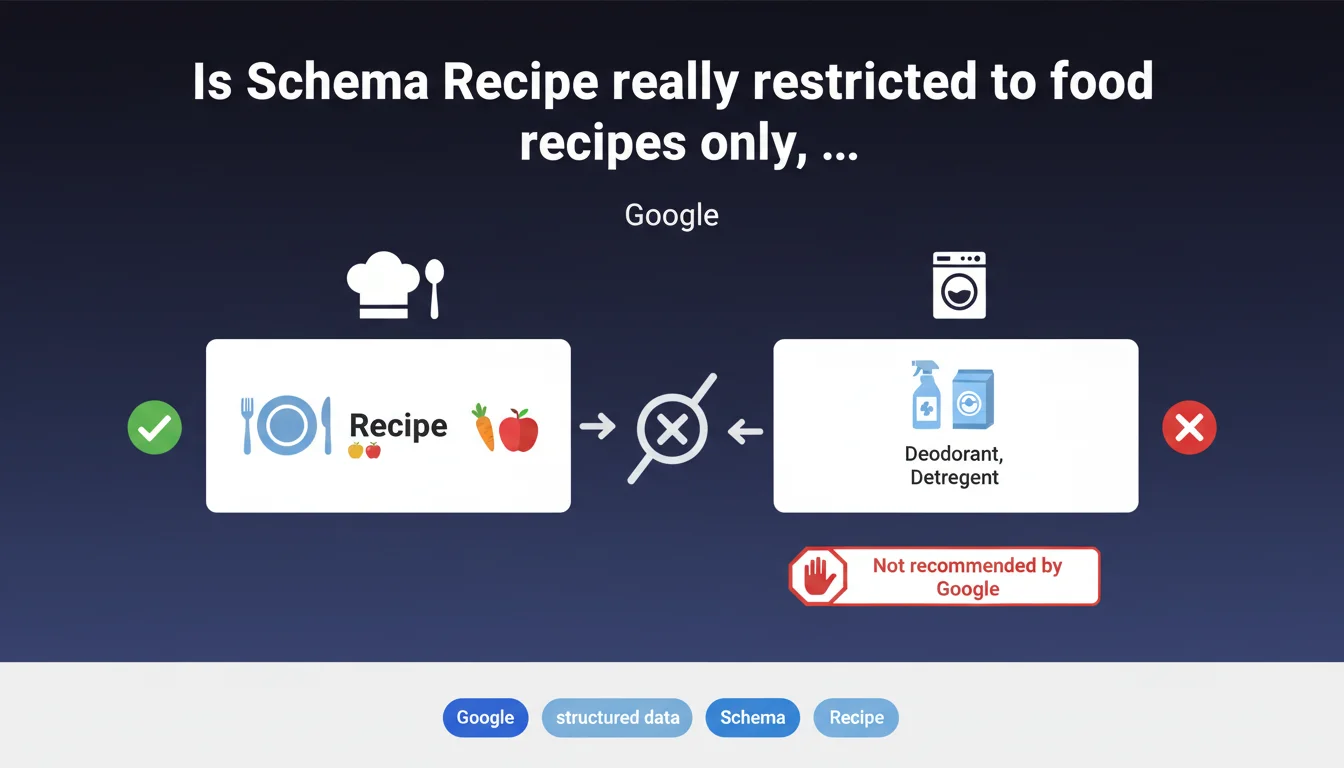
Google strictly prohibits using Schema Recipe markup for non-food recipes such as cosmetics or household products. Only edible recipes intended for human consumption are eligible. Misusing this markup exposes you to manual penalties or complete disregard of your structured data.
What you need to understand
Google regularly tightens its structured data guidelines, and this one leaves no room for ambiguity. Schema Recipe was designed to enrich search results related to cooking and food — period.
Some sites have attempted to exploit this markup for non-food DIY projects (homemade soaps, laundry detergents, homemade deodorants) hoping to benefit from appealing rich snippets: image, preparation time, star rating. Google puts an end to this practice.
Why does this restriction exist?
Rich results for recipes are designed for a specific use case: the user is looking for what to cook, how to prepare a dish, how long it takes. Displaying homemade deodorant in these results pollutes the user experience and misleads search intent.
Google applies the relevance-first principle: each type of structured data must correspond exactly to its documented use case. Any repurposing, however creative, remains a misuse.
What defines an "edible" recipe according to Google?
The guideline doesn't provide an exhaustive list, but common sense prevails: if the final result is not intended to be eaten or drunk by a human, it is not eligible for Schema Recipe. This automatically excludes cosmetics, household products, non-food craft creations.
Even a recipe for dogs or cats could technically pose a problem, although the gray area is more blurred here. Google has not explicitly ruled on it, but caution dictates sticking to food for humans.
What are the risks if you ignore this rule?
Two main scenarios. First case: Google simply ignores the markup — you've worked for nothing, zero rich snippet, zero visibility advantage.
Second case, more problematic: a manual action for structured data spam. Less frequent than penalties for artificial links, but documented in Search Console. Result: potential loss of all your rich results, not just recipes.
- Strict rule: Schema Recipe reserved for edible food recipes for humans
- Excluded cases: DIY cosmetics, homemade detergents, household products, non-food creations
- Possible penalty: ignoring the markup or manual action for structured data spam
- Documentation: Google Search Central guidelines are explicit on this point
SEO Expert opinion
Is this ban really enforced algorithmically?
Let's be honest: the automated enforcement of this rule remains partial and uneven. Even today, you can find sites using Schema Recipe for non-food recipes displaying rich snippets without apparent issue. This doesn't mean the practice is tolerated — simply that Google's automated systems haven't flagged these pages yet.
The real risk? That a quality rater or internal reviewer stumbles upon your page and manually reports the problem. At that point, it's no longer a question of algorithm but of human action — and therefore much harder to anticipate or circumvent.
Why doesn't Google simply block invalid markup?
A legitimate question. Technically, Google could refuse to display any Recipe rich result as soon as it detects non-food content. It doesn't do so — at least not systematically.
One hypothesis: Google prefers the flexibility of manual interpretation over overly rigid automated filters that generate false positives. Result: some sites slip through, others get caught. The inconsistency can be frustrating, but it reflects the complexity of moderating billions of pages at scale.
[To verify] There is no public data on the automatic detection rate of Schema Recipe abuse. Everything is based on empirical observations and scattered feedback from the SEO community.
Are some types of DIY content in a gray area?
Clearly. Consider pet food recipes: homemade dog food, homemade cat treats. Technically edible, but not for humans. Google has never publicly ruled on this scenario.
The same ambiguity applies to non-food infusions (herbal baths, hair decoctions). Where to draw the line between cosmetic use and consumable? Rather than play with fire, it's better to use alternative schemas like HowTo — less visually appealing, but compliant with guidelines.
Practical impact and recommendations
What to do if you've already marked non-food recipes?
First step: complete audit of your structured data. Review all pages using Schema Recipe and identify those that don't involve food strictly edible for humans. Use Google's Rich Results Test tool to verify compliance page by page.
Second action: migrate to an appropriate schema. For DIY, homemade cosmetics, household products, the HowTo schema is your best ally. Less spectacular in terms of rich snippet, but completely legitimate and compliant with guidelines.
How to clearly differentiate between food recipes and tutorials?
Simple rule: if the final result is eaten or drunk, it's Schema Recipe. Everything else falls under HowTo, even if the structure resembles a recipe (ingredient list, steps).
Concretely, this means reviewing your templates if you have a general DIY site. Clearly separate food content from other content in your CMS and apply the markup accordingly — ideally automatically via conditions on category or post type.
What checks to perform regularly?
Search Console remains your first radar. Check the Enhancements report, Recipes section, to spot any alerts about incorrectly marked pages. Google isn't always forthcoming on exact reasons, but a spike in errors on this type of content should alert you.
Next, monitor your impressions and CTR in SERPs for recipe queries. A sudden drop may indicate that Google has stopped displaying your rich snippets — a signal that something is wrong with your implementation.
- Audit all pages using Schema Recipe to identify non-food content
- Migrate DIY, cosmetics, household products to the HowTo schema
- Verify compliance with Google's Rich Results Test tool
- Clearly separate food content and tutorials in your CMS
- Regularly check the Enhancements report in Search Console
- Monitor impressions and CTR of recipe pages to detect any loss of rich snippet
❓ Frequently Asked Questions
Le Schema Recipe peut-il être utilisé pour des recettes de cosmétiques maison ?
Que risque-t-on concrètement si on balise un DIY non alimentaire en Recipe ?
Les recettes pour animaux sont-elles acceptées par Google ?
Comment vérifier si mes données structurées Recipe sont conformes ?
Quel schéma alternatif utiliser pour des tutoriels non alimentaires ?
🎥 From the same video 19
Other SEO insights extracted from this same Google Search Central video · published on 18/07/2024
🎥 Watch the full video on YouTube →
💬 Comments (0)
Be the first to comment.