
Official statement
Other statements from this video 19 ▾
- □ Faut-il paniquer si votre hreflang disparaît temporairement pendant une migration ?
- □ Faut-il bloquer GoogleOther ou risquer d'impacter ses services Google ?
- □ Les domaines locaux (ccTLD) offrent-ils vraiment un avantage SEO pour le référencement local ?
- □ Pourquoi Google traite-t-il un site après expansion massive comme un tout nouveau site web ?
- □ Pourquoi Google continue-t-il d'afficher l'ancien nom de votre site après un rebranding ?
- □ Faut-il vraiment corriger toutes les erreurs d'indexation signalées dans la Search Console ?
- □ Comment exploiter l'API du tableau de bord de statut Google Search pour vos outils SEO ?
- □ Pourquoi vos données structurées produits n'apparaissent-elles pas dans les résultats enrichis ?
- □ Pourquoi Google refuse-t-il les requêtes d'indexation illimitées dans Search Console ?
- □ Comment masquer du texte à Google en bloquant le JavaScript qui le contient ?
- □ Peut-on vraiment utiliser le Schema Recipe pour n'importe quel type de recette ?
- □ Google peut-il transférer vos rankings SEO lors d'une migration de domaine ?
- □ Comment la balise noindex fonctionne-t-elle réellement page par page ?
- □ Faut-il vraiment remplir tous les champs des données structurées pour que Google les prenne en compte ?
- □ Les flux RSS sont-ils vraiment exploités par Google pour l'exploration et l'indexation ?
- □ Pourquoi votre nouveau favicon met-il autant de temps à apparaître dans les résultats Google ?
- □ L'ordre des balises H1, H2, H3 influence-t-il vraiment le classement Google ?
- □ Les liens sur pages bloquées au crawl perdent-ils vraiment toute leur valeur SEO ?
- □ Faut-il vraiment structurer ses sitemaps selon des règles précises ou peut-on faire n'importe quoi ?
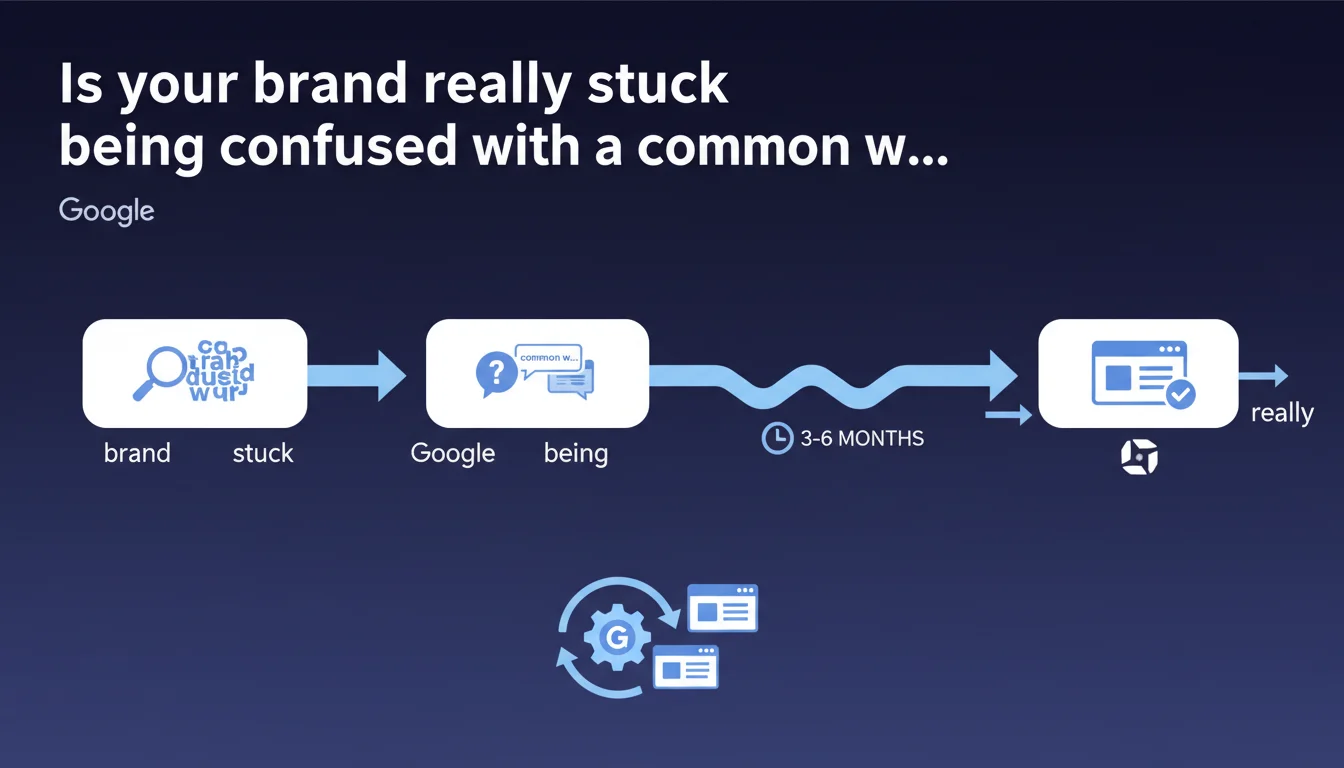
Google claims that when a brand is confused with a common English word, its algorithms will eventually understand that users are searching for the site and not a misspelling — but this can take several months. No technical shortcuts exist to speed up this process according to them. In other words: forced patience.
What you need to understand
This Google statement concerns a specific but common scenario: a brand name that resembles a banal or misspelled English word. Initially, the search engine may interpret queries as typos or informational searches rather than as an intent to navigate to the brand's website.
Why does Google confuse a brand with a common word?
Google's systems rely on historical query patterns and automatic spelling corrections. If a term already exists in the English vocabulary — even as a frequent error — the algorithm will default to this interpretation.
Only by accumulating enough user signals (clicks, bounces, reformulations) will Google understand that a brand intent is emerging behind this term. The process is gradual and does not directly depend on domain age or theoretical notoriety.
How long does it actually take to wait?
Google mentions several months, without specifying a range. Based on field observations, you can expect a minimum of 3 to 6 months for brands with moderate search volume.
The lower the brand traffic, the slower the learning will be. Conversely, an aggressive awareness campaign can accelerate signal accumulation — but Google insists: no direct technical lever allows you to force recognition.
What signals does Google use to recognize a brand?
Google doesn't explain explicitly, but we know the algorithm aggregates: repeated clicks on the same domain in SERPs, query reformulations including the brand name, long sessions without returning to results, and probably structured entities (Knowledge Graph, schema markup).
The volume of direct brand searches (with or without .com extension) also plays a role. If no one is actively typing your brand name, Google will have no reason to associate it with a generic term.
- Mandatory patience: Google offers no technical lever to accelerate
- Dependence on user signals: clicks, reformulations, long sessions
- Variable duration: minimum 3 to 6 months depending on search volume
- No technical shortcuts: neither tags nor parameters force recognition
SEO Expert opinion
Is this statement consistent with field observations?
Yes and no. In principle, it's true: Google eventually associates an ambiguous term with a brand if user signals are strong enough. But saying there are no shortcuts is debatable — [To verify].
We observe that certain actions indirectly influence recognition speed: massive awareness campaigns (Google Ads on brand, display), media mentions with links, structured presence in the Knowledge Graph via Wikidata. Google doesn't admit it explicitly, but these levers create convergent signals that accelerate learning.
What are the concrete risks of this initial confusion?
During the ambiguity period, you lose brand traffic to informational pages or better-established competitors. Users type your name, Google displays something else, they click elsewhere — you lose the session.
Worse: if your click-through rate drops on brand queries, Google may interpret this as a negative signal and reinforce the ambiguity. It's a vicious cycle hard to break without external traffic volume (social media, press, advertising).
Another point: Google doesn't specify whether this confusion affects only the classic search engine or also Google Discover, YouTube, Maps. We can assume each service has its own learning thresholds.
Are there cases where this rule doesn't apply?
Yes. If your brand is already present in the Knowledge Graph (entity recognized via Wikidata, Wikipedia, or other structured sources), Google can bypass learning through user signals. In this case, recognition is almost immediate.
Similarly, if you have an active and well-maintained Google Business profile, brand-to-entity association happens faster for local queries. But for purely informational queries or those without geographic intent, the delay remains.
Practical impact and recommendations
What should you do concretely to accelerate recognition?
Even if Google says there's no shortcut, certain actions create favorable conditions. First, structure your site with a complete Organization schema markup: name, logo, sameAs links to social networks, canonical URL. This helps Google identify your entity.
Next, push direct and brand traffic through all non-SEO channels: Google Ads on your exact name (yes, even if it's your name), display campaigns, social media, press. Every click on your domain from a brand search is a signal for Google.
Finally, work on structured notoriety: get mentions from sources Google considers reliable (media, professional directories, Wikidata if eligible). These mentions create bridges between the ambiguous term and your actual entity.
What mistakes should you avoid during this period?
Don't panic-change your brand name — it's the worst solution. You start from scratch and lose all accumulated capital. Don't over-optimize your tags either with forced brand name repetitions: Google detects keyword stuffing and it doesn't help.
Another common mistake: ignoring the problem thinking it will pass on its own. If you don't create active user signals (traffic, mentions, clicks), Google will never learn. Resolution "on its own" still requires sufficient search volume.
How do you monitor Google's recognition progress?
Use Google Search Console to track impressions and clicks on your exact brand. If you see growing CTR on these queries, Google is starting to associate the term with your site. Also compare average position: it should climb toward positions 1-3.
In parallel, run manual searches in private browsing from different locations. Note whether your site appears in the Knowledge Panel or in autocomplete suggestions. These are early indicators of recognition.
- Add a complete Organization schema with logo and sameAs
- Launch Google Ads campaigns on your exact brand name
- Obtain media mentions and links from reliable sources
- Push direct traffic via social media and other channels
- Monitor Search Console: impressions, clicks and CTR on brand queries
- Regularly check Knowledge Panel and autocomplete appearance
- Don't change your brand name or over-optimize tags
❓ Frequently Asked Questions
Puis-je forcer Google à reconnaître ma marque via un paramètre ou une balise ?
Combien de temps faut-il attendre avant que Google reconnaisse ma marque ?
Est-ce que lancer des campagnes Google Ads sur mon nom de marque aide ?
Que faire si ma marque est confondue avec un terme négatif ou controversé ?
Le schema markup Organization peut-il accélérer la reconnaissance ?
🎥 From the same video 19
Other SEO insights extracted from this same Google Search Central video · published on 18/07/2024
🎥 Watch the full video on YouTube →
💬 Comments (0)
Be the first to comment.