
Official statement
What you need to understand
Rich results (rich snippets) represent a major challenge for improving visibility in Google search result pages. They allow additional information such as prices, reviews, or availability to be displayed directly in the SERPs.
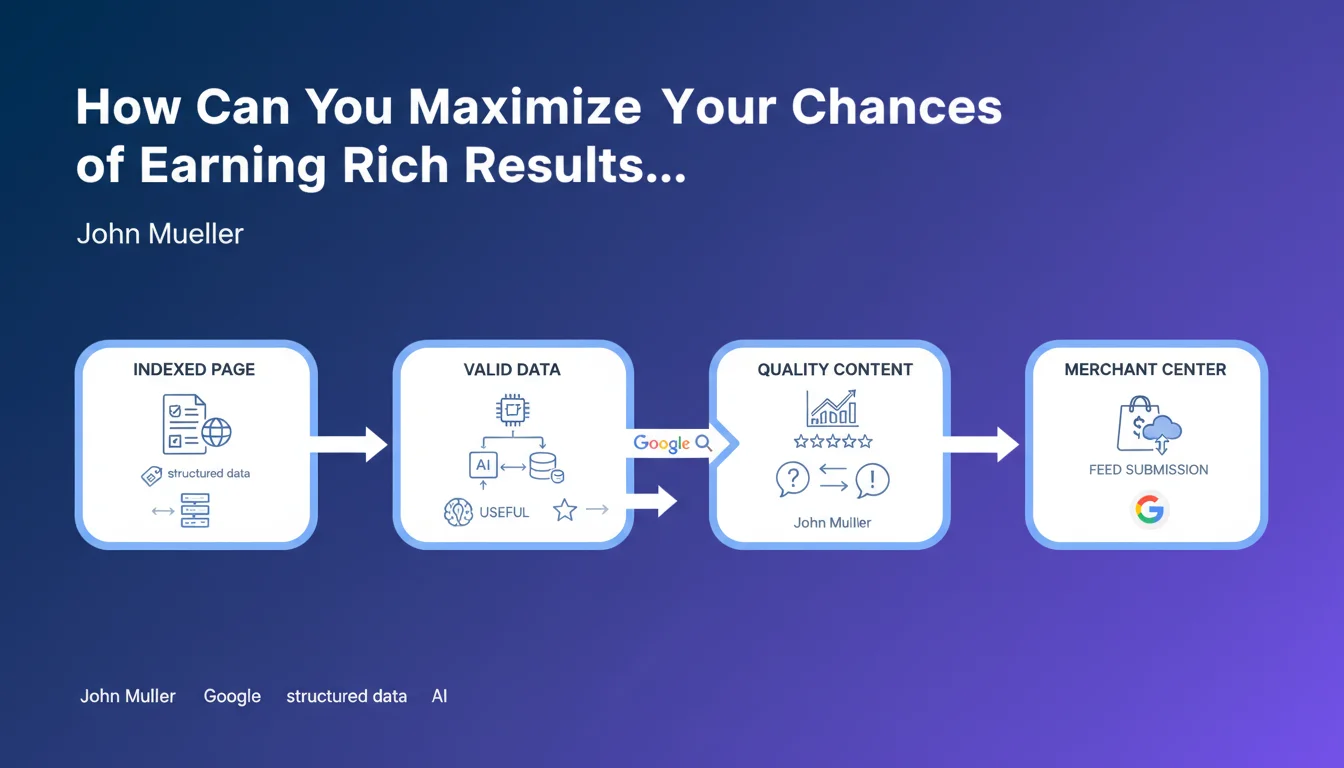
Google has clarified the four essential conditions for maximizing the display of these rich results, particularly for product pages. These criteria define a precise framework for SEO practitioners seeking to optimize their visual presence in search results.
It is important to understand that the mere presence of structured data does not guarantee their display. Google applies a qualitative selection logic that goes beyond technical compliance.
- Page indexation: absolute prerequisite before any consideration of rich results
- Valid structured data: strict compliance with schema.org specifications and Google guidelines
- Usefulness perceived by Google: information must provide real added value to users
- Merchant Center alternative: possibility of submitting a product feed to bypass certain limitations
SEO Expert opinion
This statement confirms what we observe daily: technical validation of structured data is necessary but not sufficient. Many sites scrupulously respect schema.org markup without obtaining rich results display.
The "usefulness" criterion mentioned by Google remains the most subjective and difficult to anticipate. In practice, this means that Google evaluates the consistency between page content, structured data, and search intent. Generic, duplicated, or unreliable information will be systematically excluded.
We also observe that certain ultra-competitive sectors see their rich results appear intermittently, with Google dynamically adjusting display according to the query and search context.
Practical impact and recommendations
- Systematically verify the indexation of all your product pages via Search Console before any structured data optimization
- Test your structured data with Google's official Rich Results Test tool and correct all identified errors
- Implement complete schema.org markup including at minimum: name, image, description, price, availability, reviews (if relevant)
- Ensure perfect consistency between structured data and visible content on the page (prices, availability, descriptions)
- Avoid generic information: favor unique descriptions, quality images, and data specific to each product
- Set up a Merchant Center account for your product catalogs and maintain an up-to-date feed, particularly for sites with more than 100 products
- Monitor regularly the "Enhancements" report in Search Console to identify validation issues
- Don't over-optimize: avoid adding non-relevant structured data just to "fill out" the markup
- Test actual display by performing searches from different devices and locations to evaluate performance
Implementing a comprehensive structured data strategy requires advanced technical expertise and in-depth understanding of constantly evolving guidelines. Between auditing existing markup, implementation compliant with standards, integration with Merchant Center, and continuous performance monitoring, support from a specialized SEO agency can prove valuable to guarantee optimal and sustainable deployment of your rich results.
💬 Comments (0)
Be the first to comment.