
Official statement
Other statements from this video 21 ▾
- □ Should you update the same page or create a new URL every day for frequently refreshed content?
- □ Should you stop using the manual submission tool in Google Search Console?
- □ Do H2 tags in your footer actually hurt your SEO rankings?
- □ Do HTML5 <header> and <footer> tags really boost your SEO rankings?
- □ Should you really rely on the schema.org validator to optimize your structured data?
- □ Does improving page speed really boost your rankings as fast as everyone claims?
- □ Does Google really crawl all your sitemaps at the same pace?
- □ Does Google really keep crawling a sitemap after you remove it from Search Console?
- □ Is Google really refusing to index your pages even though they're crawled regularly and have no technical issues?
- □ Can you safely use bidirectional canonicals between two site versions without any risk?
- □ Can structured data really replace traditional internal linking strategy?
- □ Why is one x-default enough for your entire multi-domain hreflang configuration?
- □ Should you really avoid product structured data on category pages?
- □ Do you really need to pick one primary language per page if you're targeting multiple markets?
- □ Why is Google completely ignoring your desktop version once mobile-first indexing kicks in?
- □ Can commodity content really survive in Google search results?
- □ Should you isolate your FAQs on separate pages to rank better?
- □ Is Google really cutting back on FAQ rich snippets in search results, and what does that mean for your SEO strategy?
- □ Can you host your XML sitemap on a different domain than your main website?
- □ Does the shift from 'Bad' to 'Medium' on Core Web Vitals really transform your Google rankings?
- □ Does server speed really impact the crawl budget of large websites?
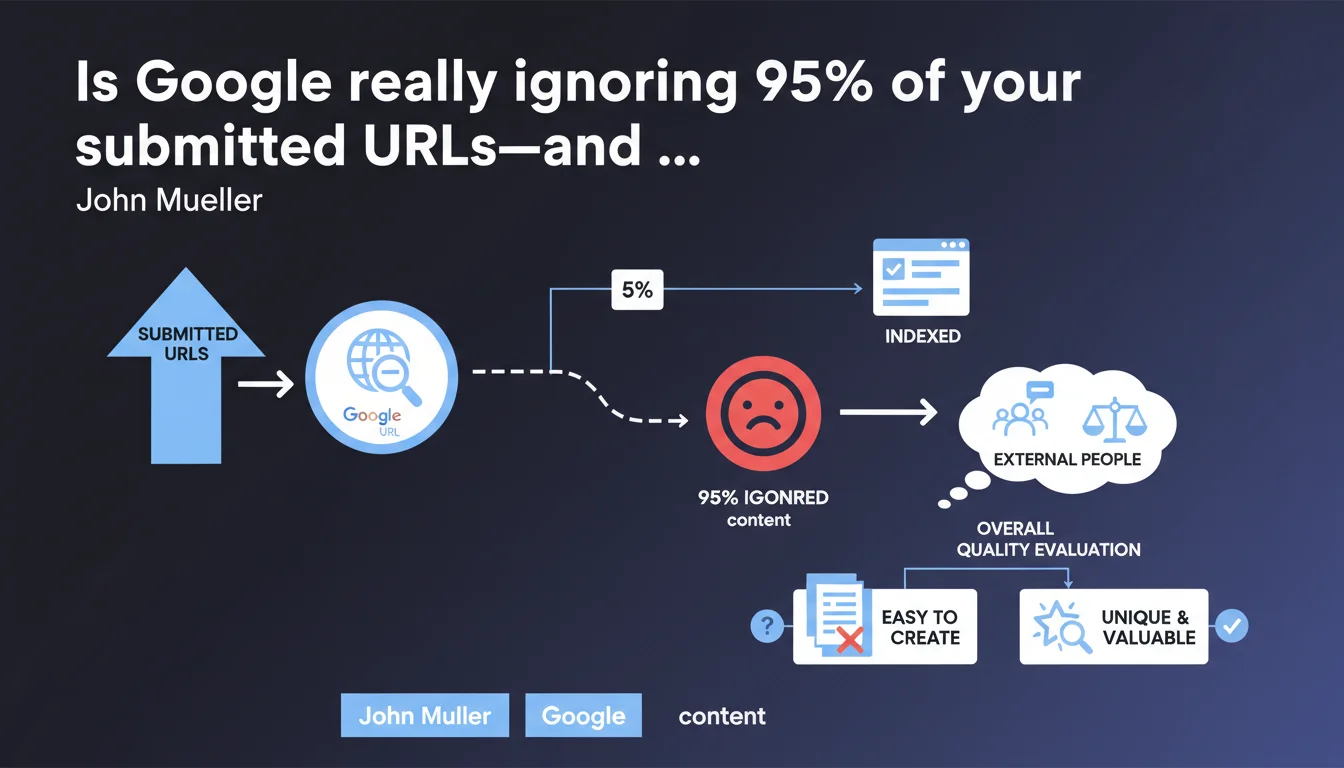
Google is indexing only 86 pages out of 4,500 submitted? The issue probably isn't technical. John Mueller is clear: generating thousands of pages effortlessly doesn't guarantee any unique value for the index. Before chasing technical fixes, assess your site's overall content quality with external, objective reviewers.
What you need to understand
What's really causing catastrophic indexation failure?
An indexation rate of 1.9% (86 URLs out of 4,500) signals massive rejection by Google. The instinctive reaction is to hunt for technical blockers: misconfigured robots.txt, stray noindex tags, tangled canonicals.
But Mueller points elsewhere—toward overall site quality. If Google believes your content adds nothing unique or valuable to its index, it won't waste resources indexing it all. Production volume never compensates for mediocrity.
What does "assess with external, uninvolved people" actually mean?
The team producing the content has an obvious confirmation bias. They'll always justify their choices, process, editorial strategy. That's human nature.
Mueller recommends an objective external audit—someone with no emotional stake in the project. This person must honestly evaluate whether the pages offer something you can't find elsewhere, and whether a real user would find genuine value there.
Why is ease of production a red flag?
"Creating thousands of pages easily"—this phrase directly targets strategies built on automated templates, programmatically generated content, parametric variations with no real differentiation.
If your CMS churns out 10,000 pages in one click because you have a product catalog or geolocated database, Google has zero obligation to index all of it. The question isn't "how many pages" but "what unique value per page."
- Catastrophic indexation rates (
SEO Expert opinion
Is this statement aligned with what we actually observe in the field?
Absolutely. We've been seeing for years that Google heavily demotes sites with templated content—product pages without unique descriptions, cloned city pages, landing pages mass-generated with minimal variations.
The catch? Mueller stays vague about exact criteria for uniqueness and value. "Something unique" is operationally meaningless. A specific product attribute? Editorial analysis? A differentiated format? [To verify]—Google never gives quantitative thresholds.
When does this rule not apply as strongly?
High-authority sites get different treatment—it's observable. Amazon indexes millions of low-differentiation product pages. Leboncoin indexes hundreds of thousands of ephemeral classifieds.
So "unique value" is contextual and relative to domain authority. An established e-commerce player can get away with standardized product sheets that a new entrant never could. History, authority, direct traffic matter—even though Google never admits this explicitly.
What critical nuance is missing from this statement?
Mueller doesn't distinguish between "not indexing" and "de-indexing after indexation". If Google indexes then removes pages, that's a different signal—often linked to freshness, internally detected duplication, or algorithmic penalty.
Here we're talking about massive refusal to index initially. This points to filtering at the crawl or discovery stage, not post-indexation evaluation. The problem sits upstream—Google doesn't even judge it worth crawling deeply.
Practical impact and recommendations
What should you actually do facing catastrophic indexation rates?
First, rule out technical issues—but quickly. Check robots.txt, Search Console (coverage, errors), canonicals, redirects. If everything's technically sound, move immediately to a quality audit.
Next, have 20-30 representative pages reviewed by someone external (independent SEO, external senior writer, even a typical user from your audience). Ask: "Does this page offer something you can't find elsewhere?" If the answer is no or hesitant, you've found your diagnosis.
What mistakes should you absolutely avoid?
Don't fall into the "let's add 200 words to every page" trap. Adding text volume without informational value solves nothing—it often makes things worse by diluting signal.
Another classic mistake: thinking semantic optimization (silos, internal linking architecture) will compensate for fundamental weakness. Structure improves crawl distribution and internal PageRank flow, but it won't transform mediocre content into indexable content.
How do you prioritize fixes across thousands of pages?
Segment first by page type (product sheets, categories, articles, location pages, etc.). Identify which type has the worst indexation rate—attack that one first with a sample of 50-100 pages.
Test improvements on that sample: enriched unique content, structured data, original media, UX improvements. Submit via Search Console, wait 4-6 weeks. If indexation improves, scale it up. If not, pivot.
- Complete technical audit (robots.txt, canonicals, redirects, Search Console)
- Quality assessment by external party on representative sample (20-30 pages)
- Page-type segmentation to identify low-indexation categories
- A/B testing on reduced sample before scaling corrections
- Real editorial enrichment—not just padding word counts
- Relevant Schema.org structured data to aid comprehension
- Strategic de-indexation of low-value pages (deliberate noindex)
❓ Frequently Asked Questions
Un taux d'indexation de 2% est-il toujours un problème de qualité ?
Combien de temps faut-il pour corriger un problème d'indexation massif ?
Faut-il désindexer volontairement les pages non indexées par Google ?
L'ajout de contenu généré par IA peut-il résoudre un problème d'unicité ?
Les données structurées aident-elles à améliorer l'indexation ?
🎥 From the same video 21
Other SEO insights extracted from this same Google Search Central video · published on 05/03/2022
🎥 Watch the full video on YouTube →
💬 Comments (0)
Be the first to comment.