
Official statement
Other statements from this video 21 ▾
- □ Should you update the same page or create a new URL every day for frequently refreshed content?
- □ Should you stop using the manual submission tool in Google Search Console?
- □ Do H2 tags in your footer actually hurt your SEO rankings?
- □ Do HTML5 <header> and <footer> tags really boost your SEO rankings?
- □ Should you really rely on the schema.org validator to optimize your structured data?
- □ Does improving page speed really boost your rankings as fast as everyone claims?
- □ Does Google really crawl all your sitemaps at the same pace?
- □ Does Google really keep crawling a sitemap after you remove it from Search Console?
- □ Is Google really refusing to index your pages even though they're crawled regularly and have no technical issues?
- □ Can you safely use bidirectional canonicals between two site versions without any risk?
- □ Can structured data really replace traditional internal linking strategy?
- □ Why is one x-default enough for your entire multi-domain hreflang configuration?
- □ Should you really avoid product structured data on category pages?
- □ Do you really need to pick one primary language per page if you're targeting multiple markets?
- □ Why is Google completely ignoring your desktop version once mobile-first indexing kicks in?
- □ Can commodity content really survive in Google search results?
- □ Is Google really cutting back on FAQ rich snippets in search results, and what does that mean for your SEO strategy?
- □ Is Google really ignoring 95% of your submitted URLs—and what does that say about your content?
- □ Can you host your XML sitemap on a different domain than your main website?
- □ Does the shift from 'Bad' to 'Medium' on Core Web Vitals really transform your Google rankings?
- □ Does server speed really impact the crawl budget of large websites?
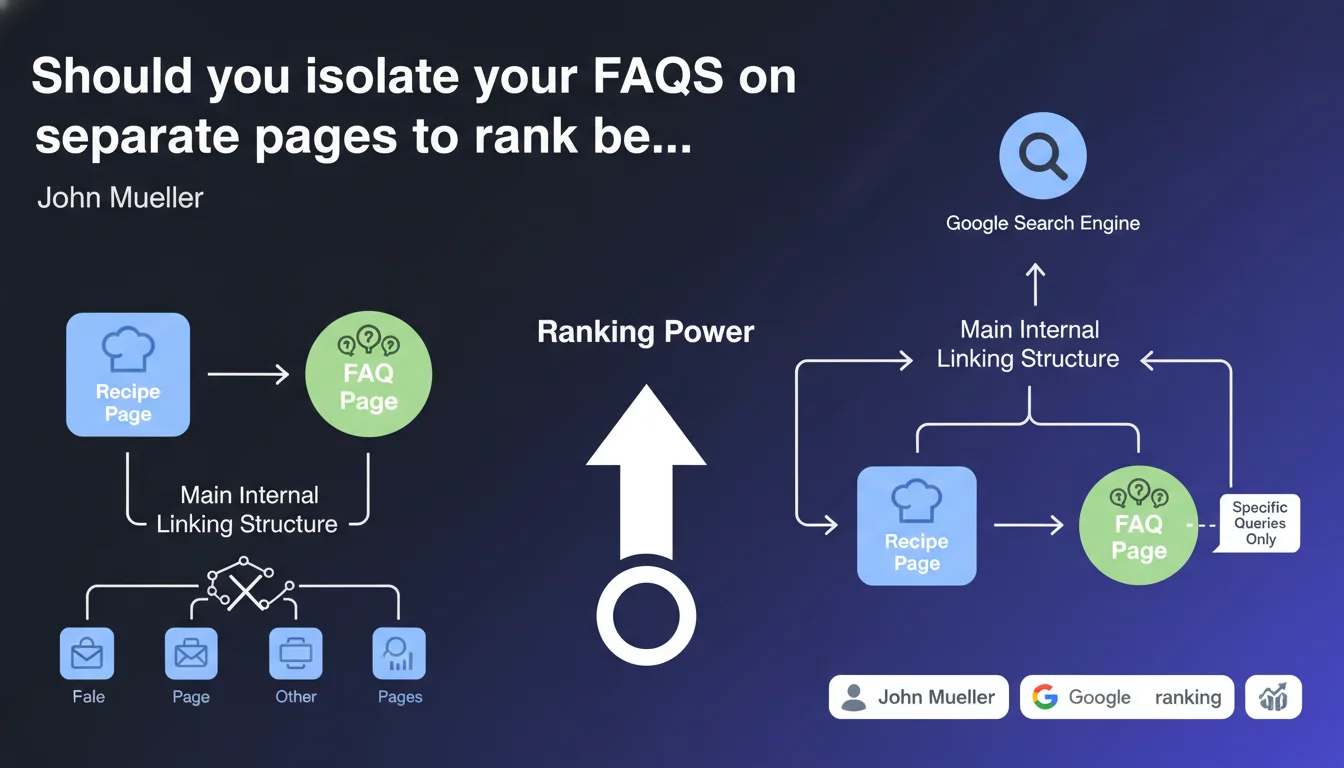
Separating FAQs from main pages (recipes, products, services) is a strategy validated by Google. The idea: concentrate ranking power on the strategic page, while allowing the FAQ to rank on niche queries if it's linked only from this page. Google adapts its focus based on your internal linking structure.
What you need to understand
Why does Google validate this separation approach?
The logic is straightforward: Google interprets internal linking as a signal of relative importance. An isolated FAQ page, linked only from its parent page, doesn't dilute that page's PageRank. The search engine understands that the recipe (or product page) is the main content and the FAQ is merely a supplement.
This separation also allows Google to target the right search intentions. The recipe page will appear for broad transactional or informational queries, while the FAQ will address very specific questions.
What does Mueller mean by "ranking power"?
He's referring to consolidated ranking signals on a single URL: backlinks, authority, user engagement, E-E-A-T signals. By avoiding duplicating or fragmenting main content, you maximize the SEO impact of your strategic page.
If the FAQ were integrated into the recipe, Google might sometimes display this page for queries where only a short answer is needed — potentially cannibalizing traffic intended for the full recipe.
How does Google decide which page to show?
Everything comes down to internal linking and semantic structure. An FAQ linked only from the recipe, without other internal links, remains in the shadows of priority crawling. Google discovers it, indexes it, but considers it secondary.
For generic queries ("apple pie recipe"), the main page ranks. For precise queries ("how long to bake apple pie"), the FAQ can emerge — if it provides a direct, well-structured answer.
- Separation validated: isolating the FAQ on a dedicated page is a legitimate SEO strategy.
- Selective linking: linking the FAQ only from the parent page prevents PageRank dilution.
- Targeted queries: Google shows the FAQ for specific questions, the main page for broad intents.
- No penalty: this architecture is not considered cloaking or manipulation.
SEO Expert opinion
Does this strategy actually work in practice?
Yes, but with nuances depending on the industry and query type. In e-commerce and blog-style content sites, we do observe that isolated FAQ pages rank on very specific long-tail keywords — often in featured snippets. However, for corporate or institutional sites, the effect is less pronounced: Google prioritizes the main page even for ancillary questions.
Another point: this approach assumes the FAQ has autonomous value. If it contains only 2-3 generic questions, you're better off integrating them directly into the main page. Separation only makes sense if the FAQ deserves to exist as a standalone resource.
What risks come with generalizing this logic across your entire site?
Be careful not to fall into the trap of excessive fragmentation. If every strategic page has its own orphaned FAQ, you end up with hundreds of weakly-linked pages that are difficult to crawl and maintain. Google may then consider them low-quality content — especially if they resemble each other.
The real danger is disguised thin content. An FAQ created solely to rank on secondary keywords, without real added value, will end up ignored or demoted. Mueller talks about an "acceptable strategy," not a magic formula. [Verify]: no public data confirms the measurable impact of this separation on CTR or conversion rate.
In which cases is it better to integrate the FAQ directly?
If your main page lacks depth or semantic keywords, the FAQ can enrich the content and strengthen overall relevance. This is often the case for short e-commerce product pages, where questions/answers add context and address purchase objections.
Another case: when search volume on the questions is marginal. Why create a dedicated page if no one is searching for this info? Better to leverage the main page's authority and keep all the SEO juice in one place.
Practical impact and recommendations
How do you decide if your FAQ should be separate or integrated?
Ask yourself two questions: 1) Does the FAQ have autonomous value? If it contains at least 8-10 substantial questions/answers, that justifies a dedicated page. 2) Is there identifiable search volume on these questions? Analyze "People Also Ask" and Google suggestions to find out.
If the answers are "yes," separation is relevant. Otherwise, integrate directly into the main page to strengthen its semantic depth.
What mistakes should you avoid with this architecture?
Don't create an orphaned FAQ without a link from the parent page. Even if you want to isolate it from general internal linking, it must at least be linked from the recipe/product in question — otherwise Google may never crawl it.
Also avoid duplicating the same questions/answers across multiple FAQs. That creates internal duplicate content and dilutes signals. Each FAQ should be unique and adapted to its parent page's context.
Finally, don't forget the schema.org FAQPage markup. Without it, Google won't be able to display your answers in rich snippets, and you lose much of the benefit of separation.
What checklist should you apply to optimize this strategy?
- Identify strategic pages with substantial FAQ potential (minimum 8+ questions).
- Analyze search volume on questions via "People Also Ask" and suggestion tools.
- Create the FAQ page only if it provides autonomous value and answers targeted queries.
- Link the FAQ only from the parent page, not from the menu or footer.
- Implement FAQPage schema.org markup to maximize rich snippet chances.
- Avoid any content duplication between FAQs or with the main page.
- Monitor FAQ performance (impressions, clicks, position) to validate the value of separation.
- If the FAQ generates no traffic after 3-6 months, consider merging it back with the main page.
❓ Frequently Asked Questions
Une page FAQ séparée peut-elle ranker mieux que la page principale ?
Faut-il inclure la FAQ séparée dans le sitemap XML ?
Le schema.org FAQPage est-il obligatoire pour cette stratégie ?
Combien de questions minimum pour justifier une page FAQ dédiée ?
Peut-on lier la FAQ depuis d'autres pages du site sans perdre l'effet d'isolation ?
🎥 From the same video 21
Other SEO insights extracted from this same Google Search Central video · published on 05/03/2022
🎥 Watch the full video on YouTube →
💬 Comments (0)
Be the first to comment.