
Official statement
What you need to understand
What's happening with FAQ snippets in Google results?
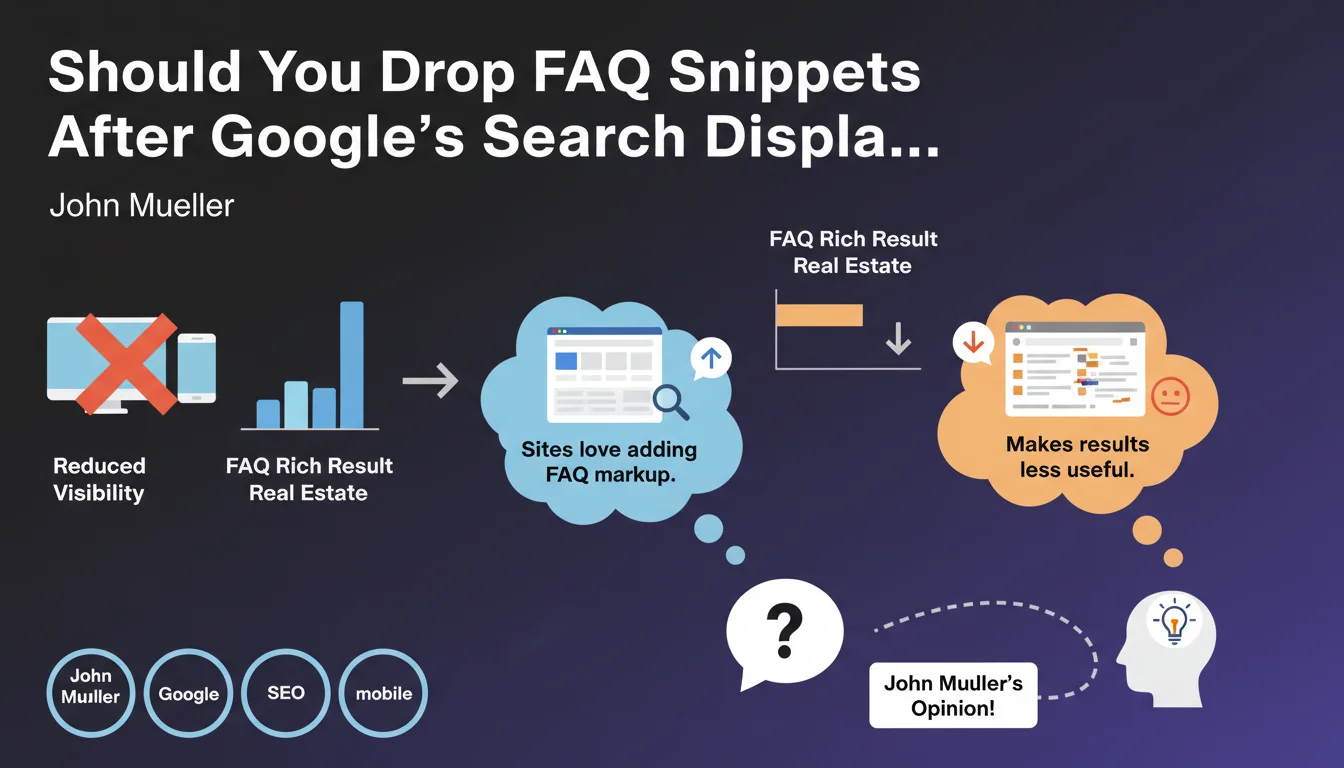
Google has significantly reduced the display of FAQ snippets in its search results pages, both on mobile and desktop. This evolution has been observed by numerous SEO practitioners worldwide over the past few weeks.
John Mueller from Google explains this trend by excessive usage: sites have massively adopted FAQ Schema.org markup to gain visibility, creating saturation that harms the user experience in the SERPs.
Why is Google now limiting these rich snippets?
The logic is simple: when too many sites use the same optimization technique, search results become less diverse and less useful for users. Google always prioritizes the quality of user experience.
This is an algorithmic adjustment to rebalance the relevance of SERPs. FAQs continue to exist but are only displayed when they provide real added value to the searcher.
Does this statement have an official status?
John Mueller clearly states that this is his personal opinion, not an official announcement. Nevertheless, field observations confirm this trend with a measurable decrease in FAQ display.
- Notable reduction in the presence of FAQ snippets in SERPs across all devices
- Identified cause: massive and sometimes abusive use of FAQ Schema markup
- Google seeks to preserve the usefulness of its search results
- Status: opinion expressed but trend confirmed by observations
- FAQs remain valid but are displayed in a more selective and restrictive manner
SEO Expert opinion
Was this evolution predictable for SEO professionals?
Absolutely. This situation illustrates a classic cycle in the evolution of natural search optimization. When Google introduces a feature that allows for increased visibility, its massive adoption eventually dilutes its effectiveness.
We've observed the same phenomenon with featured snippets, rich cards, and other rich formats. Balance is always sought between optimization opportunity and overall quality of results.
Does FAQ markup lose all its value as a result?
No, this is an essential nuance. Google is not penalizing FAQ markup itself, it's filtering it more severely. Pages with genuinely relevant and useful FAQs will continue to be highlighted.
The difference lies in the quality and legitimacy of the content. A product page with artificial FAQs will have fewer chances than a real FAQ page answering genuine user questions.
The technical impact of the markup remains positive for semantic understanding of your content by Google, even without rich display in the SERPs.
What are the risks if you keep your current FAQs?
There is no penalty risk in keeping your existing FAQ tags. Google doesn't penalize their presence, it simply chooses not to display them as frequently.
Stay vigilant about manipulative or artificial FAQs that could eventually be considered structured data spam if Google tightens its guidelines.
Practical impact and recommendations
What should you do concretely with your existing FAQs?
Start with an audit of your current FAQ markup. Identify those that correspond to real user questions versus those created solely for SEO.
Keep FAQs on pages where they have natural editorial legitimacy: support pages, detailed guides, service pages. Remove them from product or category pages where they seem artificial.
Focus on quality rather than quantity. Better to have 3-4 truly relevant questions than 15 forced questions to occupy space.
What alternatives exist to maintain your visibility in rich SERPs?
Diversify your structured data strategy. Leverage Product, Review, HowTo, Article markup according to the real nature of your content.
Optimize to obtain featured snippets through content structuring (lists, tables, clear definitions). This approach remains highly effective.
Work on your People Also Ask strategy by creating content that naturally answers related questions in your topic area.
How can you check the impact on your site and adjust your strategy?
Use Search Console to monitor the evolution of your rich results. Compare impressions and clicks before/after on pages with FAQs.
Analyze your click-through rates in the SERPs: a significant drop may indicate that your FAQs are no longer displaying and you've lost vertical visibility.
- Audit all FAQ markup currently deployed on your site
- Evaluate the editorial relevance of each FAQ: does it correspond to real questions?
- Remove artificial FAQs on product and commercial pages
- Keep FAQs on support, help and guide pages
- Improve the quality of answers in retained FAQs
- Diversify with other types of structured data (HowTo, Article, Product)
- Monitor evolution in Search Console and Google Analytics
- Optimize for featured snippets as an alternative
- Create content targeting "People Also Ask" questions
- Test and measure the impact of each modification
💬 Comments (0)
Be the first to comment.