
Official statement
What you need to understand
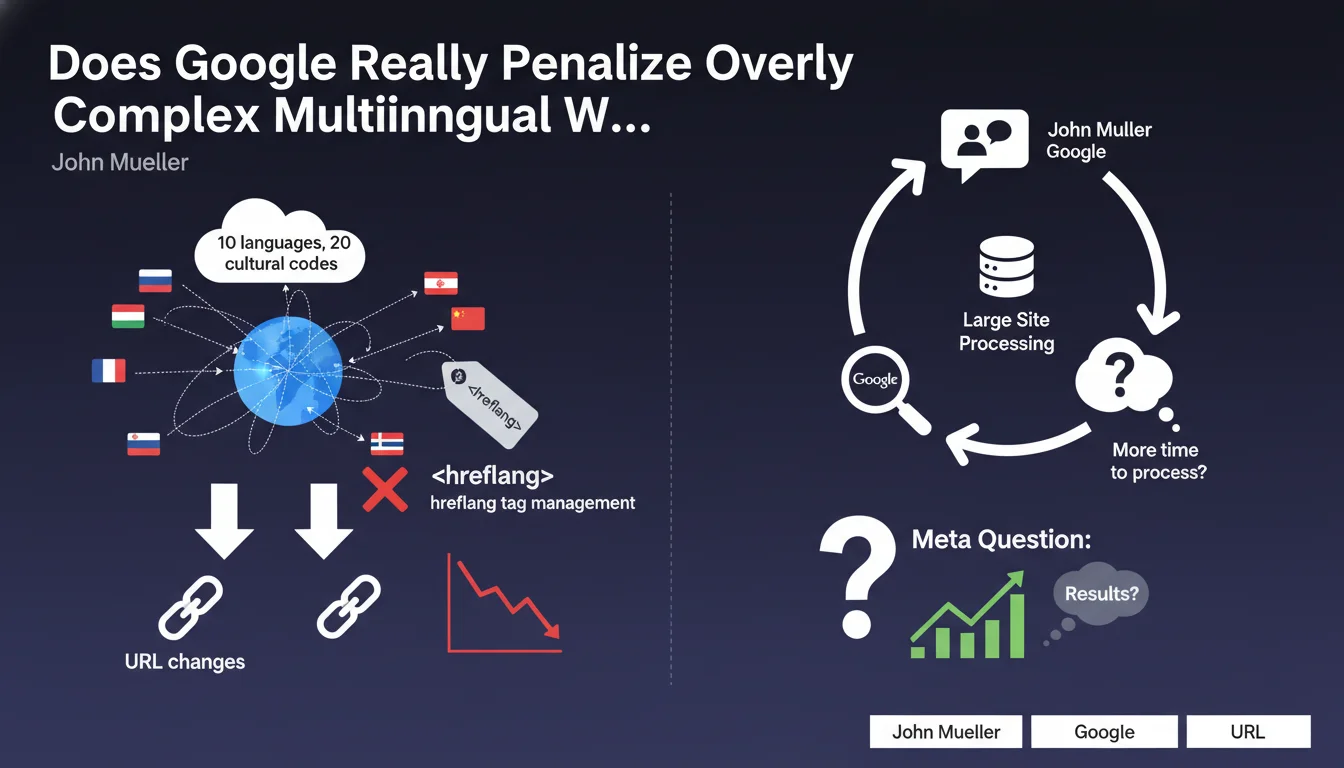
John Mueller has provided important clarifications regarding the processing of modifications on large-scale sites, particularly those with multiple linguistic and cultural versions.
The observation is clear: the more structurally complex a site is, the longer Google takes to process the changes made. This particularly concerns sites with numerous languages, cultural codes, and hreflang tag implementations.
But Mueller goes further by questioning the very usefulness of these complex configurations. He suggests that technical complexity doesn't always bring value proportional to the efforts required to maintain it.
- URL modifications on large sites require more processing time by Google's crawlers
- Structural complexity generates significant maintenance costs in the long term
- Simplifying the architecture can be more beneficial than maintaining an elaborate multicultural structure
- The real ROI must be evaluated for hreflang configurations and multiple national versions
SEO Expert opinion
This statement is perfectly consistent with what we observe in the field. Sites with complex multilingual architectures indeed experience much longer crawl and indexing delays.
However, simplification should not be systematic. For large international brands with truly distinct audiences by country, maintaining national versions remains relevant. The crucial question is: does your audience justify this complexity?
One point deserves attention: poorly planned simplification can cause more damage than a well-maintained complex structure. Removing linguistic versions or abandoning hreflang without a migration strategy risks destroying qualified traffic.
Practical impact and recommendations
- Audit your current architecture: list all your linguistic and cultural versions with their respective contribution to traffic
- Calculate the ROI of each version: maintenance time, translation costs, revenue generated
- Identify underperforming versions that could be merged or removed without major impact
- Simplify your hreflang structure by grouping similar cultural variants (e.g., fr-FR, fr-BE, fr-CH into a single /fr/)
- Avoid massive URL changes on large sites unless absolutely necessary
- Favor progressive modifications rather than complete overhauls on complex sites
- Rigorously document every modification to facilitate future tracking and maintenance
- Test on a sample first before deploying large-scale changes
- Consider expert assistance: multilingual architecture redesign requires specialized expertise in international SEO, complex migration management, and risk analysis. These projects demand meticulous planning and in-depth technical monitoring that a specialized SEO agency can orchestrate effectively, thus helping you avoid costly mistakes and visibility losses.
💬 Comments (0)
Be the first to comment.