
Official statement
What you need to understand
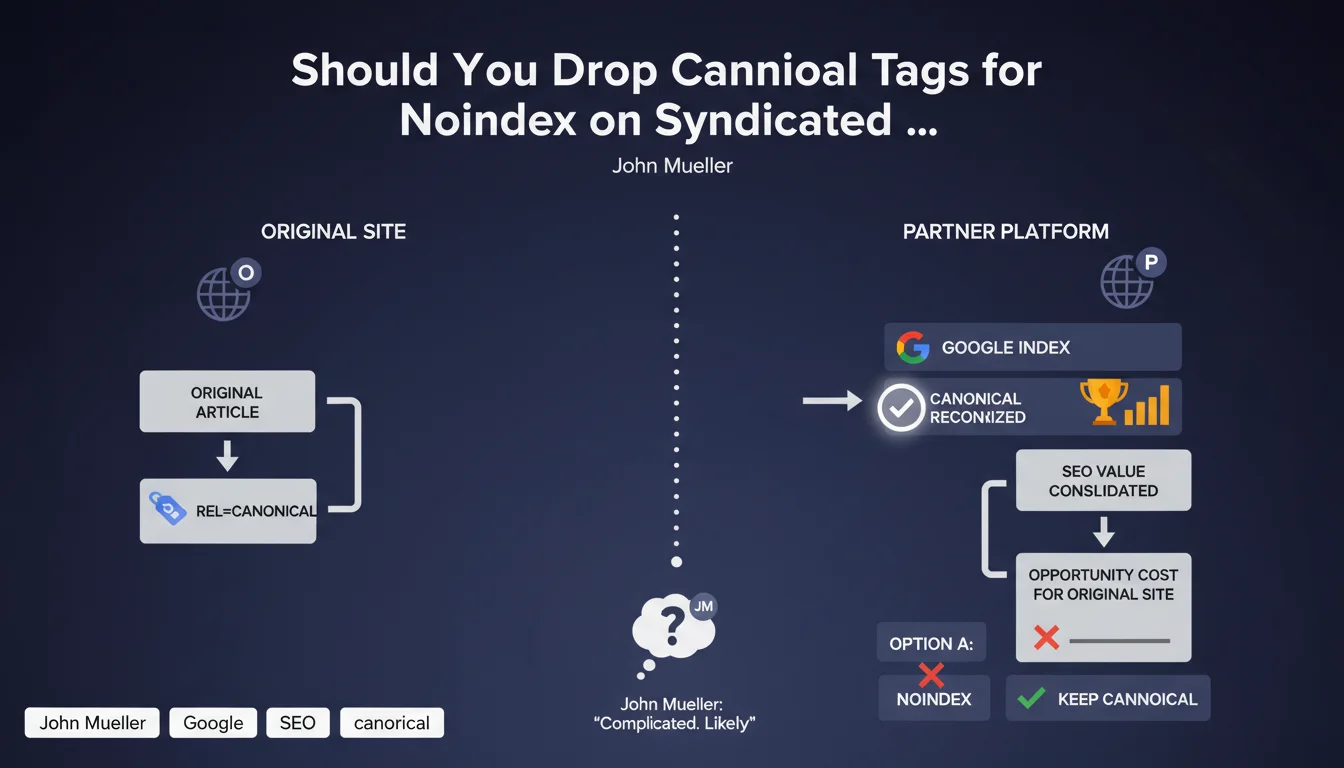
Content syndication involves publishing the same article across multiple websites, typically through partnerships. Traditionally, SEOs used the cross-domain canonical tag to indicate to Google which version to consider as the original.
According to John Mueller, when Google chooses a page as canonical, it is this version that receives the ranking signals. The problem: Google can sometimes consider the syndicated version as canonical rather than the original, which transfers all the SEO value to the partner.
Google's official recommendation is now clear: use the meta noindex tag on syndicated versions instead of canonical. This approach purely and simply prevents the indexation of duplicate content.
- Cross-domain canonical remains a suggestion that Google can ignore
- Noindex is a strong directive that blocks indexation
- With noindex, SEO value is guaranteed to remain on the source site
- This approach eliminates the risk of algorithmic confusion
SEO Expert opinion
This statement confirms what many SEO practitioners have observed for years: the canonical tag is only a signal, not an absolute directive. Google always reserves the right to choose another version as canonical, particularly if it judges the syndicated page to be of better quality or more relevant.
The noindex approach is indeed more secure for protecting your equity. However, it presents a trade-off: the partner site receives no organic traffic through this page. This can be problematic in certain syndication agreements where the partner also expects a return on investment.
Mueller's recommendation is pragmatic for classic syndication partnerships, where the primary objective is to extend content reach without cannibalizing your own SEO. It applies particularly well to guest blogs, content shared between sites in the same network, or republications on secondary platforms.
Practical impact and recommendations
- Audit all your current syndication partnerships and identify where your content is republished
- Contact your partners to request the addition of a meta noindex tag on syndicated versions of your content
- Include this clause in your future agreements for syndication: contractual requirement for noindex on the partner side
- Check in Search Console that Google is indeed indexing your version as the original, not the partner's
- Create a monitoring process: regularly crawl syndicated URLs to verify the presence of noindex
- For content already syndicated with canonical, prioritize migration to noindex on the most important partnerships
- Document your strategy: create clear internal guidelines on syndication for your content teams
- Monitor the impact: measure organic traffic recovery after noindex implementation at your partners
The technical management of syndication, auditing canonical signals, and coordinating with multiple partners represents complex work that requires expertise and rigor. For companies managing numerous content partnerships or site networks, support from a specialized SEO agency allows you to structure this transition methodically, avoid costly mistakes, and maximize SEO value recovery over the long term.
💬 Comments (0)
Be the first to comment.