
Official statement
What you need to understand
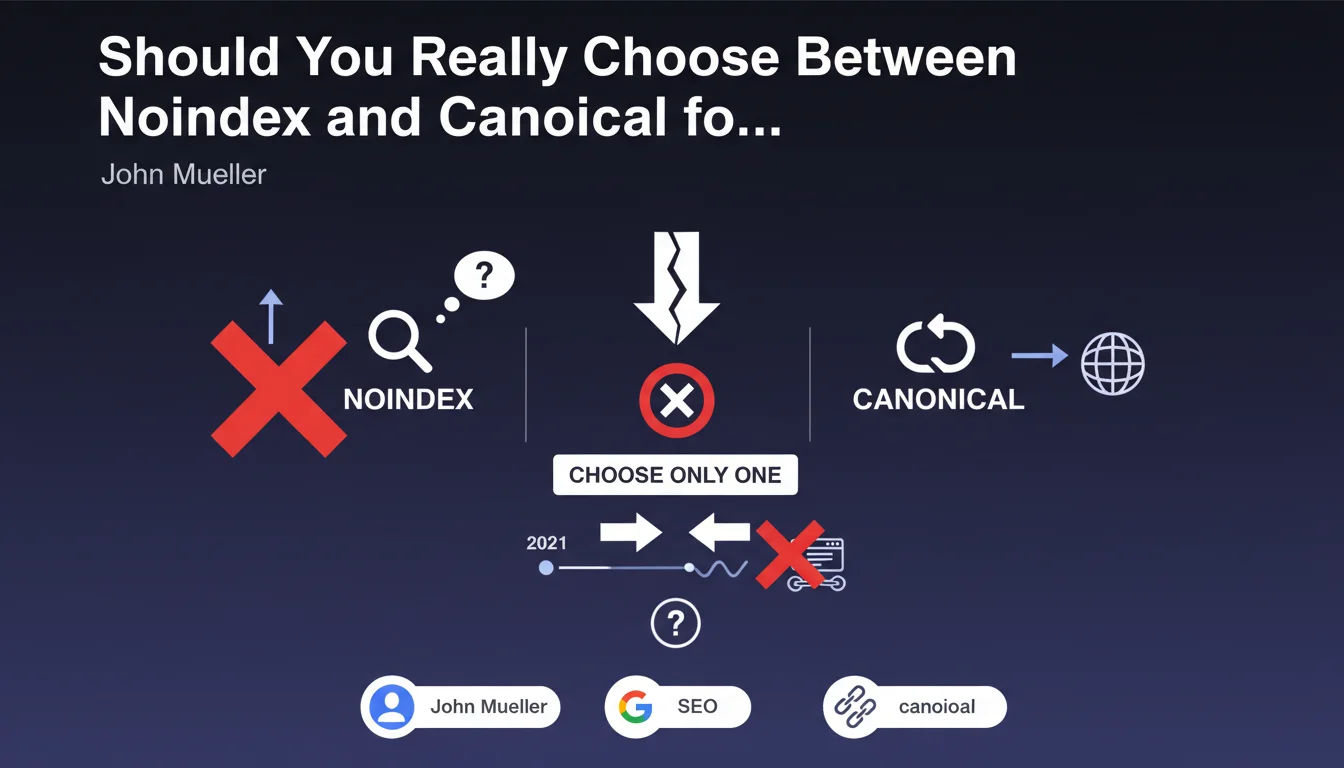
The simultaneous use of noindex and canonical tags on the same page creates a contradictory situation for search engines. The noindex tag asks Google not to index the page, while the canonical tag indicates which URL should be considered as the main version to index.
This technical contradiction can generate unpredictable behaviors from Googlebot. Even though Google has suggested that certain signals might transit via the canonical tag despite the presence of a noindex, this transmission remains uncertain and varies depending on site configurations.
SEO practitioners must therefore understand that these two directives serve different purposes and should not be combined on the same URL.
- Noindex: used to permanently exclude a page from Google's index
- Canonical: used to consolidate signals toward a preferred URL in case of duplicate content
- Combination discouraged: creates uncertainty about SEO signal processing
- Practical rule: a page is either meant to be indexed (with or without canonical) or not to be indexed (noindex alone)
SEO Expert opinion
This clarification from Google is consistent with field observations from SEO professionals. In practice, sites using both tags simultaneously often experience erratic behaviors: pages deindexed but temporarily maintaining their rankings, or conversely pages remaining visible in the index despite the noindex.
However, there exists a rarely discussed edge case: during a migration or redesign, some SEOs temporarily apply this double directive to force a gradual transition. This practice remains risky and should be avoided in favor of properly configured 301 redirects.
The recommendation is clear: choose your intention. If the page has value, use only canonical toward the best version. If it doesn't, use noindex without canonical.
Practical impact and recommendations
- Audit your site: identify all pages simultaneously using noindex and canonical via a technical crawl (Screaming Frog, Oncrawl, Botify)
- Prioritize your intentions: for each problematic page, decide whether it should be indexed or not
- Remove the noindex: on pages with a canonical tag that should remain indexable
- Remove the canonical: on pages with noindex that aren't meant to transmit signals
- Check Search Console: review the coverage report to detect alerts related to these contradictory directives
- Document your choices: create a clear decision matrix for future content (when to use noindex, when to use canonical)
- Monitor after correction: track the evolution of indexation and organic traffic for 4 to 6 weeks post-correction
Final recommendation: This issue illustrates the growing complexity of technical SEO optimizations. Between contradictory directives, server configurations, and crawling subtleties, the risks of error are numerous.
Rigorous indexation management requires sharp expertise and regular monitoring. If your site presents advanced technical configurations or if you manage a large catalog, the support of a specialized SEO agency can prove valuable to avoid costly mistakes and sustainably optimize your organic visibility.
💬 Comments (0)
Be the first to comment.