
Official statement
Other statements from this video 21 ▾
- □ Should you update the same page or create a new URL every day for frequently refreshed content?
- □ Should you stop using the manual submission tool in Google Search Console?
- □ Do H2 tags in your footer actually hurt your SEO rankings?
- □ Do HTML5 <header> and <footer> tags really boost your SEO rankings?
- □ Should you really rely on the schema.org validator to optimize your structured data?
- □ Does improving page speed really boost your rankings as fast as everyone claims?
- □ Does Google really crawl all your sitemaps at the same pace?
- □ Does Google really keep crawling a sitemap after you remove it from Search Console?
- □ Is Google really refusing to index your pages even though they're crawled regularly and have no technical issues?
- □ Can you safely use bidirectional canonicals between two site versions without any risk?
- □ Can structured data really replace traditional internal linking strategy?
- □ Should you really avoid product structured data on category pages?
- □ Do you really need to pick one primary language per page if you're targeting multiple markets?
- □ Why is Google completely ignoring your desktop version once mobile-first indexing kicks in?
- □ Can commodity content really survive in Google search results?
- □ Should you isolate your FAQs on separate pages to rank better?
- □ Is Google really cutting back on FAQ rich snippets in search results, and what does that mean for your SEO strategy?
- □ Is Google really ignoring 95% of your submitted URLs—and what does that say about your content?
- □ Can you host your XML sitemap on a different domain than your main website?
- □ Does the shift from 'Bad' to 'Medium' on Core Web Vitals really transform your Google rankings?
- □ Does server speed really impact the crawl budget of large websites?
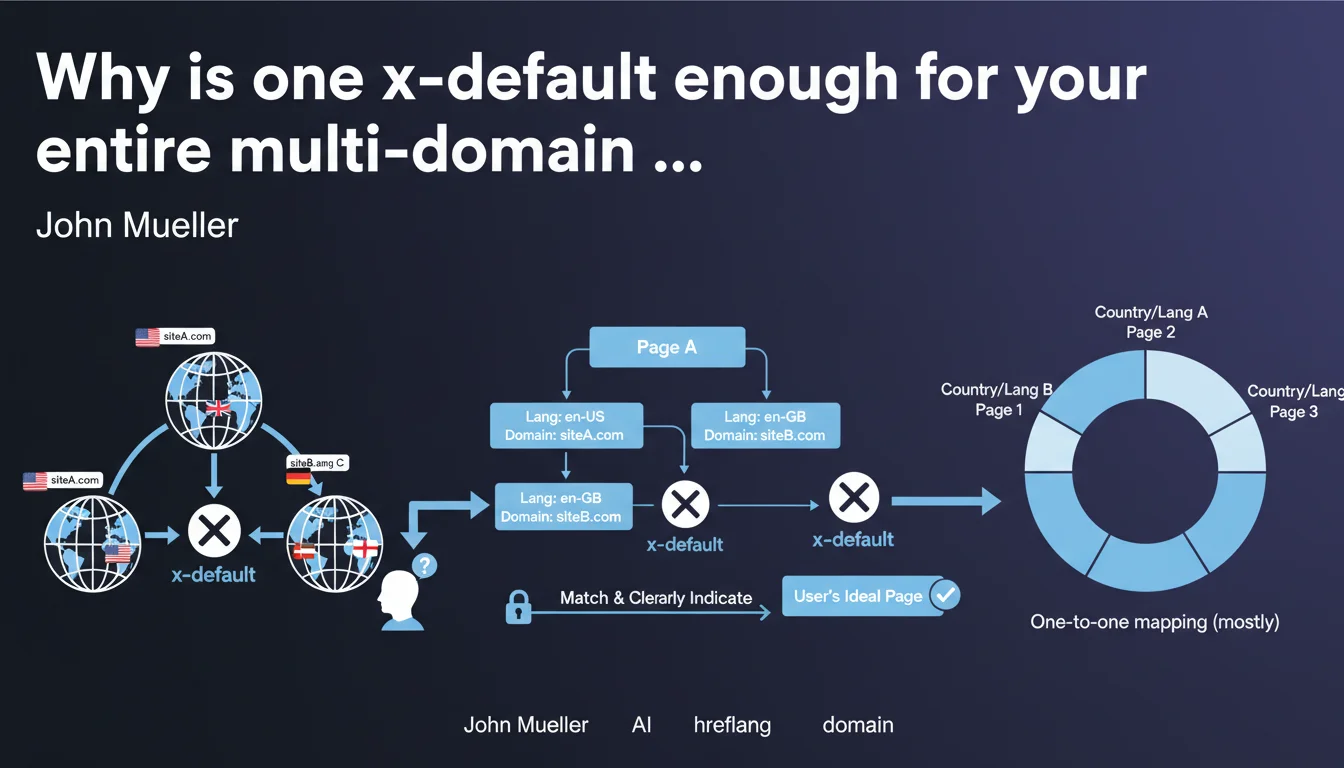
Google enforces a strict rule: a single x-default tag per group of alternative pages, even if your language versions are spread across multiple domains. The country/language to URL mapping must be one-to-one, but a single page can serve multiple markets. Any duplication of x-default creates ambiguity that Google will not tolerate.
What you need to understand
What is x-default and why this uniqueness constraint?
The x-default acts as a safety net in your hreflang configuration. When a user doesn't match any of the declared language or geographical variants, Google redirects them to this default URL.
The classic mistake? Declaring a different x-default for each national domain. Imagine: you have example.fr, example.de, example.es. If each domain points its own x-default, Google receives contradictory signals. Which version is really the reference?
How does the one-to-one mapping of language versions work?
The principle is straightforward: for a given country/language combination, only a single URL should be designated. If you declare that fr-FR points to example.fr/home, no other page in the hreflang cluster can claim to serve fr-FR.
However — and this is crucial — a single URL can perfectly well serve multiple markets. Your example.com/fr page can be declared for fr-FR, fr-BE, fr-CA. This is a one-to-many mapping on the destination side, but always one-to-one on the source side.
What happens if annotations don't match between each other?
The reciprocity of hreflang annotations is a non-negotiable rule. If page A declares pointing to B for en-GB, then B must imperatively declare A in its own set of annotations, with the appropriate language.
A lack of correspondence — called a "broken hreflang chain" — causes Google to simply ignore your annotations entirely. You lose the benefit of international targeting, and wrong versions appear in SERPs for the countries involved.
- A single x-default per group of alternative pages, never multiple
- Mandatory reciprocity: each page in the cluster must reference all others
- One-to-one mapping: one country/language combination = one URL target only
- One page can serve multiple markets, but each market points to only one page
- Annotations must be identical across all affected domains
SEO Expert opinion
Is this rule really respected by real-world implementations?
Let's be honest: the majority of multi-domain hreflang configurations I audit are broken. The duplicated x-default remains one of the most frequent errors, often coupled with non-reciprocal annotations.
The problem usually stems from decentralized management. Each national subsidiary manages its own site, its own CMS, and no one oversees global consistency. Result: fragmented hreflang clusters where each domain declares itself as x-default.
What nuances should be added to this directive?
Mueller's statement is clear, but it leaves an open question: what do you do if you have multiple completely distinct content universes? For example, an e-commerce site and a corporate site, both internationalized.
In this case — [To be verified] as Google doesn't communicate explicitly about this — you can have a distinct x-default per content universe. Each cluster of alternative pages (products vs. corporate articles) forms an independent group with its own x-default. But within the same group, the rule remains: only one.
Another nuance: the choice of x-default itself. Mueller doesn't say which page to designate. Logic suggests it should be the most generic version (often .com in English), but some sites choose a language selection page. Both approaches work, as long as the x-default is unique.
In what cases does this implementation become unmanageable?
Complex architectures with dozens of ccTLD domains pose a real operational challenge. Each page must carry the entire set of hreflang annotations for all its alternatives, which can represent 50+ lines of link tags.
Some work around the problem via XML sitemaps declaring hreflang relationships. That works, but Google favors HTML annotations for their reliability. And in both cases, the rule of a single unique x-default applies.
Practical impact and recommendations
How to audit and fix an existing hreflang configuration?
First step: map all your current x-defaults. A simple crawl with Screaming Frog or Oncrawl is enough. Filter the link rel="alternate" hreflang="x-default" tags and list all distinct URLs.
If you find more than one per content cluster, you have a problem. Identify which version should become the unique x-default — typically the most geographically neutral one — and remove the other declarations.
Next, verify the reciprocity of annotations. Each page in the cluster must point to exactly the same alternative URLs, in both directions. Tools like Aleyda Solis' hreflang Tags Testing Tool or Merkle's hreflang validator are indispensable here.
What errors should you avoid when implementing?
Don't confuse hreflang with canonical. The canonical points to the preferred version of duplicate content, while hreflang indicates distinct language variants. A page can have a self-referential canonical and hreflang tags pointing to other languages — this is actually the standard configuration.
Another pitfall: relative URLs in hreflang annotations. Google requires absolute URLs, protocol included. An incomplete annotation is ignored, breaking the entire cluster.
Finally, pay attention to language/country codes. fr-fr (lowercase) is not valid — ISO standards require fr-FR. These details silently fail your entire implementation.
How to maintain consistency across multiple domains?
The operational challenge is real. When you add a new market or domain, all existing pages must be updated to include this new alternative. This doesn't scale manually.
Approaches that work rely on a centralized source of truth — a mapping file, an API, a database — that all sites consume to generate their annotations. The page template dynamically builds hreflang tags from this single source.
- Audit all your domains to identify every x-default declared
- Choose a single version as x-default and remove other declarations
- Verify reciprocity: each page must reference all its alternatives, and vice versa
- Use only absolute URLs with protocol (https://)
- Respect the case of ISO codes: fr-FR, en-GB, de-DE
- Centralize hreflang generation logic to avoid inconsistencies across domains
- Regularly monitor Search Console for hreflang errors reported by Google
- Clearly document which domain carries the x-default and why
❓ Frequently Asked Questions
Peut-on avoir plusieurs x-default si on gère plusieurs sites totalement distincts ?
Le x-default doit-il forcément être une page en anglais ou .com ?
Que se passe-t-il si on oublie complètement le x-default ?
Les annotations hreflang dans le sitemap XML respectent-elles la même règle de x-default unique ?
Faut-il inclure le x-default dans les annotations hreflang de chaque page du cluster ?
🎥 From the same video 21
Other SEO insights extracted from this same Google Search Central video · published on 05/03/2022
🎥 Watch the full video on YouTube →
💬 Comments (0)
Be the first to comment.