
Official statement
Other statements from this video 14 ▾
- □ Does your URL structure really affect how hreflang works on Google?
- □ Are ccTLDs really losing their SEO weight for geographic targeting?
- □ Can Google really target geography at the individual page level?
- □ Should you really ignore the HTML lang attribute for multilingual SEO?
- □ Will Google finally automate hreflang tag detection?
- □ Why does Google trust hreflang more than the HTML lang attribute?
- □ Should you really worry about hreflang if only 9% of websites actually use it?
- □ Should you abandon hreflang in sitemaps and switch to HTML or HTTP headers instead?
- □ Does hreflang automatically trigger Google to crawl all your alternative URLs?
- □ Do you really need to include a self-referencing hreflang tag on every page?
- □ Does Google really index your multilingual pages separately with hreflang, or does it only store one version?
- □ Why are your hreflang pages disappearing from Search Console without being deindexed?
- □ Is hreflang really enough to handle nearly identical pages that only differ by currency or VAT?
- □ Why did Google discontinue its official hreflang validator tool?
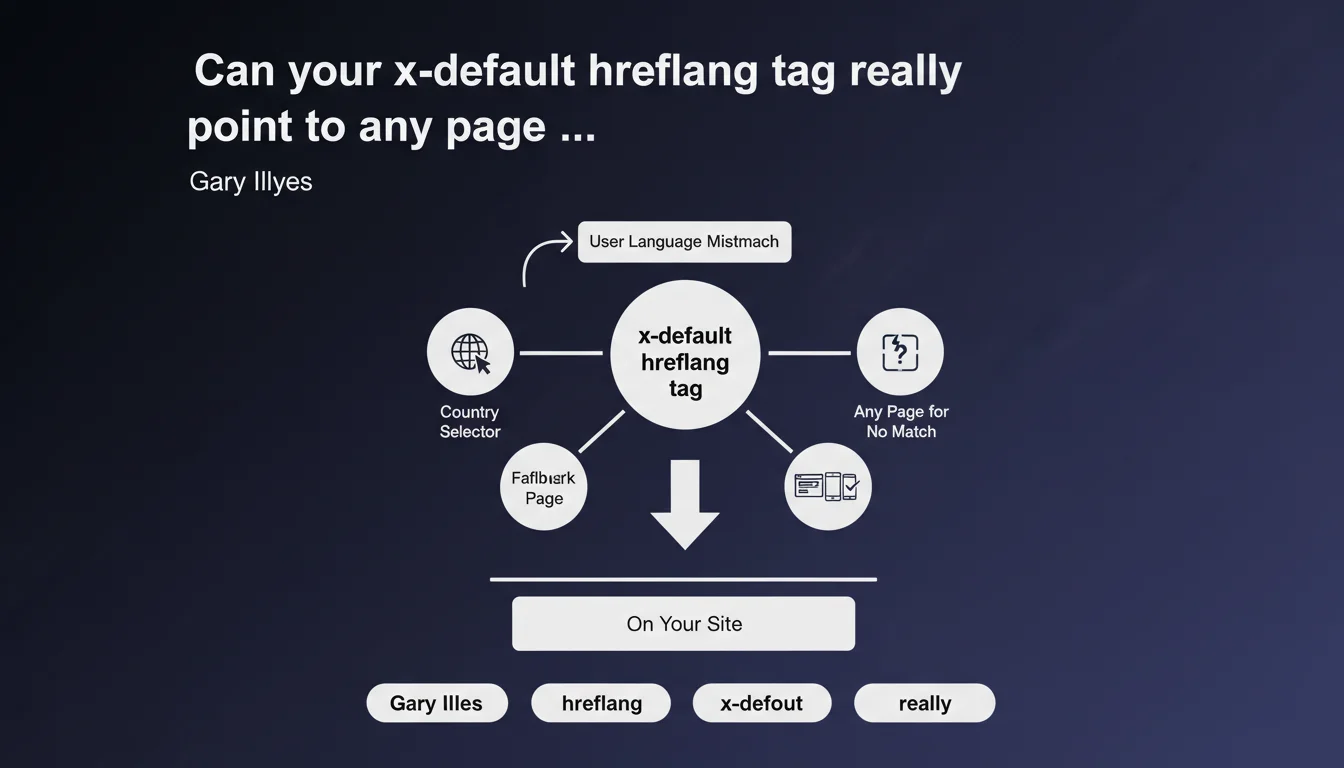
Google confirms that the x-default hreflang is not limited to declared language variants. You can direct it to a country selector, a universal landing page, or any relevant fallback page. This changes the game for complex multilingual architectures.
What you need to understand
What exactly is the x-default hreflang?
The x-default is a special hreflang tag value that tells Google which page to display when no language or regional variant matches the user's profile. Unlike other hreflang annotations that target specific languages (fr-FR, en-US, etc.), x-default acts as a safety net.
For years, many SEOs used it restrictively — typically pointing it to the default English variant. This statement from Gary Illyes explicitly broadens the possibilities.
Why does this flexibility change everything?
Until now, official documentation remained vague about what this fallback page could be. Some believed it had to be one of the language variants listed in the other hreflang tags.
Google confirms that's not the case. You can create a specific user experience for visitors without a match: an intelligent region selector, a neutral homepage, or even a landing page optimized for international acquisition.
What are the concrete use cases?
- A geolocalized country/language selector that directs the user based on their IP
- A generic international page in simplified English (even if you don't have a formal en-US version)
- An acquisition landing page specifically designed for uncovered emerging markets
- An intelligent redirect page based on browser signals or behavioral data
SEO Expert opinion
Was this flexibility already being applied in the field?
Let's be honest: many sites were already exploiting this latitude without knowing if it was officially supported. Complex architectures pointed their x-default to regional hubs or custom selectors — and it worked in most cases.
This statement simply formalizes a tolerated practice. But be careful: "tolerated" doesn't mean "optimal in all contexts." The main risk remains diluting relevance if your fallback page is poorly designed or too generic.
What are the limits of this directive?
Gary says "any page," but that's obviously not an invitation to point to just anything. Technically, you could make x-default point to a product page, a custom 404, or a form — but is that relevant? No.
Google expects this page to deliver a cohesive experience for a user without a language match. If you serve content totally disconnected from the rest of your hreflang structure, you create algorithmic confusion. [To verify]: no official data specifies whether an incoherent x-default page can impact the crawl or indexation of other variants — but common sense suggests it might.
Should you systematically use a geographic selector?
It's an elegant solution, but not universal. A country selector works well if you have 10+ language variants and a dispersed audience. But for a site with only 3-4 markets, a simple international homepage with clear navigation may suffice.
The selector adds a layer of technical complexity — especially if poorly implemented in JavaScript — and can slow down the user journey. Concretely? Test what converts best for your audience before generalizing.
Practical impact and recommendations
How do you choose the right page for your x-default?
First rule: this page must be accessible and indexable. No content blocked in client-side rendered JavaScript if Google needs to understand it. No automatic redirect that defeats the purpose of the x-default.
Second rule: it must offer a clear navigation path to all your language variants. Visible links, explicit selector, or detection system with manual override option — the user must never feel trapped.
Third rule: optimize this page for international conversion. If it's your entry point for uncovered markets, it deserves special care in UX and copywriting.
What mistakes should you absolutely avoid?
- Never point x-default to a URL with a 302 or 301 redirect — you lose the entire point of the tag
- Avoid pointing x-default to a page not referenced in your other hreflang annotations if it has nothing to do with your multilingual structure
- Don't create a referencing loop: if the x-default page itself has hreflang tags, ensure consistency
- Don't underestimate the SEO weight of this page — it can capture organic traffic if properly optimized
How do you audit your current implementation?
Crawl your site with Screaming Frog or an equivalent tool and extract all your hreflang annotations. Verify that each page pointed to by an x-default returns an HTTP 200 and contains links to your variants.
Then test with Google Search Console: submit your x-default URL and verify it's properly indexed, with no hreflang errors reported in the "International Targeting" report.
❓ Frequently Asked Questions
Le x-default est-il obligatoire sur un site multilingue ?
Peut-on pointer x-default vers une page en français si c'est notre marché principal ?
Faut-il inclure le x-default dans les annotations hreflang de toutes les autres variantes ?
Un sélecteur de pays en JavaScript est-il compatible avec le x-default ?
Que se passe-t-il si on ne déclare pas de x-default ?
🎥 From the same video 14
Other SEO insights extracted from this same Google Search Central video · published on 25/07/2024
🎥 Watch the full video on YouTube →
💬 Comments (0)
Be the first to comment.