
Official statement
Other statements from this video 15 ▾
- □ Does Google really juggle 40 different signals to pick the right canonical URL?
- □ Does Google really treat clustering and canonicalization as two separate processes, or is it all just one mechanism?
- □ Does rel canonical really play a dual role in Google's algorithm?
- □ What happens when your canonicalization signals contradict each other?
- □ Does Google actually prioritize HTTPS in search results, or does it depend on other factors?
- □ Is your redirect chain preventing Google from choosing the HTTPS version as canonical?
- □ Does Google really treat boilerplate translations and full content translations in completely different ways?
- □ Does hreflang really work independently from duplicate content clustering?
- □ Is Google really about to give trusted sites an hreflang fast-track to indexing?
- □ Do 200 Error Pages Really Create Clustering Black Holes?
- □ Are soft 404 pages really the only ones creating problematic clusters in your index?
- □ Can a clear error message really save your crawl budget from clustering disasters?
- □ Does Google really handle JavaScript redirects to error pages correctly through clustering?
- □ Does Google really remove pages faster with a no-index than with a 404 or 410 error code?
- □ Can an empty rel canonical really wipe your entire site from Google's index?
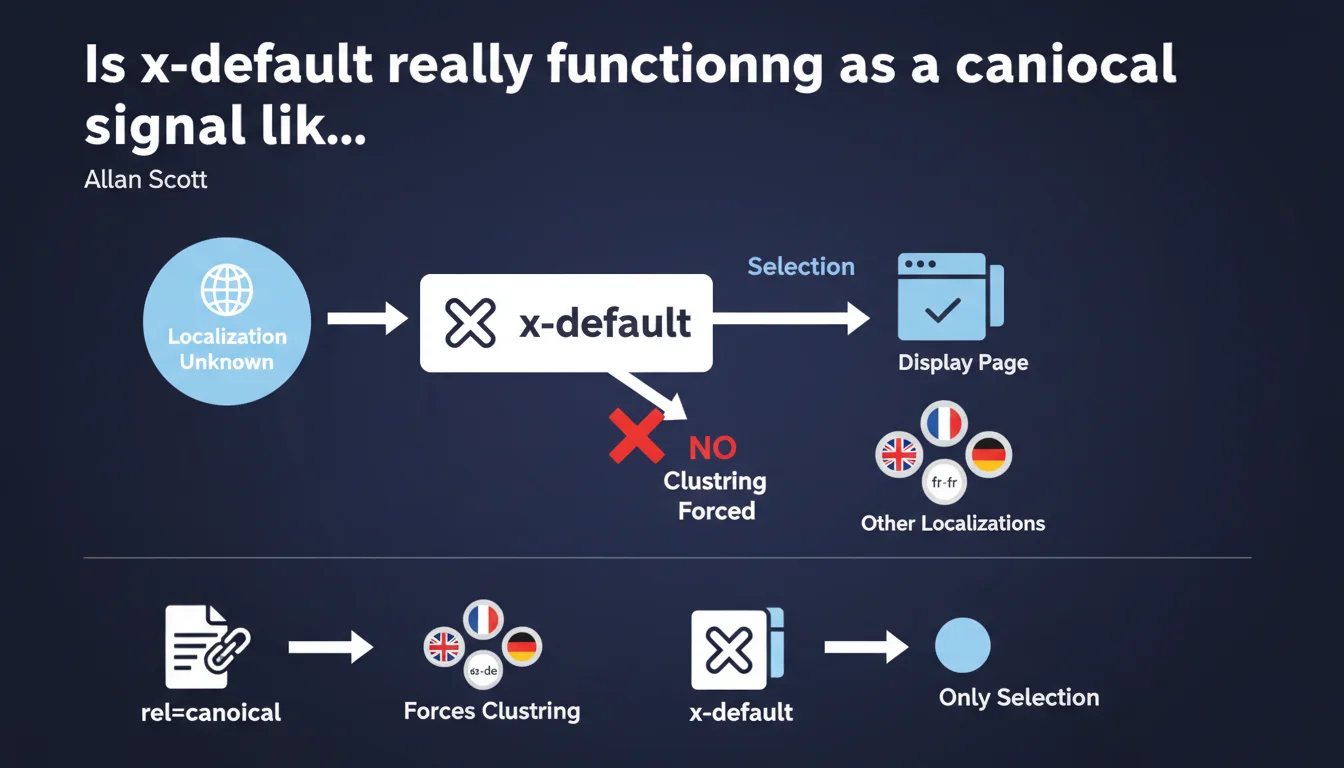
Google confirms that x-default works as a canonicalization signal, but with a crucial nuance: it does not impose page clustering the way rel=canonical does. Its role is limited to indicating which version to display when the user's geolocation is unknown or does not match any of the proposed language variants.
What you need to understand
What is the exact role of x-default in canonical selection?
The hreflang x-default tag serves as a fallback indicator for users whose language or localization does not match any of the declared variants. Contrary to what one might think, it does not merely redirect — it actively influences the canonical selection process.
Google uses it to determine which URL to display in search results when it cannot match the user with a specific variant. So it is indeed a canonicalization signal, not just a user-side display mechanism.
How does x-default differ from rel=canonical?
The distinction is fundamental. Rel=canonical forces page clustering — it tells Google "these URLs are duplicates, treat them as a single entity". X-default, on the other hand, does not merge anything. It participates in selection without imposing consolidation of ranking signals.
Concretely? Each language variant retains its autonomy in the index. X-default merely points to the default version when no other option suits. No signal dilution, no forced cannibalization.
Why does this clarification change everything?
Many SEO professionals treated x-default as a simple technical directive with no direct SEO impact. This statement confirms that it plays an active role in the visibility of your international pages. If misconfigured, it can steer Google toward the wrong default version.
The implication? A poorly chosen x-default page (for example an underoptimized version or one in a minority language) can become the default choice for a significant portion of your international organic traffic.
- X-default is a canonicalization signal, not just a display parameter
- It does not force page clustering like rel=canonical does
- It influences which version appears in the SERPs when localization is unknown
- Each language variant retains its autonomy in the index
- Poor configuration directly impacts international visibility
SEO Expert opinion
Is this distinction between selection and clustering credible in real-world scenarios?
Yes, and it is consistent with what we observe in Search Console. Coverage reports clearly show that hreflang pages remain indexed independently, even with an x-default declared. No forced consolidation of impressions or clicks as we would see with a misplaced canonical.
However — and this is where it gets tricky — Google remains vague about the exact weighting of this signal. Does x-default carry as much weight as a canonical in the final decision? [To be verified] in cases with contradictory signals (x-default pointing to one URL, canonical to another).
When does x-default become problematic in practice?
The classic case: a site that declares x-default toward its US English version, while its main non-targeted audience comes from Asia. Google will serve the US version by default, even if an undeclared APAC version in hreflang would have been more relevant.
Another sneaky scenario: pointing x-default to a "country selector" page without indexable content. Google can interpret this as a canonicalization signal toward an essentially empty page, which dilutes the visibility of all your variants for searches without clear geolocation.
Does this clarification resolve the inconsistencies observed?
Partially. It explains why sites with properly configured hreflang + x-default still see their variants "wrongly served" in some cases. If x-default is just one signal among others (and not the strongest), it can be counterbalanced by IP geolocation, browser language preferences, or user history.
What is missing here? A clear hierarchy of signals. Google does not say whether x-default takes precedence over user preferences, or vice versa. In practice, we observe that browser preferences seem to take the lead — but without official confirmation, this is reverse engineering.
Practical impact and recommendations
How do you configure x-default to maximize its relevance?
First rule: point x-default toward your most universal version. Generally, this is international English (en-US or en-GB depending on your main market), not an ultra-specific regional version. The goal is to serve a cohesive experience to "undefined" traffic.
Absolutely avoid pointing to a manual country/language selection page unless it contains substantial indexable content. Otherwise, you signal to Google that none of your variants are appropriate by default — which weakens your entire hreflang structure.
What technical errors sabotage x-default effectiveness?
The fatal error: declaring x-default in HTML but not in the XML sitemap (or vice versa). Google crawls both sources — an inconsistency between the two nullifies the signal. Verify that each language variant declares the same x-default, everywhere.
Second trap: pointing x-default to a URL that itself uses a rel=canonical toward another page. You create a signal conflict — Google must choose between x-default and canonical, and the outcome is unpredictable. Keep these directives aligned.
- Declare x-default toward your most universal language version (often en-US)
- Ensure consistency between HTML tags and XML sitemap for x-default
- Never point x-default to a page with canonical pointing to another URL
- Avoid country/language selection pages without indexable content
- Regularly test with VPNs/neutral locations to verify which version displays
- Monitor Search Console to identify variants "wrongly served" despite x-default
X-default is not a negligible technical detail — it is a lever for international visibility. Its configuration directly impacts which version of your site captures traffic from searches without clear geolocation. Misused, it can steer a significant portion of your audience toward a suboptimal variant.
The complexity of multilingual and multi-regional sites often requires a thorough technical audit to identify inconsistencies between hreflang, x-default, canonicals, and sitemaps. If your international infrastructure shows contradictory signals or uneven performance across regions, support from a specialized SEO agency can save you precious time and prevent costly visibility errors.
❓ Frequently Asked Questions
Peut-on avoir plusieurs balises x-default sur un même site ?
X-default remplace-t-il la nécessité d'un rel=canonical ?
Que se passe-t-il si je ne déclare pas de x-default ?
X-default doit-il pointer vers une URL accessible dans tous les pays ?
Est-ce que x-default influence le crawl budget ?
🎥 From the same video 15
Other SEO insights extracted from this same Google Search Central video · published on 05/12/2024
🎥 Watch the full video on YouTube →
💬 Comments (0)
Be the first to comment.