
Official statement
Other statements from this video 15 ▾
- □ Comment Google jongle-t-il avec 40 signaux pour choisir l'URL canonique ?
- □ Clustering et canonicalisation : Google fait-il vraiment la différence entre ces deux processus ?
- □ Le rel canonical joue-t-il un double rôle dans l'algorithme de Google ?
- □ Comment Google choisit-il réellement entre HTTP et HTTPS dans ses résultats ?
- □ Pourquoi vos redirections multiples empêchent-elles Google de choisir la version HTTPS ?
- □ Google traite-t-il vraiment différemment les traductions de boilerplate et de contenu ?
- □ Hreflang fonctionne-t-il indépendamment du clustering de contenu dupliqué ?
- □ Google va-t-il vraiment faciliter le traitement du hreflang pour les sites fiables ?
- □ X-default est-il vraiment un signal canonique comme les autres ?
- □ Les pages d'erreur 200 créent-elles vraiment des trous noirs de clustering ?
- □ Les pages en soft 404 sont-elles vraiment les seules à créer des clusters problématiques ?
- □ Pourquoi un message d'erreur explicite peut-il sauver votre crawl budget ?
- □ Les redirections JavaScript vers des pages d'erreur sont-elles vraiment prises en compte par Google ?
- □ Pourquoi un no-index supprime-t-il une page plus vite qu'une erreur 404 ou 410 ?
- □ Un rel canonical vide peut-il vraiment supprimer tout votre site de l'index Google ?
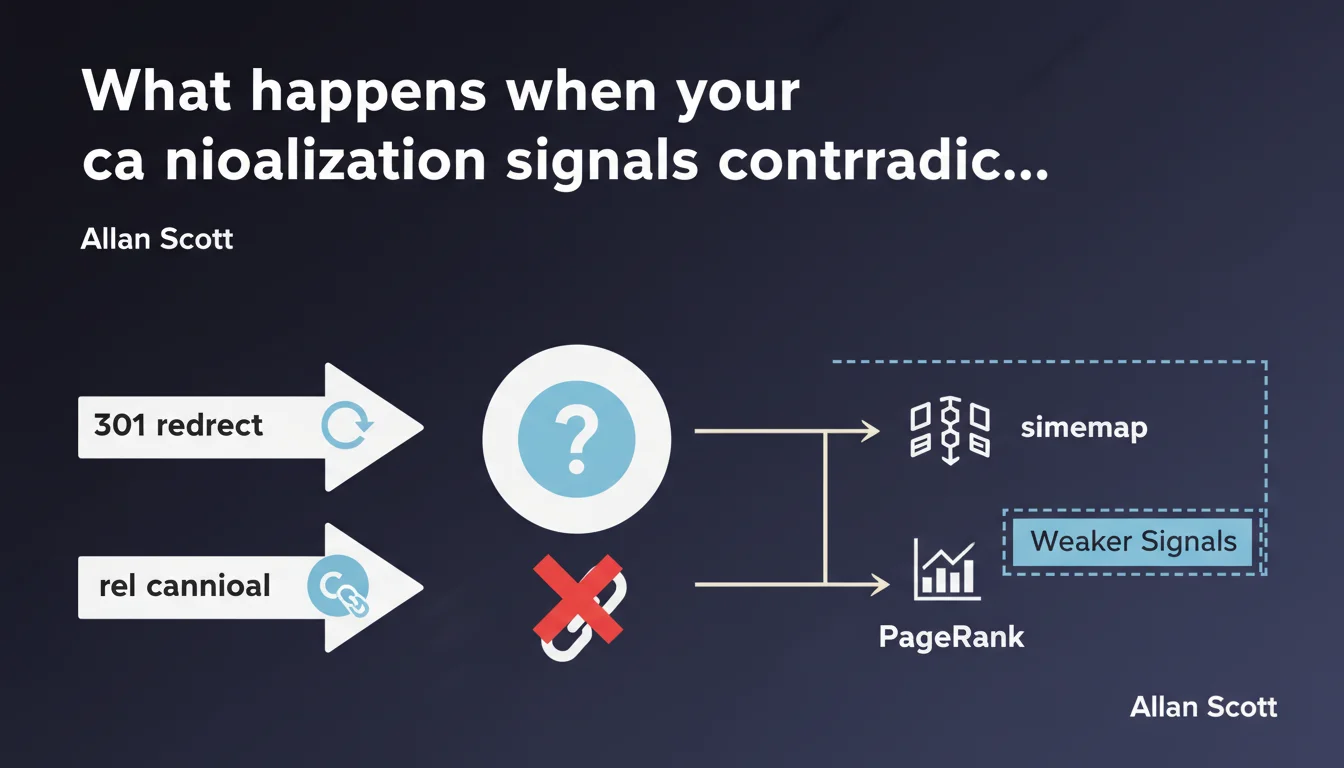
When a 301 redirect and a rel canonical point to two different URLs, Google ignores both strong signals and falls back on secondary criteria like sitemaps or PageRank. This contradiction drastically weakens your control over canonical selection, making Google's choice unpredictable.
What you need to understand
Why does Google abandon strong signals when they contradict?
The logic is straightforward: if you send two completely opposite instructions to the search engine, it cannot guess which one is correct. A 301 redirect is supposed to say "this page has permanently moved to X", while a rel canonical asserts "the reference version is Y". When X ≠ Y, the system considers your configuration defective.
Rather than arbitrarily choosing between two contradictory signals — which could compound a configuration error — Google neutralizes both and shifts to less reliable criteria. This is a form of safeguard: a suboptimal choice based on coherent signals is better than a random choice between two incompatible instructions.
What are these "weaker" signals Google falls back to?
Allan Scott explicitly mentions sitemaps and PageRank. Concretely, the engine will check which URL appears in your XML sitemap, which version receives the most internal or external links, and potentially other factors like content freshness or URL structure.
The problem? These signals were never designed to arbitrate canonicalization. They provide clues, not instructions. Result: you lose control over the canonical choice and Google may select a URL you hadn't anticipated.
In what situations do you end up with contradictory signals?
More often than you'd think. Typically during poorly prepared migrations where old canonical tags persist on redirected URLs. Or when different teams work in silos: devs implement redirects, the CMS automatically generates canonicals pointing elsewhere.
Multilingual or multiregional sites are also fertile ground: a geolocalized redirect clashes with a static canonical defined at the template level. Another classic case: URL parameters (utm, sessionid) managed differently depending on whether we're talking about redirects or canonical tags.
- Strong signal nullified: 301 redirect + rel canonical pointing to different targets = both lose their weight
- Weak signals activated: Google uses sitemaps, PageRank, URL structure to decide
- Loss of control: the chosen canonical becomes unpredictable and may vary over time
- Common cases: poorly coordinated migrations, multilingual sites, URL parameter management
- Difficult detection: Search Console does not systematically flag these contradictions
SEO Expert opinion
Is this statement consistent with field observations?
Yes — and it's even reassuring that Google finally confirms it openly. In the field, we regularly observe cases where the selected canonical corresponds to neither the 301 target nor the rel canonical. Search Console then displays "surprising" canonical URLs without clear explanation.
What Allan Scott brings here is the explicit hierarchy: strong signals (301, canonical) are prioritized UNLESS they contradict each other. In that specific case, Google ignores both. This logic explains why some cleanly executed migrations fail when phantom canonical tags linger in templates.
What nuances should be noted?
Google speaks of "strong signals" as if they were equally weighted. In practice, a server-side 301 redirect is generally more determinative than an HTML rel canonical — except that contradiction neutralizes both. But what proportion of "contradiction" is enough to trigger this mechanism? [To verify]
Another point: the statement doesn't clarify whether this rule also applies to 302 redirects, nor how HTTP header canonicals versus HTML behave. We lack granularity on the internal hierarchy of weak signals — does the sitemap always take precedence over internal PageRank, or does it depend on context?
Should you always avoid redirects when a canonical exists?
No, that would be too binary a reading. The real message is: absolute coherence. If you redirect A → B, the canonical of A should point to B (or not exist at all, since the page returns a 301). The canonical of B should point to B or be absent.
On the other hand, redirecting A → B while putting a canonical A → C is a technical aberration. And yet it happens — misconfigured templates, .htaccess rules that stack, CDN with redirect rules that override initial intent. Let's be honest: most CMS platforms don't verify this coherence natively.
Practical impact and recommendations
What concretely should you do to avoid these contradictions?
First step: audit coherence between your redirects and canonical tags. A crawl with Screaming Frog or Oncrawl lets you cross both layers and identify discrepancies. Specifically filter for URLs returning 301 that still carry a rel canonical pointing elsewhere.
Second action: review the logic of canonical generation in your templates. If you use self-referencing canonicals, ensure they disappear as soon as a redirect is in place. Many CMS platforms continue generating the tag even on a page that redirects — it's pointless and potentially dangerous.
Third point: document the rules. When multiple teams are involved (devs, SEO, ops), a simple shared spreadsheet listing "for each scenario, which redirect + which canonical" prevents 90% of conflicts. It sounds basic, but it's rarely done.
How do you detect if your site is already a victim of this problem?
Export from Search Console the list of canonical URLs selected by Google. Compare it with your intentions: if URLs you thought were redirected appear as canonicals, or if the chosen canonical matches neither your 301 nor your rel canonical, you're in the thick of it.
Another indicator: unexplained fluctuations in the canonical over time. If Google is hesitant between multiple versions of the same page, it's often a sign that your strong signals are contradictory and the engine is navigating by sight with weak signals — which themselves can vary (sitemap update, evolution of internal linking).
What errors must you absolutely avoid?
- Never leave a rel canonical active on a page that redirects — remove it from the template before redirecting
- Avoid poorly formed relative canonicals that might point to a different URL than the redirect target
- Don't assume that "Google will understand" — in case of doubt, it chooses for you, and rarely as you would have
- Don't ignore canonical HTTP headers if you use them — they also factor into the equation
- Don't forget staging/preprod environments that can pollute the index with incoherent canonicals
- Verify that your redirect rules (htaccess, nginx, CDN) don't override the SEO intentions defined elsewhere
The essentials: one signal, one target. If you redirect, remove the canonical or align it. If you canonicalize, don't redirect to another URL. Any contradiction at all causes you to lose control in favor of unpredictable secondary criteria.
These cross-layer verifications between technical stacks (server, HTML, headers) can quickly become complex, especially on large-scale sites or after successive migrations. If your SEO ecosystem comprises multiple technological layers — CMS, CDN, reverse proxy, multiple servers — it may be wise to seek specialized support to map all signals and ensure lasting coherence. A technical SEO agency has the tools and experience to detect these invisible contradictions and build a robust canonicalization architecture.
❓ Frequently Asked Questions
Un canonical dans le HTML et un canonical HTTP header qui se contredisent déclenchent-ils le même mécanisme ?
Est-ce qu'une redirection 302 + un rel canonical vers des URLs différentes posent le même problème ?
Google prévient-il dans la Search Console quand il détecte ces contradictions ?
Le sitemap est-il vraiment prioritaire sur le PageRank quand les signaux forts sont neutralisés ?
Peut-on utiliser cette mécanique pour forcer Google à choisir une URL spécifique en jouant sur les sitemaps ?
🎥 From the same video 15
Other SEO insights extracted from this same Google Search Central video · published on 05/12/2024
🎥 Watch the full video on YouTube →
💬 Comments (0)
Be the first to comment.