
Official statement
Other statements from this video 15 ▾
- □ Clustering et canonicalisation : Google fait-il vraiment la différence entre ces deux processus ?
- □ Le rel canonical joue-t-il un double rôle dans l'algorithme de Google ?
- □ Que se passe-t-il quand vos signaux de canonicalisation se contredisent ?
- □ Comment Google choisit-il réellement entre HTTP et HTTPS dans ses résultats ?
- □ Pourquoi vos redirections multiples empêchent-elles Google de choisir la version HTTPS ?
- □ Google traite-t-il vraiment différemment les traductions de boilerplate et de contenu ?
- □ Hreflang fonctionne-t-il indépendamment du clustering de contenu dupliqué ?
- □ Google va-t-il vraiment faciliter le traitement du hreflang pour les sites fiables ?
- □ X-default est-il vraiment un signal canonique comme les autres ?
- □ Les pages d'erreur 200 créent-elles vraiment des trous noirs de clustering ?
- □ Les pages en soft 404 sont-elles vraiment les seules à créer des clusters problématiques ?
- □ Pourquoi un message d'erreur explicite peut-il sauver votre crawl budget ?
- □ Les redirections JavaScript vers des pages d'erreur sont-elles vraiment prises en compte par Google ?
- □ Pourquoi un no-index supprime-t-il une page plus vite qu'une erreur 404 ou 410 ?
- □ Un rel canonical vide peut-il vraiment supprimer tout votre site de l'index Google ?
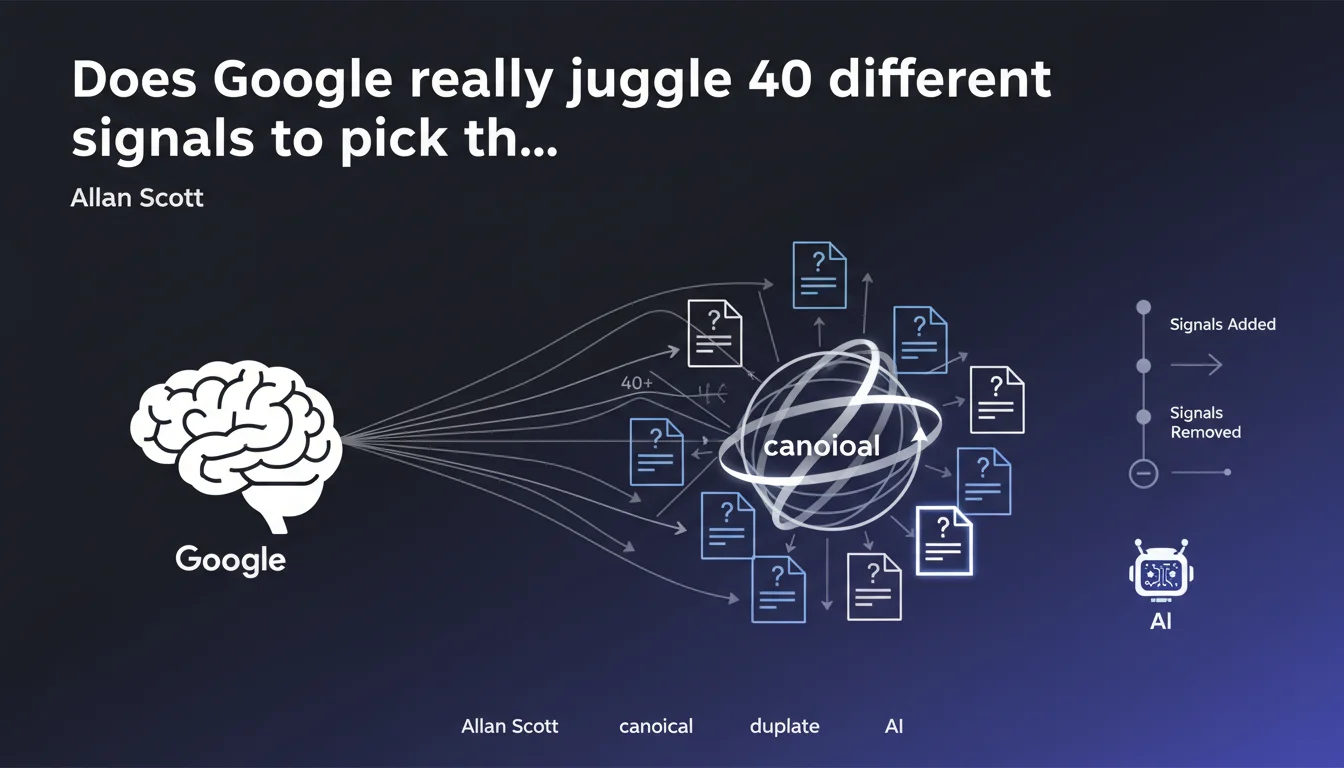
Google relies on approximately 40 different signals to determine which URL to display as the canonical version in a cluster of duplicate content. This figure is not fixed — signals are regularly added or removed as the algorithm evolves. Understanding these mechanisms allows you to anticipate Google's choices and avoid unwanted canonicalization.
What you need to understand
Why does Google need 40 signals just to pick one canonical URL?
Selecting a canonical URL isn't a simple binary choice. Google faces millions of situations where multiple versions of the same page coexist: URL parameters, HTTP/HTTPS versions, trailing slashes, pagination, mobile/desktop variants, unintentional duplicates.
Each signal provides a reliability clue: URL popularity through backlinks, internal linking consistency, presence of an explicit canonical tag, indexation age. But no single signal is absolute. Google aggregates these 40 indicators to make a decision — and sometimes, it gets it wrong.
What types of signals come into play in this selection?
Google doesn't publicly list these 40 signals, but we can deduce the main categories: technical signals (canonical tags, redirects, XML sitemaps), popularity signals (backlinks pointing to a specific URL, user traffic), consistency signals (internal linking, hreflang, AMP or mobile versions).
Some signals are probably contextual — for example, detected language, server geolocation, URL parameter structure. Others evolve: a signal that was relevant five years ago (such as PageRank Sculpting via nofollow) may have been removed or deprecated.
Is this figure of 40 signals stable or does it constantly fluctuate?
Allan Scott clarifies that this number varies over time. Google adds signals when new problems emerge (example: Core Web Vitals, or managing client-side rendered JavaScript pages). Conversely, some signals become obsolete or redundant.
This instability means that a well-optimized site today could experience different canonicalization tomorrow if Google changes the weighting of a key signal. Monitoring changes in Search Console becomes essential.
- Approximately 40 signals to arbitrate between duplicate URLs, a non-fixed figure
- No single signal has absolute weight — Google aggregates and arbitrates
- Signals evolve with the algorithm: some disappear, others appear
- Canonicalization can change without action on your part if Google revises its criteria
SEO Expert opinion
Is this statement consistent with what we observe in the field?
Yes, and it's actually reassuring to have official confirmation. In practice, we regularly observe erratic canonicalization: Google ignores a properly implemented canonical tag, or favors a URL with parameters when a clean version exists.
These inconsistencies are now explained: with 40 signals at play, a single misconfigured signal can be enough to reverse the decision. Classic example: page A points to B in canonical, but massive internal linking to A plus external backlinks to A tip the scales. Google decides — and not always as expected.
What nuances should we add to this figure of 40 signals?
Be careful: 40 signals doesn't mean 40 equal weights. Some signals are probably much more influential than others — the explicit canonical tag, 301 redirects, backlinks. Others are likely minor arbiters used only when there's a tie.
Google reveals neither the complete list nor the relative weighting. [Needs verification]: we don't know if these 40 signals include content quality criteria (e.g., partial duplication, thin content) or if they're limited to technical and popularity aspects.
Another nuance: this figure concerns canonical selection within an already-identified cluster. Before that, Google must first detect that multiple URLs are duplicates — and this process probably uses additional signals.
In what cases do these 40 signals fail to arbitrate correctly?
Edge cases reveal the system's weaknesses. Multilingual sites with misconfigured hreflang: Google may canonize one language over another randomly. E-commerce sites with faceted filters: Google struggles to distinguish a legitimate category page from a minor variation.
Poorly managed pagination (e.g.: rel=prev/next tags removed by Google but still present on some sites): Google may canonize page 1 over page 5 or vice-versa. In these situations, the 40 signals cancel each other out, and Google makes an arbitrary choice.
Practical impact and recommendations
What should you actually do to control canonicalization?
Multiply coherent signals. If you want Google to canonize the URL /product and not /product?ref=123, make sure that all signals converge: canonical tag, internal linking exclusively to the clean version, 301 redirects from variants, XML sitemap listing only the canonical version.
Monitor Search Console in the "Coverage" and "URL Parameters" tabs. Google shows you which URL it has chosen as canonical — and if it differs from the one you declared, that's a red flag. Dig deeper to identify which signal(s) is pulling in the other direction.
What errors should you avoid to prevent confusing Google's signals?
Avoid contradictory signals. Classic example: a canonical tag points to A, but the XML sitemap lists B, and internal linking sends 80% of links to C. Google has no reason to believe you over relying on backlinks or user traffic.
Don't change canonicalization without strategic reason. If you modify your URL structure or canonical tags, Google will need to re-evaluate its 40 signals — and during this period, you risk visibility fluctuations.
Another mistake: ignoring self-referential canonicals. Even if a page has no obvious duplicate, declare <link rel="canonical" href="page-URL"> to prevent Google from inventing canonicalization based on tracker parameters or sessions.
- Systematically declare a canonical tag, even self-referential
- Point internal linking exclusively to the desired canonical URL
- Redirect in 301 unwanted variants (HTTP to HTTPS, www to non-www, etc.)
- List only canonical URLs in the XML sitemap
- Configure URL parameters in Search Console if applicable
- Regularly audit indexed URLs via
site:and Search Console - Monitor unwanted canonicalization changes in coverage reports
How do you verify that Google respects your canonicalization choices?
Use the URL inspection tool in Search Console. Enter the URL you think is duplicate, and Google shows you which canonical URL defined by Google it has selected. If this doesn't match your canonical tag, you have a conflict.
Supplement with a crawl via Screaming Frog or Oncrawl to identify all accessible URLs, then compare with indexed URLs in Search Console. Gaps reveal uncontrolled canonicalization — or worse, duplicate content you didn't know about.
❓ Frequently Asked Questions
Est-ce que la balise canonical suffit à imposer mon choix à Google ?
Google révèle-t-il la liste complète des 40 signaux utilisés pour la canonisation ?
Pourquoi le nombre de signaux varie-t-il dans le temps ?
Comment savoir si Google a choisi une URL canonique différente de celle que j'ai déclarée ?
Peut-on forcer Google à respecter notre choix de canonique dans 100% des cas ?
🎥 From the same video 15
Other SEO insights extracted from this same Google Search Central video · published on 05/12/2024
🎥 Watch the full video on YouTube →
💬 Comments (0)
Be the first to comment.