
Official statement
Other statements from this video 15 ▾
- □ Does Google really juggle 40 different signals to pick the right canonical URL?
- □ Does Google really treat clustering and canonicalization as two separate processes, or is it all just one mechanism?
- □ What happens when your canonicalization signals contradict each other?
- □ Does Google actually prioritize HTTPS in search results, or does it depend on other factors?
- □ Is your redirect chain preventing Google from choosing the HTTPS version as canonical?
- □ Does Google really treat boilerplate translations and full content translations in completely different ways?
- □ Does hreflang really work independently from duplicate content clustering?
- □ Is Google really about to give trusted sites an hreflang fast-track to indexing?
- □ Is x-default really functioning as a canonical signal like the others?
- □ Do 200 Error Pages Really Create Clustering Black Holes?
- □ Are soft 404 pages really the only ones creating problematic clusters in your index?
- □ Can a clear error message really save your crawl budget from clustering disasters?
- □ Does Google really handle JavaScript redirects to error pages correctly through clustering?
- □ Does Google really remove pages faster with a no-index than with a 404 or 410 error code?
- □ Can an empty rel canonical really wipe your entire site from Google's index?
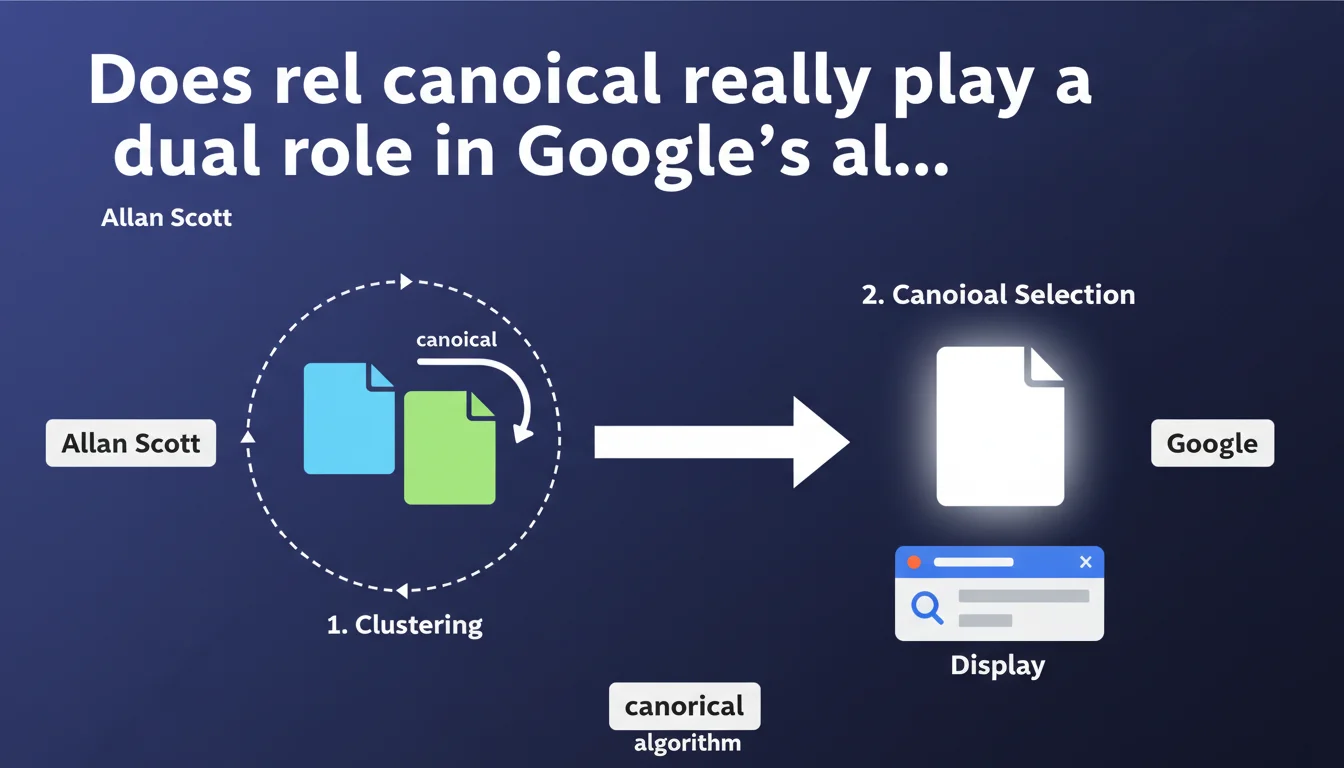
Rel canonical doesn't just designate a page's preferred version. Google uses it first to group similar pages into the same cluster, then as a signal to choose which one to display. This dual function changes everything: when placed incorrectly, a canonical can merge pages that should never have been associated together.
What you need to understand
How does this clustering concept change things in practice?
Until now, most SEOs viewed rel canonical as a simple designation tool: you point to the page you want indexed, and you're done. Except Google is telling us here that the process unfolds in two stages.
First, the canonical creates a cluster — a grouping of pages deemed sufficiently similar. Only then, if these pages are actually clustered together, does Google use the canonical as a signal to determine which URL to display. In other words, the canonical influences how similarity is perceived first, before even playing its role as a selector.
Why is this distinction between clustering and canonical selection so important?
Because it means that an incorrectly placed canonical can force Google to group distinct content. If you accidentally point a product page to a category page with a canonical, you're not just saying "display the category" — you're also telling Google "these two pages are about the same thing".
Result: Google may decide never to display the product page, even in contexts where it would have been relevant. Clustering comes before canonicalization, which makes the mistake heavier in consequences than a simple URL choice.
Does Google always follow the canonical to the letter?
No, and that's where it gets complicated. The canonical is one signal among many — not an absolute directive. Google can ignore your canonical if other clues (content, internal linking, external links) suggest to it that another URL is more relevant.
But this statement confirms that the canonical carries significant weight in the clustering process. Even if it's not always followed for the final selection, it influences how Google perceives relationships between your pages.
- Rel canonical first serves to group similar pages together (clustering)
- It then becomes a selection signal to choose which URL to display
- An incorrectly placed canonical can merge distinct content
- Google doesn't always follow the canonical, but it heavily influences clustering
SEO Expert opinion
Is this statement consistent with what we observe in the field?
Yes, and it explains certain behaviors that many SEOs have noticed without really understanding. For example, when you remove a self-referencing canonical from a page, you sometimes see Google merge this page with another one it considers close — when you thought you were just removing a redundant signal.
Similarly, when you add a cross-domain canonical between two slightly different pieces of content, Google can treat them as duplicates when they could have coexisted. This notion of prior clustering sheds light on these behaviors: the canonical modifies the perception of similarity before playing on URL choice.
What gray areas remain in this explanation?
Google doesn't say how much weight the canonical carries in clustering compared to other signals — textual content, HTML structure, semantic distance. We know it counts, but in what proportion? [To be verified]
Another unclear point: what happens if two pages designate each other with crossed canonicals? Google rarely addresses these edge cases. Technically, it should create a cluster, but what criterion becomes prioritized for selection? The answer remains opaque.
Should we question certain established practices?
Some "classic" recommendations deserve nuance. For example, the idea of systematically placing a self-referencing canonical on every page — supposedly a defensive best practice — can sometimes unnecessarily rigidify clustering.
If Google detects that two versions of a page (HTTP/HTTPS, with/without www) are technically identical but you force a self-referencing canonical everywhere, you may be complicating the engine's job rather than helping it. Conversely, omitting a canonical between parameterized variations (filters, sorts) can leave Google creating unwanted clusters.
Practical impact and recommendations
What should you prioritize checking on an existing site?
Start by auditing canonicals pointing to different content — product pages to categories, articles to sections, variants to general pages. Each canonical must truly designate an equivalent version, not a parent or related page.
Next, track orphaned canonicals: pages pointing to 404 URLs, 301 redirects, or worse, URLs that no longer exist. Google may then ignore the canonical, but in the meantime, it may have already clustered these pages together.
What common mistakes should you avoid at all costs?
Never use the canonical as a lazy substitute for proper duplicate content management. If you have 50 nearly identical product pages and canonicalize them all to one, you're telling Google "these 50 pages are about the same thing" — and you lose any chance of ranking on search nuances.
Also avoid poorly configured relative canonicals. A relative path can point to the wrong URL if your structure changes or if parameters are added. Prefer absolute URLs to avoid ambiguity.
- Verify that each canonical points to a truly equivalent version
- Track canonicals to 404 or 301 URLs
- Avoid canonicalizing substantially different content
- Prefer absolute URLs to relative paths
- Audit pages without a canonical that should have one (parameterized variations, sorts, filters)
- Never use multiple canonical tags on the same page
How can you ensure Google interprets your canonicals correctly?
Use Search Console to cross-reference "Inspected URL" with "Canonical URL detected by Google". If Google chooses a different URL than the one you indicate, it's because a stronger signal (links, content, redirections) is pushing it elsewhere.
Also monitor coverage reports: if pages marked "Excluded: duplicate, different canonical page" appear when you haven't canonicalized them yourself, Google has detected a cluster and made a decision. Sometimes justified, sometimes debatable.
❓ Frequently Asked Questions
Si je retire un canonical auto-référencé, est-ce que Google risque de clustériser ma page avec une autre ?
Le canonical a-t-il le même poids dans le clustering que dans la sélection canonique ?
Peut-on utiliser le canonical pour désigner une page catégorie comme version principale d'une page produit ?
Que se passe-t-il si deux pages se pointent mutuellement avec des canonicals croisés ?
Le canonical influence-t-il le crawl budget en réduisant le nombre de pages explorées ?
🎥 From the same video 15
Other SEO insights extracted from this same Google Search Central video · published on 05/12/2024
🎥 Watch the full video on YouTube →
💬 Comments (0)
Be the first to comment.