
Official statement
Other statements from this video 15 ▾
- □ Does Google really juggle 40 different signals to pick the right canonical URL?
- □ Does Google really treat clustering and canonicalization as two separate processes, or is it all just one mechanism?
- □ Does rel canonical really play a dual role in Google's algorithm?
- □ What happens when your canonicalization signals contradict each other?
- □ Does Google actually prioritize HTTPS in search results, or does it depend on other factors?
- □ Is your redirect chain preventing Google from choosing the HTTPS version as canonical?
- □ Does Google really treat boilerplate translations and full content translations in completely different ways?
- □ Does hreflang really work independently from duplicate content clustering?
- □ Is Google really about to give trusted sites an hreflang fast-track to indexing?
- □ Is x-default really functioning as a canonical signal like the others?
- □ Do 200 Error Pages Really Create Clustering Black Holes?
- □ Are soft 404 pages really the only ones creating problematic clusters in your index?
- □ Can a clear error message really save your crawl budget from clustering disasters?
- □ Does Google really handle JavaScript redirects to error pages correctly through clustering?
- □ Can an empty rel canonical really wipe your entire site from Google's index?
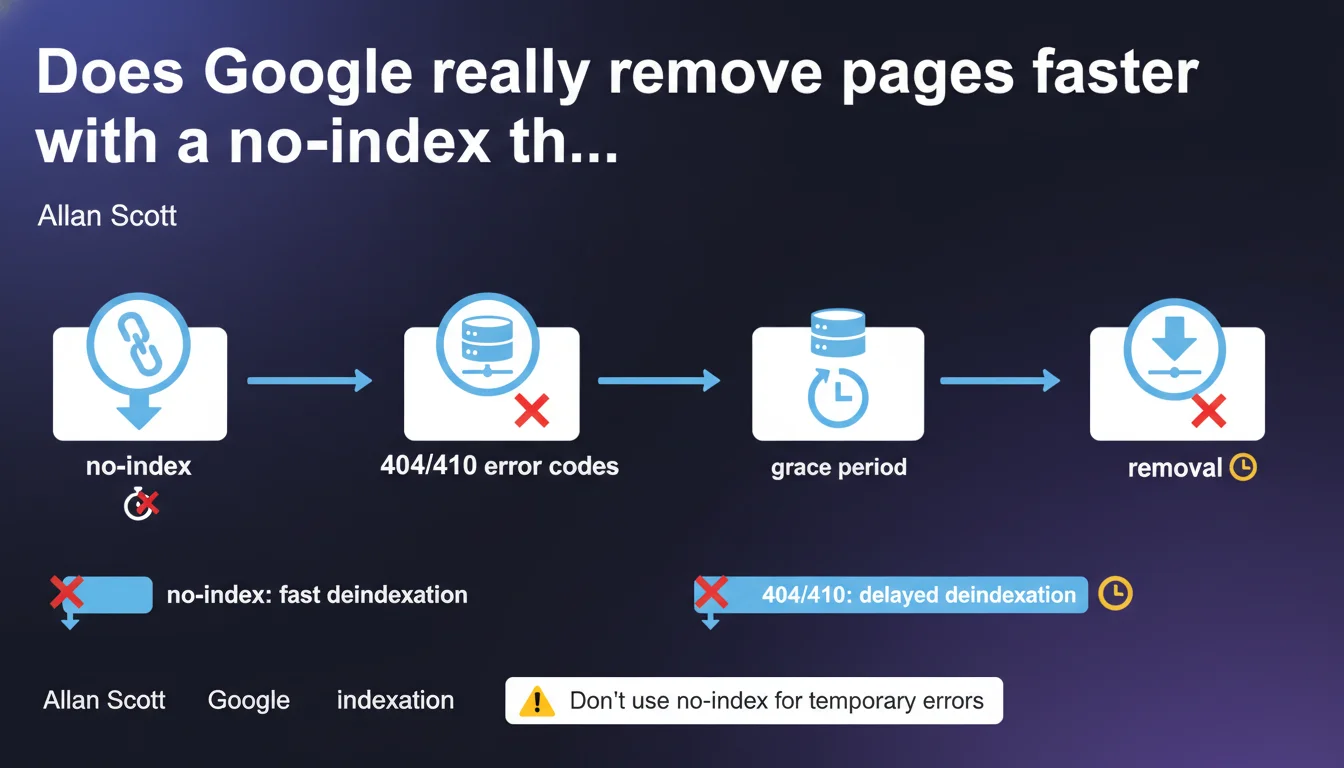
Google grants a grace period for HTTP error codes (404, 410, etc.) before deindexing a page in case the error is temporary. No-index, on the other hand, commands immediate removal from the index. Conclusion: never use no-index to handle temporary issues.
What you need to understand
What is the fundamental difference between an HTTP error and a no-index?
An HTTP error (404, 410, 503, etc.) signals to Google that a page is inaccessible. The search engine interprets this situation as potentially temporary — a server bug, maintenance work, incorrect configuration. It therefore grants a grace period before permanently removing the page from its index.
The no-index, on the other hand, is an explicit instruction: "This page should not appear in search results". No ambiguity. Google executes the order without waiting.
How long does this grace period last for HTTP errors?
Google doesn't communicate a precise duration. Field observations show that it varies according to several factors: page authority, site crawl frequency, type of error (a 503 generally benefits from a longer delay than a 410).
Some experts speak of anywhere from a few days to several weeks. [To verify]: no official data quantifies this period. What we know for certain is that it exists — unlike no-index which acts immediately.
Why does Google make this distinction?
Let's be honest: the web is unstable. Sites go down, servers crash, DNS configs get messed up. If Google instantly deindexed every page returning an error, the index would be a permanent battlefield.
No-index, on the other hand, is a matter of deliberate editorial decision. A webmaster placing a no-index knows what they're doing — or should. Google has no reason to moderate this instruction.
- HTTP errors benefit from a variable grace period (days to weeks)
- No-index commands immediate removal from the index
- Never confuse a temporary signal (error) with an editorial instruction (no-index)
- The grace period protects against technical accidents, not human errors
SEO Expert opinion
Is this statement consistent with practices observed in the field?
Yes, and it's actually one of the rare Google communications that perfectly aligns with reality. SEO audits confirm this behavior: a page placed on no-index disappears from SERPs within a few days maximum, often at the next crawl.
404 errors, on the other hand, sometimes persist in the index for weeks — especially if the page had authority or backlinks. Google Search Console also displays these URLs as "Excluded" with explicit mention of the processing delay.
In what cases can this rule cause problems?
The classic trap: a site going into temporary maintenance and applying a global no-index instead of a 503. Result? Complete deindexation. Recovery is long and painful, even after removing the no-index.
Another tricky scenario: migrations where an old site stays online "just in case". If someone places a no-index to "avoid duplicate", pages disappear before the migration is even stabilized. This is where a 410 would have left time to fix missing redirects.
What is the limitation of this statement?
Allan Scott doesn't specify whether the grace period varies by HTTP error type. A 503 (temporary by definition) should logically receive more lenient treatment than a 410 (permanent deletion). [To verify]: no official data quantifies these differences.
Similarly, nothing about the impact of related signals — could a continuous flow of backlinks to a 404 page extend the grace period? Field observations suggest yes, but Google remains unclear on this point.
Practical impact and recommendations
What should you concretely do to manage page removals?
For a permanent deletion: use a 410 Gone. This is the clearest signal. The page will disappear from the index with the usual grace period, giving you time to fix any missing redirects.
For temporary unavailability: serve a 503 Service Unavailable with a Retry-After header. Google will respect this delay and return to crawl later. Above all, never touch the no-index in this case.
What mistakes should you absolutely avoid?
Never place a no-index to temporarily hide content. Typical examples: seasonal pages, out-of-stock products, content under revision. Always prefer a server solution (503) or application-level solution (CSS/JS masking on the client side if the content needs to remain crawlable).
Beware of tools that add a no-index "for safety" — some builders, themes, or plugins do this by default on staging environments. If you clone that environment to production without checking, it's a disaster.
How do I audit and secure my site on this point?
- Crawl your site with Screaming Frog or Oncrawl to detect any unexpected no-index
- Verify that your maintenance mode returns a 503, never a no-index
- Set up a Search Console alert for sudden drops in indexation
- Document your HTTP error management strategy in an internal wiki
- Test maintenance scenarios on a staging environment before deployment
- Automate verification of robots.txt and meta robots tags in your CI/CD pipeline
❓ Frequently Asked Questions
Puis-je utiliser un no-index pour retirer temporairement une page des résultats de recherche ?
Combien de temps faut-il pour qu'une page en no-index disparaisse de l'index ?
Une page 404 reste-t-elle indéfiniment dans l'index si elle a beaucoup de backlinks ?
Quelle erreur HTTP dois-je utiliser pour une suppression définitive de page ?
Que faire si j'ai accidentellement posé un no-index sur tout mon site ?
🎥 From the same video 15
Other SEO insights extracted from this same Google Search Central video · published on 05/12/2024
🎥 Watch the full video on YouTube →
💬 Comments (0)
Be the first to comment.