
Official statement
Other statements from this video 15 ▾
- □ Does Google really juggle 40 different signals to pick the right canonical URL?
- □ Does Google really treat clustering and canonicalization as two separate processes, or is it all just one mechanism?
- □ Does rel canonical really play a dual role in Google's algorithm?
- □ What happens when your canonicalization signals contradict each other?
- □ Does Google actually prioritize HTTPS in search results, or does it depend on other factors?
- □ Is your redirect chain preventing Google from choosing the HTTPS version as canonical?
- □ Does Google really treat boilerplate translations and full content translations in completely different ways?
- □ Does hreflang really work independently from duplicate content clustering?
- □ Is x-default really functioning as a canonical signal like the others?
- □ Do 200 Error Pages Really Create Clustering Black Holes?
- □ Are soft 404 pages really the only ones creating problematic clusters in your index?
- □ Can a clear error message really save your crawl budget from clustering disasters?
- □ Does Google really handle JavaScript redirects to error pages correctly through clustering?
- □ Does Google really remove pages faster with a no-index than with a 404 or 410 error code?
- □ Can an empty rel canonical really wipe your entire site from Google's index?
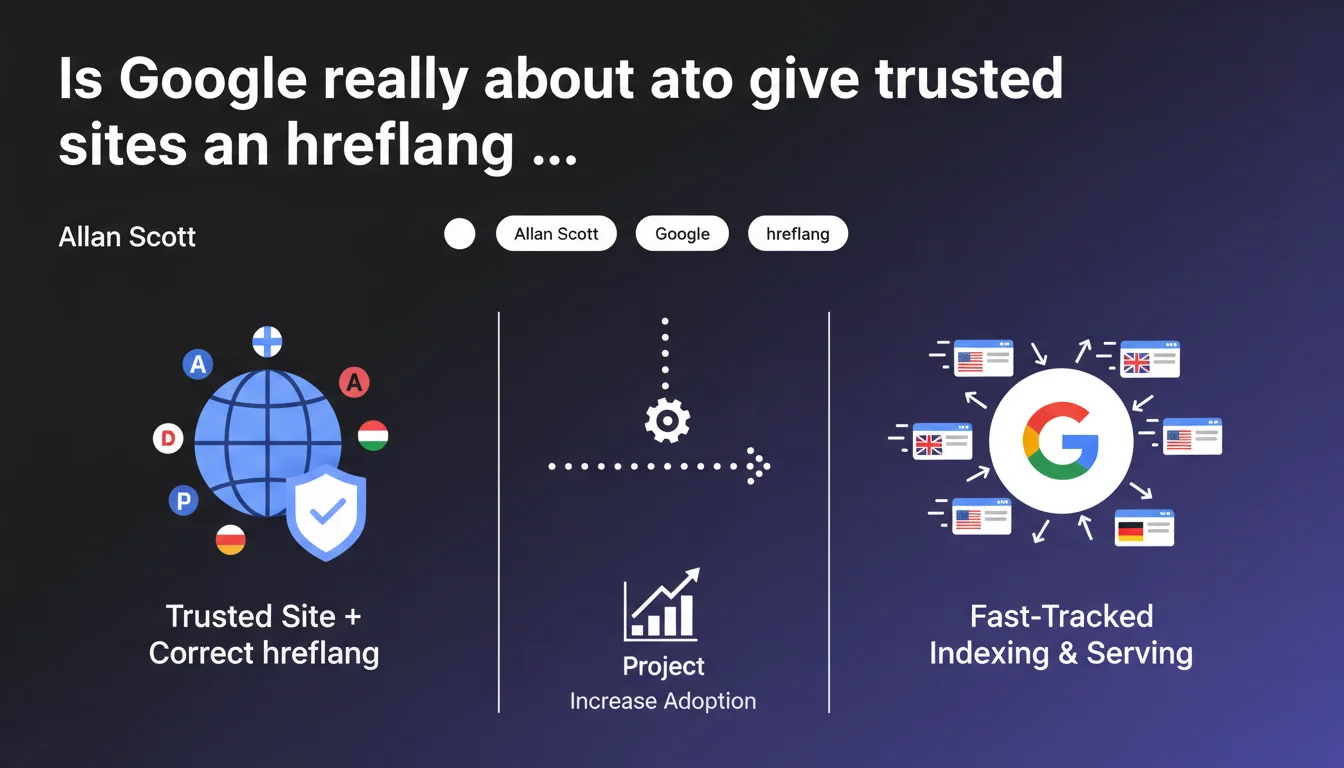
Google is rolling out a trust-based system for hreflang: sites implementing it correctly will have their language variants served more frequently without constant verification. The search engine will grant a form of "credit" to reliable domains, reducing the technical processing burden on Google's side.
What you need to understand
What exactly changes with this hreflang evolution?
Until now, Google systematically verified the consistency of hreflang annotations on every crawl. This process is resource-intensive — both for the search engine and for servers hosting multilingual sites.
With this improvement, Google is introducing a notion of historical reliability. If your hreflang implementation follows the rules over time, the engine can decide to serve your variants without systematic validation. Translation: lower latency, faster responsiveness in displaying the correct language versions.
What does Google mean by site "reliability"?
The announcement remains vague about specific criteria. We can assume it's about technical compliance history: correct reciprocal annotations, absence of pointing errors, stability of declared URLs.
Probably also a matter of consistency over time. A site that constantly changes its multilingual structure or multiplies hreflang errors won't inspire confidence. Google seems to want to reward domains that play by the rules properly.
Why is Google announcing this change now?
Crawl resource optimization. Google crawls billions of pages daily, and systematic hreflang verification unnecessarily mobilizes computing resources on sites that do things correctly.
It's also a way to push publishers to better structure their implementations. If you benefit from privileged treatment by being clean, you have every incentive to invest in technical quality.
- Google is introducing a progressive trust system based on hreflang implementation history
- Reliable sites will see their language variants served faster and more often
- Fewer verifications = crawl budget better used for other pages
- The exact criteria for "reliability" remain undocumented — probably a mix of technical compliance and temporal stability
- This evolution favors well-structured multilingual sites and indirectly penalizes approximate implementations
SEO Expert opinion
Is this announcement consistent with what we observe in the field?
Yes and no. On large multilingual sites, we do observe variable delays in how hreflang annotations are processed. Some domains see their new language versions indexed in days, others wait weeks.
What's missing is transparency about thresholds. How many errors do you need before losing your "reliable site" status? What's the observation window — 3 months, 6 months, a year? Google doesn't say. [Needs verification]
What risks does this evolution pose for multilingual sites?
The main danger is the ratchet effect. If your site loses its trust status due to a poorly managed redesign or temporary bug, how long to recover it? No indication given.
Another point: this "technical reputation" logic can create a gap between large and small players. An established site with years of history, even with some rough edges, might benefit from favorable inertia. A new multilingual site will have to prove its reliability — how long that takes, we don't know.
In what cases probably doesn't this rule apply?
Hard to say precisely, but we can imagine that new sites and domains with a history of repeated errors will remain under systematic verification. Google doesn't specify if there's a minimum maturity threshold.
Similarly, sites that change structure frequently — adding/removing languages, URL restructuring — might never reach "reliable" status. Stability seems to be an implicit criterion.
Practical impact and recommendations
What concretely should you do to benefit from this improvement?
First, audit your current hreflang implementation. Are all annotations reciprocal? Do the URLs pointed to actually return to active, relevant pages? Use Search Console to spot errors reported by Google.
Next, stabilize your multilingual structure. Avoid frequent URL changes, language removals without proper redirects, inconsistencies between XML sitemap and on-page annotations.
Test regularly with tools like hreflang Tags Testing Tool or crawlers (Screaming Frog, OnCrawl) to catch breaks before Google reports them.
What errors must you absolutely avoid?
Never declare a language you don't actually offer. This is a classic mistake: a site declares "en-us" when it only has a generic "en" version. Google detects the inconsistency and loses trust.
Avoid incomplete hreflang chains. If your FR page points to EN, DE, ES, each of those pages must point to the three others + itself. A single missing annotation, and the entire chain becomes suspect.
Also watch out for redirects. If a URL declared in hreflang redirects to another, Google may consider the annotation unreliable. Always point to the final canonical URL.
- Check strict reciprocity of all hreflang annotations
- Ensure each declared URL returns a 200 code (no 301, 404, 5xx)
- Use absolute, canonical URLs in hreflang tags
- Integrate hreflang into XML sitemap plus HTML to aid discovery
- Monitor Search Console monthly to detect new errors
- Document your multilingual structure to prevent regressions during redesigns
- Test after each major deployment with a full crawl
This Google evolution rewards technical rigor. Well-structured multilingual sites will gain visibility and faster indexing responsiveness. Conversely, approximate implementations risk remaining under permanent scrutiny, with negative impact on international SEO performance.
The complexity of hreflang configurations — especially on sites with hundreds of pages and multiple languages — makes these optimizations tricky. A professional audit and tailored support from a specialized SEO agency can make the difference between rapid visibility gains and months of indexing latency.
❓ Frequently Asked Questions
Comment savoir si mon site bénéficie déjà du statut de confiance hreflang ?
Une erreur hreflang temporaire peut-elle me faire perdre le statut de fiabilité ?
Faut-il privilégier hreflang en HTML ou dans le sitemap XML ?
Le hreflang influence-t-il directement le classement dans les SERP ?
Que faire si mon site multilingue a un historique d'erreurs hreflang ?
🎥 From the same video 15
Other SEO insights extracted from this same Google Search Central video · published on 05/12/2024
🎥 Watch the full video on YouTube →
💬 Comments (0)
Be the first to comment.