
Official statement
What you need to understand
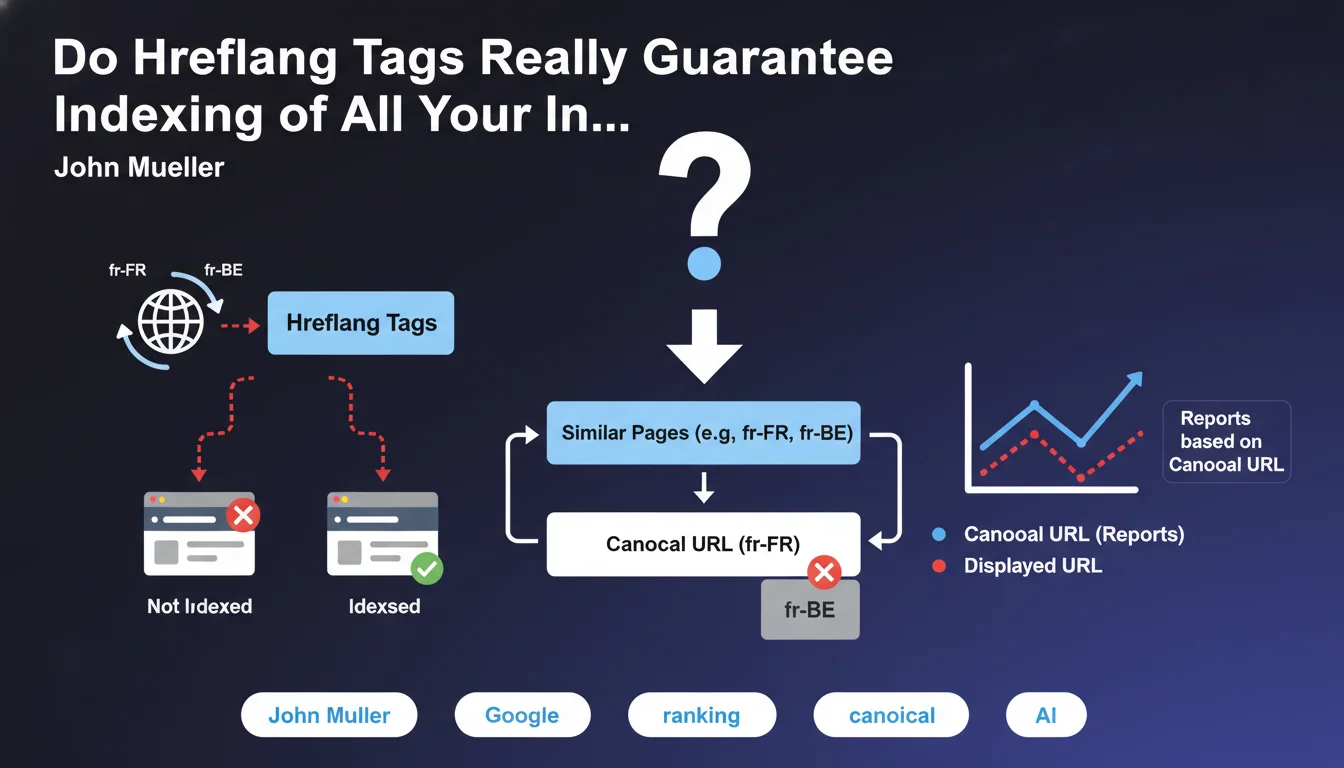
Hreflang tags are often perceived as a magic solution for managing multilingual and multi-regional websites. However, their primary role is to indicate to Google which version of a page to display to which user based on their language and location.
These tags do not force the indexing of all linguistic or regional variants. Google retains its freedom to decide which pages to index, based on numerous criteria such as quality, relevance, and content similarity.
The search engine adopts a pragmatic approach: when two variants are very similar (such as fr-FR and fr-BE with nearly identical content), it often selects a single canonical version to simplify its index. The displayed URL may change depending on the user's location, but internally, Google processes everything through the canonical version.
- Hreflang is a targeting signal, not an indexing guarantee
- Very similar variants are often consolidated onto a single canonical URL
- The displayed URL may differ from the indexed URL in Search Console reports
- Google prioritizes simplifying its index for content in the same language
SEO Expert opinion
This clarification is perfectly consistent with what we've been observing in the field for years. Many international websites discover with surprise that certain regional variants never appear in the index, despite correct hreflang implementation.
The important nuance concerns the degree of content differentiation. If your fr-FR and fr-BE pages are 95% identical, Google will indeed treat them as duplicates. However, if the content presents substantial differences (cultural references, currencies, local regulations, specific vocabulary), the chances of multiple indexing increase significantly.
The implication for reporting is crucial: in Search Console, you will see data consolidated on the canonical URL, even if users see the localized URL. This complicates performance analysis by market and requires a different reporting approach.
Practical impact and recommendations
- Audit your regional variants to assess their actual degree of differentiation - if the content is nearly identical, accept that only one version will be indexed
- Substantially differentiate your regional content if you want multiple indexing: add local references, adapt vocabulary, include market-specific information
- Don't multiply variants fr-FR, fr-BE, fr-CH, fr-CA if the content remains identical - favor a generic fr version with geographic targeting via Search Console
- Check your canonicals: ensure they are self-referential on each linguistic variant, not crossed between regional variants
- Adapt your reporting: use canonical URL data as a reference and supplement with Analytics for actual market tracking
- Prioritize different language pairs rather than regional variants if your resources are limited
- Test actual indexing with targeted site: searches and document which variants are actually present in the index
💬 Comments (0)
Be the first to comment.