
Official statement
Other statements from this video 15 ▾
- □ Does Google really juggle 40 different signals to pick the right canonical URL?
- □ Does Google really treat clustering and canonicalization as two separate processes, or is it all just one mechanism?
- □ Does rel canonical really play a dual role in Google's algorithm?
- □ What happens when your canonicalization signals contradict each other?
- □ Is your redirect chain preventing Google from choosing the HTTPS version as canonical?
- □ Does Google really treat boilerplate translations and full content translations in completely different ways?
- □ Does hreflang really work independently from duplicate content clustering?
- □ Is Google really about to give trusted sites an hreflang fast-track to indexing?
- □ Is x-default really functioning as a canonical signal like the others?
- □ Do 200 Error Pages Really Create Clustering Black Holes?
- □ Are soft 404 pages really the only ones creating problematic clusters in your index?
- □ Can a clear error message really save your crawl budget from clustering disasters?
- □ Does Google really handle JavaScript redirects to error pages correctly through clustering?
- □ Does Google really remove pages faster with a no-index than with a 404 or 410 error code?
- □ Can an empty rel canonical really wipe your entire site from Google's index?
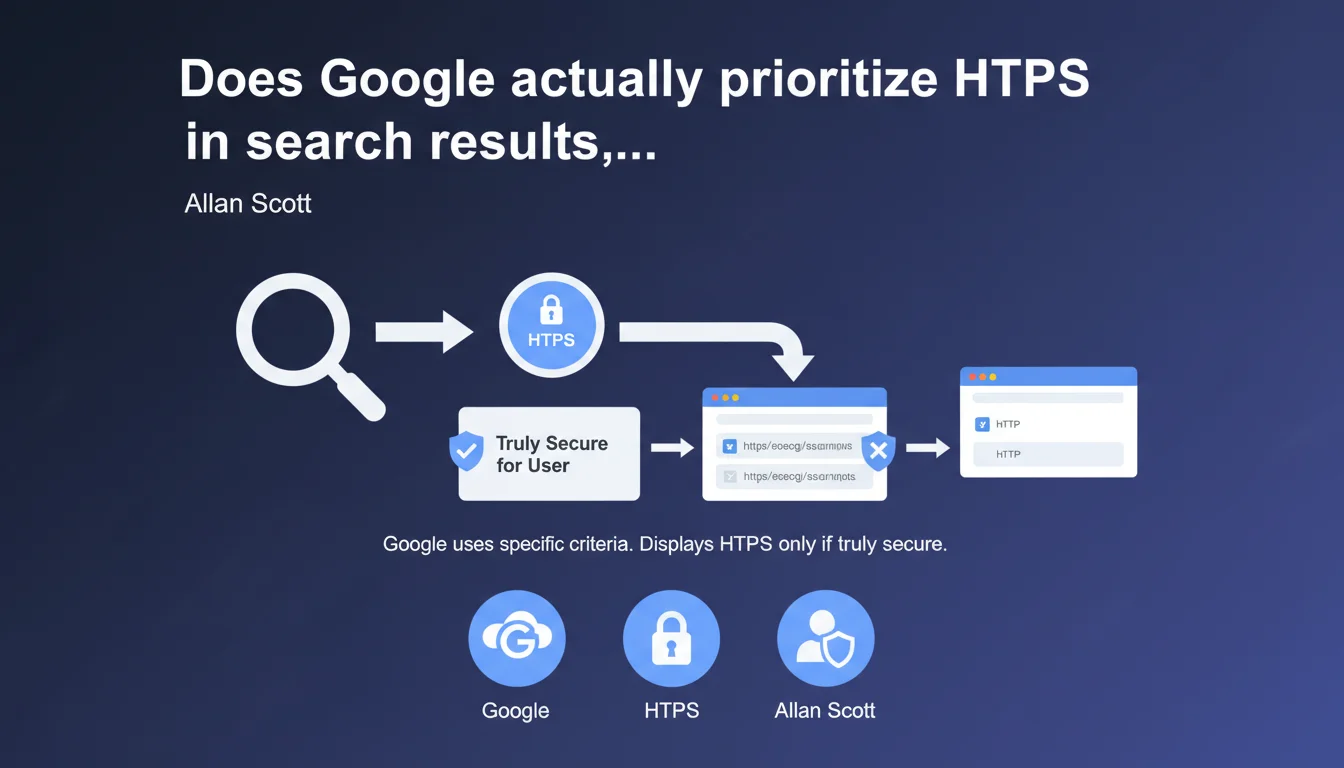
Google doesn't automatically display the HTTPS version of a page in its results. The search engine applies specific canonicalization criteria to assess whether the secure version is truly reliable before favoring it. A site can therefore see its HTTP version indexed even if HTTPS exists, if the latter doesn't meet Google's security requirements.
What you need to understand
Why doesn't Google automatically prioritize HTTPS?
Contrary to what many believe, migrating to HTTPS doesn't guarantee that Google will index this version. The search engine first examines whether the SSL certificate is valid, whether the page loads correctly in HTTPS, and whether it doesn't send contradictory signals.
Google crosses multiple canonicalization criteria — redirects, canonical tags, sitemaps, internal links — to determine which URL to display. If these signals point to HTTP or if HTTPS presents technical issues, the non-secure version may remain the one indexed.
What makes an HTTPS page "truly secure" for Google?
Google doesn't settle for an active SSL certificate. The search engine verifies that all page resources — images, scripts, CSS — are loaded via HTTPS. If mixed content (HTTP/HTTPS) persists, the page is not considered fully secure.
Certificate errors, redirect loops, or HTTPS versions inaccessible to crawling result in a fallback to HTTP in search results. This is a protection for the end user, not an algorithmic whim.
What are the canonicalization criteria at stake?
- 301/302 redirects: if HTTP redirects to HTTPS, it's a strong signal — but not sufficient alone
- Canonical tags: must point to the HTTPS version from all page variants
- XML sitemaps: should only list HTTPS URLs if that's the preferred version
- Internal links: massive linking in HTTP dilutes the canonicalization signal toward HTTPS
- Hreflang and alternative tags: must also reference only HTTPS
- Technical quality of HTTPS: valid certificate, no mixed content, equal or better load time
SEO Expert opinion
Is this statement consistent with field observations?
Completely. We regularly observe sites migrated to HTTPS that continue to have their HTTP version indexed for weeks, even months. Google doesn't switch by magic — it waits for signals to converge.
The problem is that many HTTPS migrations are poorly executed: missing redirects on certain URLs, forgotten canonical tags, sitemaps never updated. Google then legitimately hesitates about which version to favor. Allan Scott makes this point well: actual user security is what matters, not just the existence of a certificate.
What nuances should be added to this statement?
Google remains vague about the exact weight of each criterion. We know that permanent 301 redirects are a major signal, but if the rest of the site continues to internally link to HTTP, that contradicts this signal. [To verify]: Google has never communicated a precise timeline for how long an HTTPS migration takes to be fully processed.
Another critical point: not all SSL certificates are equal. A self-signed or expired certificate completely nullifies the HTTPS benefit. Google can even temporarily deindex the HTTPS version if it generates security errors in Chrome, then revert to HTTP by default.
In what cases doesn't this rule apply strictly?
On sites with few pages and few external links, Google can switch quickly to HTTPS if all signals are coherent. Conversely, on a large site with millions of pages and mixed historical backlinks (HTTP/HTTPS), canonicalization can drag on.
Practical impact and recommendations
What should you check immediately on your HTTPS site?
First, scan your site to identify any mixed content. A single image loaded via HTTP on an HTTPS page is enough to trigger a security warning in the browser, which can negatively influence Google.
Next, verify that all HTTP → HTTPS redirects are properly in place and permanent (301). Test multiple URLs: homepage, deep pages, URLs with parameters. A missing or 302 redirect sends an ambiguous signal.
How do you ensure Google indexes the HTTPS version properly?
Inspect your URLs in Google Search Console to see which version is considered canonical. If you still see HTTP URLs indexed while HTTPS has been active for several weeks, dig deeper: contradictory canonical tags, outdated sitemaps, internal links pointing to HTTP.
Also enforce the HTTPS property in Search Console and submit an XML sitemap containing only HTTPS URLs. This is an additional signal to accelerate the switch.
What mistakes should you absolutely avoid?
- Never leave HTTP and HTTPS coexisting without redirects — Google will choose for you, often incorrectly
- Don't forget to update internal canonical tags to HTTPS
- Avoid redirect chains (HTTP → www HTTPS → HTTPS without www) that slow down crawling and dilute the signal
- Don't neglect backlinks: if possible, ask third-party sites to link directly to HTTPS
- Verify that the SSL certificate covers all domain variants (www, non-www, subdomains)
- Test HTTPS performance: if the secure version is significantly slower, it can work against you
Summary: Google only switches to HTTPS if this version is technically flawless and all canonicalization signals converge. A poorly executed HTTPS migration can harm SEO rather than improve it.
These technical checks require careful monitoring and deep knowledge of Google's crawling mechanisms. If you lack time or internal resources, it may be wise to get support from a specialized SEO agency that masters these canonicalization issues and can thoroughly audit your HTTPS migration.
❓ Frequently Asked Questions
Google peut-il indexer HTTP même si j'ai un certificat SSL actif ?
Combien de temps faut-il pour que Google bascule complètement vers HTTPS après une migration ?
Est-ce que le passage à HTTPS améliore automatiquement le ranking ?
Que faire si Google indexe à la fois HTTP et HTTPS de mes pages ?
Le contenu mixte bloque-t-il complètement l'indexation HTTPS ?
🎥 From the same video 15
Other SEO insights extracted from this same Google Search Central video · published on 05/12/2024
🎥 Watch the full video on YouTube →
💬 Comments (0)
Be the first to comment.