
Official statement
Other statements from this video 15 ▾
- □ Does Google really juggle 40 different signals to pick the right canonical URL?
- □ Does Google really treat clustering and canonicalization as two separate processes, or is it all just one mechanism?
- □ Does rel canonical really play a dual role in Google's algorithm?
- □ What happens when your canonicalization signals contradict each other?
- □ Does Google actually prioritize HTTPS in search results, or does it depend on other factors?
- □ Is your redirect chain preventing Google from choosing the HTTPS version as canonical?
- □ Does Google really treat boilerplate translations and full content translations in completely different ways?
- □ Does hreflang really work independently from duplicate content clustering?
- □ Is Google really about to give trusted sites an hreflang fast-track to indexing?
- □ Is x-default really functioning as a canonical signal like the others?
- □ Do 200 Error Pages Really Create Clustering Black Holes?
- □ Are soft 404 pages really the only ones creating problematic clusters in your index?
- □ Can a clear error message really save your crawl budget from clustering disasters?
- □ Does Google really handle JavaScript redirects to error pages correctly through clustering?
- □ Does Google really remove pages faster with a no-index than with a 404 or 410 error code?
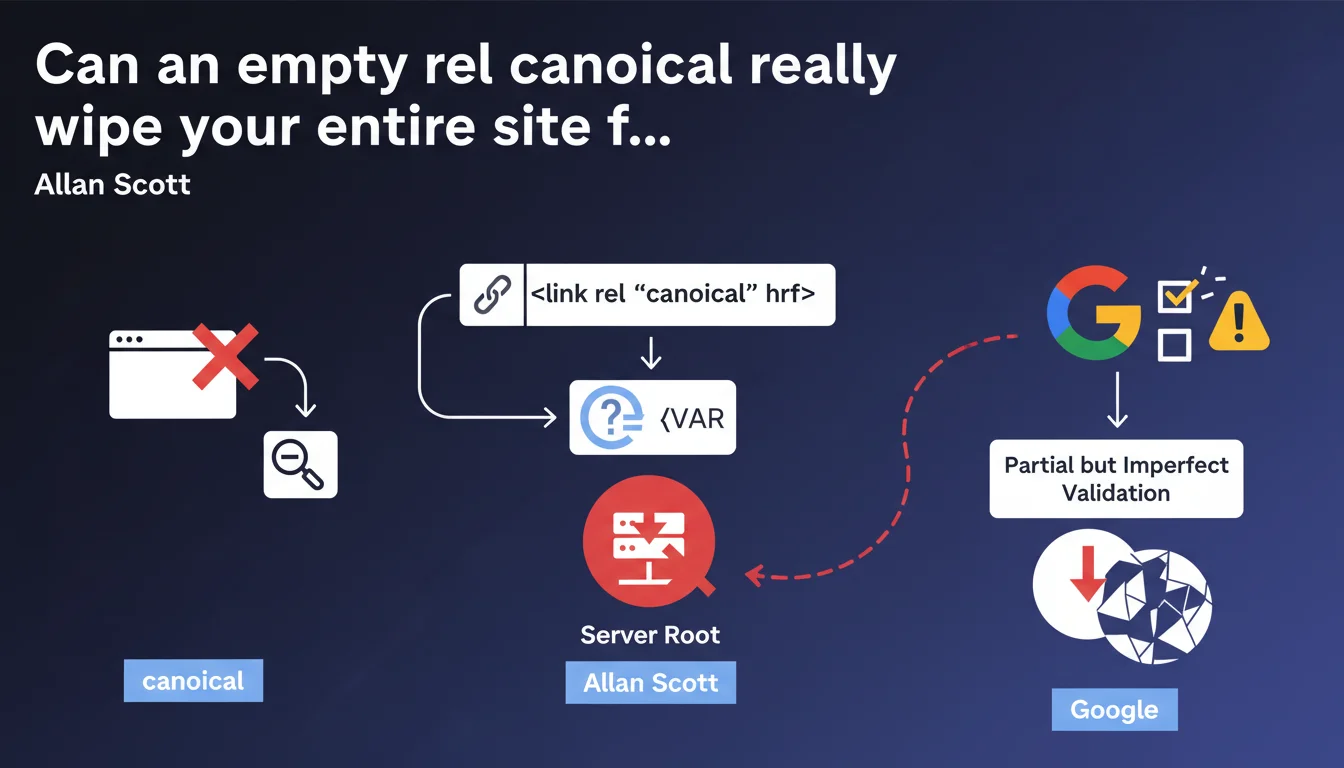
An empty rel canonical attribute or one containing an unevaluated variable can be interpreted by Google as pointing to the server root — effectively requesting complete site deindexation. Google has validation in place but it remains imperfect, exposing sites to real risk in case of technical errors or poor implementation.
What you need to understand
How can an empty canonical tag become an existential risk for your indexation?
The rel canonical tells Google which version of a page should be considered the reference. When this tag is empty (<link rel="canonical" href="" />) or contains an unevaluated variable (for example href="{{canonical_url}}" if the template breaks), Google can interpret it as a relative path pointing to the server root.
In practice? Every page on your site then declares that the canonical page is the homepage. Worse, in some implementation cases, this can be read as a request for complete consolidation toward the root — which amounts to telling Google: « All of this site should be replaced by this single root URL. » The rest becomes a candidate for deindexation.
Does Google validate these tags before applying them?
Allan Scott clarifies that Google has partial validation on these tags — but it is imperfect. In other words, the search engine does not systematically detect critical errors of this type before interpreting them. This means that a templating error, a CMS bug, or poor manipulation can slip through the cracks and trigger an indexation disaster.
Sites that dynamically generate their canonical tags (via PHP, server-side JavaScript, or frameworks like React/Next.js) are particularly exposed. A single undefined variable or misconfigured fallback is enough to create the problem.
What are the concrete scenarios where this risk materializes?
- A rushed production deployment where a configuration variable was not defined in the production environment
- A templating bug following a CMS or SEO plugin update (Yoast, Rank Math, etc.)
- Poor CDN configuration that strips certain environment variables needed to render the canonical tags
- A progressive rollout (A/B test, feature flag) that failed to properly propagate canonical values across all versions
- A human error during a redesign where a developer left a hardcoded
href=""in a global template
SEO Expert opinion
Is this statement consistent with field observations?
Yes — and it's not the first time a canonical error has caused massive deindexation. I've personally witnessed several cases where e-commerce sites lost 70 to 90% of their indexed pages within days due to such a bug. Google follows canonical directives very literally, especially when they are present consistently across the entire site.
The fact that Google admits its validation is « imperfect » is telling. It confirms what we observe in the field: the search engine trusts canonical tags even when they are aberrant, as long as they are technically well-formed. An empty href="" is valid HTML — it's a relative path — so Google interprets it.
Why doesn't Google systematically detect these errors?
Because distinguishing an accidental error from an intentional directive is complex at web scale. Google cannot guess whether an empty canonical is a bug or a (questionable) webmaster intention. The search engine therefore prioritizes strict enforcement of directives over interpretation.
[To verify]: Allan Scott does not specify whether Google has improved its safeguards since this statement, nor whether there is an alert mechanism in Search Console to flag suspicious canonicals. Without confirmation, we must assume that this flaw remains exploitable by accident.
In what cases does this rule not apply?
If your site uses absolute canonicals hardcoded (e.g. href="https://example.com/page") rather than relative paths or variables, the risk is virtually zero. Similarly, if you don't use canonicals at all on certain pages, Google will apply its own heuristics — which is less dangerous than an explicitly wrong directive.
Practical impact and recommendations
What should you check first on your site?
First reflex: audit the HTML source code of your main pages and templates. Open Search Console, go to Coverage > Inspect URL, and check the HTML as Googlebot sees it. Specifically look for <link rel="canonical" tags and ensure they contain complete and valid URLs.
Next, use a crawler (Screaming Frog, OnCrawl, Sitebulb) to extract all canonical tags from your site. Filter for empty lines, null values, or suspicious patterns like {{ or {% that betray an unevaluated variable. If you find even a single occurrence, that's a red flag.
How do you secure your templates and code?
- Use absolute canonicals systematically (protocol + domain + path) rather than relative paths
- Implement automated tests (CI/CD) that verify the presence and validity of canonicals before every deployment
- Add robust fallbacks in your templates: if the canonical variable is empty, return the full URL of the current page
- Enable Search Console alerts to be notified quickly of any sudden drop in indexed pages
- Clearly document in your technical runbook how canonicals are generated and what variables are required
- Perform a post-deployment audit systematically on a sample of pages after every major production release
What errors should you absolutely avoid?
Never leave an empty href="" in a template, even temporarily. Never deploy to production without verifying that all required environment variables are defined. And above all, never assume that Google will ignore an aberrant canonical directive — it won't.
If you have any doubt about your technical stack (WordPress + custom SEO plugin, Next.js with SSR generation, Shopify with third-party app), run a complete regression test before any major deployment. A canonical bug can go unnoticed for days while Google recrawls and reindexes — and by then, the damage is done.
❓ Frequently Asked Questions
Google envoie-t-il une alerte dans la Search Console avant de désindexer massivement à cause d'un canonical vide ?
Un canonical vide sur quelques pages seulement peut-il affecter tout le site ?
Combien de temps faut-il pour récupérer d'une désindexation causée par un canonical vide ?
Les canonical en JavaScript sont-ils plus à risque ?
Faut-il supprimer complètement les balises canonical si on n'est pas sûr de leur implémentation ?
🎥 From the same video 15
Other SEO insights extracted from this same Google Search Central video · published on 05/12/2024
🎥 Watch the full video on YouTube →
💬 Comments (0)
Be the first to comment.