
Official statement
Other statements from this video 14 ▾
- □ La structure d'URL a-t-elle un impact sur l'efficacité du hreflang ?
- □ Les ccTLD ont-ils perdu leur valeur SEO pour le ciblage géographique ?
- □ Google peut-il vraiment cibler géographiquement chaque page individuellement ?
- □ Faut-il vraiment ignorer l'attribut lang HTML pour le SEO multilingue ?
- □ Google va-t-il enfin automatiser la détection des balises hreflang ?
- □ Pourquoi Google fait-il davantage confiance au hreflang qu'à l'attribut lang HTML ?
- □ Faut-il vraiment s'inquiéter du hreflang si seulement 9% des sites l'utilisent ?
- □ Faut-il abandonner le hreflang en sitemap au profit du HTML ou HTTP ?
- □ Hreflang déclenche-t-il automatiquement le crawl des URLs alternatives ?
- □ Faut-il vraiment inclure une balise hreflang auto-référencée sur chaque page ?
- □ Pourquoi vos pages hreflang disparaissent-elles de la Search Console sans être désindexées ?
- □ La balise hreflang x-default peut-elle pointer vers n'importe quelle page de votre site ?
- □ Hreflang suffit-il à gérer des pages quasi-identiques qui ne diffèrent que par la devise ou la TVA ?
- □ Pourquoi Google a-t-il abandonné son validateur hreflang officiel ?
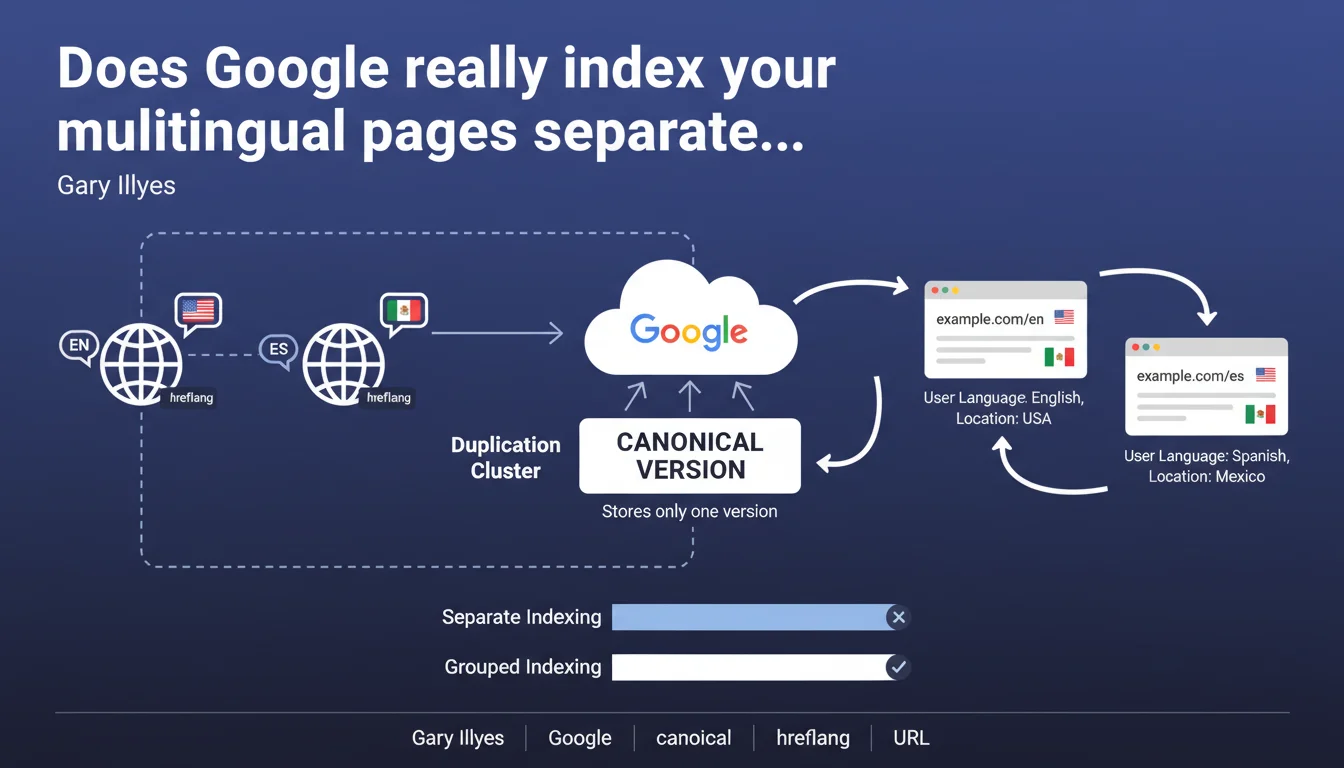
Google stores only a single canonical version of your multilingual pages, even with properly implemented hreflang. Alternative URLs are grouped into a duplication cluster and Google swaps the displayed URL based on the user's language and location. Your 10 language versions? Only one actually enters the index.
What you need to understand
Gary Illyes confirms here an internal Google operation that still surprises many professionals: hreflang does not create multiple indexed pages, but rather a system of URL substitution on the fly.
How exactly does Google handle pages with hreflang?
When you declare linguistic alternatives via hreflang, Google does not multiply your index entries. It groups all variants into a duplication cluster — exactly as it does with regular duplicate content.
Only one URL is stored as the canonical version. The others? They exist in Google's tables, but are not treated as distinct indexed entities.
What happens when a Japanese user searches for your content?
Google detects the searcher's language and location. If your cluster contains a Japanese version with hreflang="ja", it swaps the displayed URL in the search results — but it's still the same "index entry" that responds.
It's a display swap, not multiple indexing. A fundamental distinction.
Why is this distinction so important for SEO professionals?
Because it changes everything in how you measure indexation performance for your multilingual sites. If you think you have 8 indexed pages (one per language), you actually only have one in Google's tables.
- Hreflang does not multiply your indexed positions — it's a URL substitution signal
- Google stores a single canonical version per multilingual content cluster
- URL swapping happens at query time, based on detected language/location
- Your Search Console reports can display multiple URLs for the same content, but only one actually "counts" in the index
- Canonical conflicts between language versions become critical — they determine which URL is stored
SEO Expert opinion
Does this explanation match what we observe in the field?
Yes, largely. Audits of multilingual sites regularly show apparent inconsistencies in indexation counters — you see 3 versions displayed in SERPs depending on geo, but site:domain.com returns figures that don't align with a "one page = one entry" count.
Gary's statement clarifies why: because it's not one page = one entry. It's one cluster = one entry, with display swaps.
What gray areas remain in this statement?
[To verify] Gary doesn't specify how Google chooses the canonical version in the cluster. Is it based on canonical tags? On detection of the domain's primary language? On the volume of backlinks per version?
In practice, we observe that Google doesn't always respect the declared canonical in complex multilingual architectures. It can elect its own canonical version, sometimes contrary to your explicit signals.
[To verify] Another gray area: what happens when the content of language versions diverges substantially? Does Google maintain the cluster or start indexing separately?
What's the implication for complex multilingual strategies?
If you manage sites with 15+ languages, this statement means your effective crawl budget is distributed differently than you thought. Google doesn't necessarily crawl all your versions with the same intensity — it can focus on the canonical and periodically verify alternatives.
Concretely? Your updates on the Spanish version may take longer to be reflected in Spanish SERPs if Google considers the English version as the cluster's canonical.
Practical impact and recommendations
What should you verify immediately on your multilingual sites?
First step: identify which version Google considers canonical in each language cluster. Do a site: search from different geos and compare the URLs returned. Check in Search Console which URL Google actually indexes via the URL Inspection tool.
Second step: make sure your canonical tags are consistent with your hreflang strategy. If your FR version points a canonical to EN, but your hreflang declares FR as an alternative, you're creating a conflict that Google will resolve its way — rarely yours.
What implementation errors become critical with this model?
Redirect chains between language versions become toxic. If your hreflang points to a URL that redirects to another, Google can break the cluster or elect an unexpected canonical.
404 errors on hreflang alternatives are no longer just display bugs — they can destabilize your entire cluster and make you lose positions in certain geos.
How to optimize your architecture with this clustering logic?
Focus your link building and quality signals on the version you want elected as canonical. If Google stores only one version, you might as well make sure it's the one you chose.
Use multilingual sitemaps with hreflang annotations to help Google understand the cluster structure from initial crawl. Don't rely solely on in-page annotations.
- Audit canonical tags across all language versions — zero inconsistencies tolerated
- Verify that every hreflang alternative is accessible (200 OK) and doesn't redirect
- Identify the canonical version actually stored by Google (URL Inspection in Search Console)
- Eliminate redirect chains between language versions
- Test URL display from different geos (VPN + targeted searches)
- Monitor position fluctuations by geo — a canonical swap is immediately visible
- Document which version receives the most crawl in server logs
❓ Frequently Asked Questions
Si Google n'indexe qu'une version, pourquoi implémenter hreflang ?
Peut-on forcer Google à indexer toutes les versions linguistiques séparément ?
Comment savoir quelle version est stockée comme canonique ?
Les métriques Search Console sont-elles fiables pour les sites hreflang ?
Que se passe-t-il si deux versions linguistiques ont des canonical contradictoires ?
🎥 From the same video 14
Other SEO insights extracted from this same Google Search Central video · published on 25/07/2024
🎥 Watch the full video on YouTube →
💬 Comments (0)
Be the first to comment.