
Official statement
Other statements from this video 14 ▾
- □ La structure d'URL a-t-elle un impact sur l'efficacité du hreflang ?
- □ Les ccTLD ont-ils perdu leur valeur SEO pour le ciblage géographique ?
- □ Google peut-il vraiment cibler géographiquement chaque page individuellement ?
- □ Faut-il vraiment ignorer l'attribut lang HTML pour le SEO multilingue ?
- □ Google va-t-il enfin automatiser la détection des balises hreflang ?
- □ Pourquoi Google fait-il davantage confiance au hreflang qu'à l'attribut lang HTML ?
- □ Faut-il vraiment s'inquiéter du hreflang si seulement 9% des sites l'utilisent ?
- □ Faut-il abandonner le hreflang en sitemap au profit du HTML ou HTTP ?
- □ Hreflang déclenche-t-il automatiquement le crawl des URLs alternatives ?
- □ Faut-il vraiment inclure une balise hreflang auto-référencée sur chaque page ?
- □ Hreflang : pourquoi Google n'indexe-t-il pas vos pages alternatives séparément ?
- □ La balise hreflang x-default peut-elle pointer vers n'importe quelle page de votre site ?
- □ Hreflang suffit-il à gérer des pages quasi-identiques qui ne diffèrent que par la devise ou la TVA ?
- □ Pourquoi Google a-t-il abandonné son validateur hreflang officiel ?
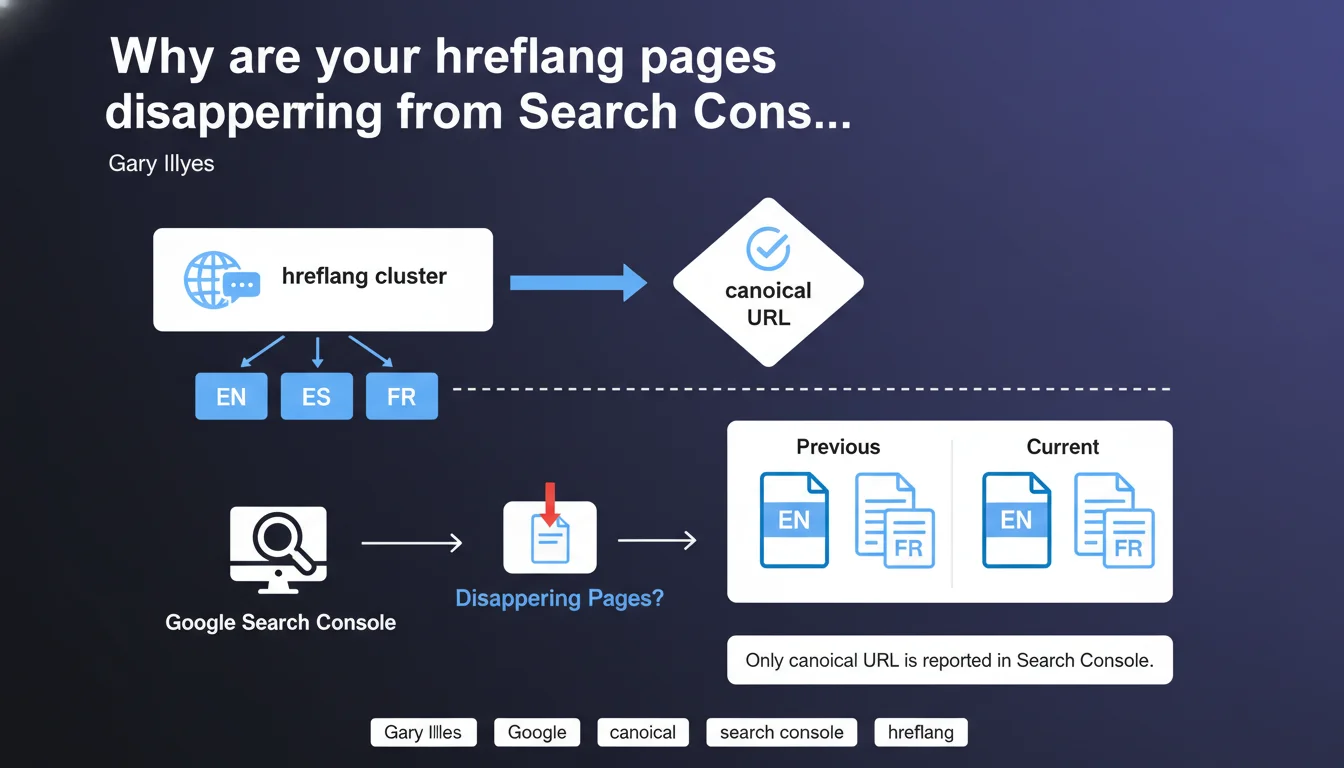
Google Search Console only surfaces data for canonical URLs within an hreflang cluster. Alternative language versions are not tracked individually, which creates a false impression of deindexation when a page loses or gains canonical status. In practice: if your /fr/ variant becomes an alternative in favor of /en/, it vanishes from the GSC report — but remains indexed.
What you need to understand
What is an hreflang cluster and how does Google handle it?
An hreflang cluster groups all language or regional variants of the same page. Google selects one URL as the canonical reference for this cluster — typically the one that best matches the primary market or original content language.
The other variants remain indexed and can serve users based on their language, but only the canonical appears in Search Console reports. This isn't a bug: it's an intentional reporting architecture choice that simplifies aggregated data.
Why do my pages seem to be dropping out of the index?
When a page shifts from canonical to alternative status within its cluster, it disappears from GSC coverage and performance reports. No notification is sent — the page simply vanishes from the statistics.
Conversely, if an alternative becomes canonical (due to structural changes, migration, or annotation adjustments), it suddenly appears in reports. This rotation creates false deindexation positives that alarm clients and teams.
What are the implications for performance tracking?
You cannot isolate the performance of your language variants in GSC if they are not canonical. The data is consolidated on the canonical, making the actual contribution of each version opaque.
- Impossible to track organic traffic individually for a /de/ or /es/ page if it's an alternative
- Indexing errors on a variant won't surface if it's not canonical
- Canonical rotation can skew click and impression trends month after month
- You must cross-reference GSC with Analytics to get a complete picture by language
SEO Expert opinion
Is this statement consistent with real-world observations?
Yes — and it explains behaviors that seemed illogical for years. I've seen dozens of multilingual sites where perfectly indexed /fr/ or /it/ pages (verifiable via site:) never appeared in GSC. The canonical rotation between variants was invisible, but very real.
The catch: Google doesn't explain why one variant becomes canonical over another. hreflang annotations are supposed to be symmetric and declarative, not normative. Yet in practice, certain languages systematically take precedence. [To verify]: What criteria determine the canonical in a properly configured cluster?
What nuances should be added?
Canonical status is not fixed. It can shift based on signals like the volume of inbound links to a variant, internal structure consistency, or even changes in hreflang annotations following a technical update.
A classic pitfall: if you have self-referencing canonical tags AND hreflang annotations, Google may arbitrate differently across pages. A minor inconsistency in linking structure or an hreflang syntax error is enough to flip the canonical — and thus empty your GSC reports for an entire language.
In what cases does this rule not apply?
If your language variants are on separate domains (e.g., example.fr, ejemplo.es), each GSC property reports its own data independently. No unified cluster, so no shared canonical issue.
Similarly, if you don't use hreflang annotations and treat each language as a separate silo, Google has no reason to group URLs into a cluster. But in that case, you lose the hreflang benefit for geographic targeting — rarely optimal.
Practical impact and recommendations
What concrete steps should you take to track all your variants?
Create a separate Search Console property per language or region if you use subdomains or subdirectories. Even if GSC only surfaces canonicals, you can at least identify which one is active at any given time.
Systematically cross-reference GSC with Google Analytics 4 (or your tracking tool) by segmenting by language. Organic traffic per URL will tell you whether a variant is actually receiving visits, even if it's absent from GSC.
How do you diagnose an unexpected canonical shift?
Use the URL Inspection Tool in GSC to manually check each variant. Google explicitly indicates which URL it considers canonical and why (user-declared, Google-selected, etc.).
Audit your hreflang annotations with a tool like Screaming Frog or Oncrawl. A syntax error, broken link, or hreflang loop can force Google to ignore your preferences and choose its own canonical.
What errors should you avoid at all costs?
- Never mix
canonicaltags andhreflangannotations in contradictory ways - Don't dismiss sudden page disappearances from GSC — verify if it's a canonical shift before panicking
- Don't rely solely on GSC data to drive a multilingual strategy
- Don't forget to declare hreflang annotations bidirectionally (each variant must point to all others)
- Don't neglect Analytics tracking by language — it's your safety net
Summary: Search Console hides non-canonical hreflang variants, creating false deindexation signals. Always cross-reference GSC with Analytics, regularly audit your hreflang annotations, and use URL Inspection to verify canonicals declared by Google. Rigorous tracking prevents false alarms and invisible visibility loss.
Managing a multilingual site with hreflang, canonicals, and multiple GSC properties can quickly become complex — especially when managing multiple markets. If you notice persistent inconsistencies or unexplained canonical shifts, it may be worth engaging an SEO-specialized agency for a thorough audit and personalized support. The stakes go beyond technical details: your international visibility is on the line.
❓ Frequently Asked Questions
Une page hreflang alternative peut-elle être indexée même si elle n'apparaît pas dans la Search Console ?
Comment savoir quelle variante est la canonique de mon cluster hreflang ?
Pourquoi ma variante /fr/ était canonique et ne l'est plus après une migration ?
Dois-je créer une propriété Search Console par langue ?
Les données de clics et impressions dans GSC incluent-elles toutes les variantes hreflang ?
🎥 From the same video 14
Other SEO insights extracted from this same Google Search Central video · published on 25/07/2024
🎥 Watch the full video on YouTube →
💬 Comments (0)
Be the first to comment.