
Official statement
Other statements from this video 14 ▾
- □ La structure d'URL a-t-elle un impact sur l'efficacité du hreflang ?
- □ Les ccTLD ont-ils perdu leur valeur SEO pour le ciblage géographique ?
- □ Google peut-il vraiment cibler géographiquement chaque page individuellement ?
- □ Faut-il vraiment ignorer l'attribut lang HTML pour le SEO multilingue ?
- □ Google va-t-il enfin automatiser la détection des balises hreflang ?
- □ Pourquoi Google fait-il davantage confiance au hreflang qu'à l'attribut lang HTML ?
- □ Faut-il vraiment s'inquiéter du hreflang si seulement 9% des sites l'utilisent ?
- □ Faut-il abandonner le hreflang en sitemap au profit du HTML ou HTTP ?
- □ Hreflang déclenche-t-il automatiquement le crawl des URLs alternatives ?
- □ Faut-il vraiment inclure une balise hreflang auto-référencée sur chaque page ?
- □ Hreflang : pourquoi Google n'indexe-t-il pas vos pages alternatives séparément ?
- □ Pourquoi vos pages hreflang disparaissent-elles de la Search Console sans être désindexées ?
- □ La balise hreflang x-default peut-elle pointer vers n'importe quelle page de votre site ?
- □ Hreflang suffit-il à gérer des pages quasi-identiques qui ne diffèrent que par la devise ou la TVA ?
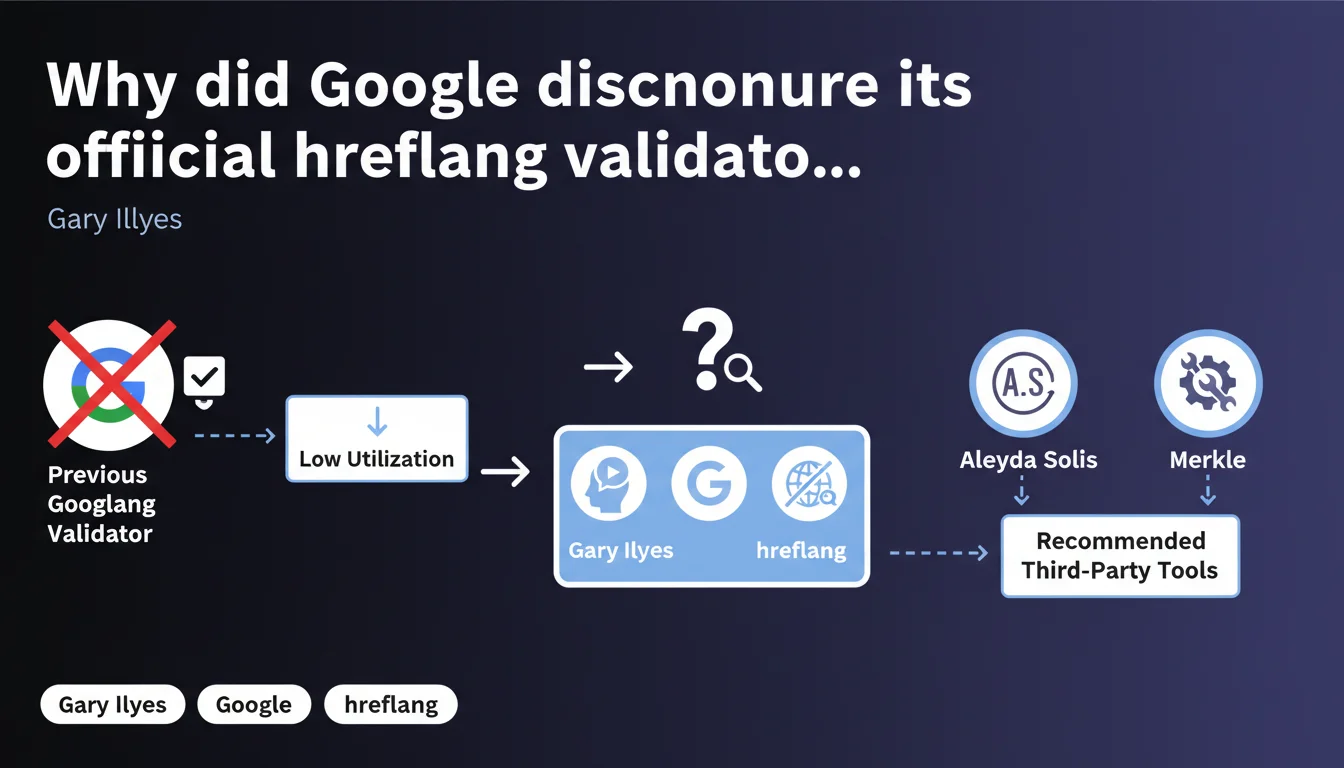
Google no longer provides an official hreflang validator. Previous validation tools were removed due to insufficient usage. The official recommendation? Turn to third-party tools like those from Aleyda Solis or Merkle to verify your hreflang tags.
What you need to understand
Did Google actually have an hreflang validator before?
Yes, and that's what makes this announcement interesting. Google had made available several tools that allowed you to validate hreflang tag syntax and detect configuration errors. These tools were integrated into the previous version of Google Search Console and allowed SEO professionals to quickly verify whether their multilingual or multi-regional implementations were correct.
The removal of these tools marks a gradual disengagement by Google from providing technical validation tools. This is consistent with other recent removals from Search Console — Google is focusing on performance data and delegating technical validation to third-party players.
What does this lack of official tool concretely mean?
First consequence: you no longer have an absolute reference to validate your hreflang implementations. Google refers you to third-party tools developed by recognized SEO experts, but without guarantees that these tools reflect exactly the validation criteria used internally by Googlebot.
Second aspect: the stated reason — low utilization — raises questions. Either SEOs were already predominantly using third-party tools, or the complexity of hreflang means that few sites implement it correctly. Either way, this confirms that hreflang remains a technical headache even for experienced professionals.
Which tools does Google explicitly recommend?
Gary Illyes specifically mentions two resources: the tools from Aleyda Solis (notably her Hreflang Tags Generator Tool) and those from Merkle (their Technical SEO Hreflang Tag Testing Tool). This is significant — Google publicly validates these third-party tools, which gives them a form of official legitimacy.
But let's be honest: there are dozens of other hreflang validators on the market. Screaming Frog, Sitebulb, OnCrawl, or even custom scripts developed internally by agencies. The specific mention of Aleyda and Merkle is probably due to their visibility in the SEO community and their proven reliability, but it's not an exhaustive list.
- Google no longer provides an official hreflang validator since the removal of previous Search Console tools
- The stated reason is low user adoption of these tools
- Google explicitly recommends the tools from Aleyda Solis and Merkle as alternatives
- This delegation to third-party tools is part of a broader trend of simplifying the Google ecosystem
- The absence of an official tool doesn't change Google's technical requirements for hreflang
SEO Expert opinion
Is this decision really justified by low utilization?
Frankly? It's debatable. Hreflang is one of the most complex technical implementations in international SEO, with a massive error rate even at major brands. Saying the tool was underutilized could mean two things: either Google poorly communicated its existence, or SEOs were already preferring more comprehensive third-party tools.
My interpretation: Google is rationalizing resources. Maintaining an up-to-date hreflang validator requires ongoing development, especially when specifications evolve (think of debates around x-default, regional variations, language-region codes). If third-party players are already doing the job effectively, why would Google bother?
Are the recommended third-party tools really reliable?
The tools from Aleyda Solis and Merkle are recognized in the industry, that's undeniable. But they have their limitations. No third-party tool has access to Googlebot's internal processing logic — they can only validate the syntax and logical consistency of hreflang tags.
Concretely? These tools detect obvious errors: duplicate tags, invalid language codes, lack of reciprocity, broken URLs. But they cannot guarantee that Google will correctly interpret your configuration in all edge cases. [To be verified] on complex sites with fine regional variations (fr-FR vs fr-BE vs fr-CA) or mixed configurations (hreflang in HTTP header + XML sitemap).
What if third-party tools give contradictory results?
That's where it gets tricky. I've seen cases where Screaming Frog flagged errors that Aleyda Solis ignored, or vice versa. When there's no absolute reference, how do you decide?
My recommendation: test with multiple tools, but most importantly validate under real conditions. Use the URL inspection tool in Search Console to verify that Google correctly detects your hreflang tags. Analyze international coverage reports. And if possible, conduct geographically targeted A/B tests to verify that the correct versions appear in the right countries.
Practical impact and recommendations
Which tool should you use now to validate hreflang?
Since Google explicitly recommends Aleyda Solis and Merkle, start there. Aleyda's tool is free and simple for generating and validating basic configurations. Merkle offers an effective online tester to verify the consistency of your tags across multiple URLs.
But don't stop there. Invest in a professional crawler like Screaming Frog, Sitebulb, or OnCrawl. These tools scan your entire site and detect hreflang errors at scale — essential if you manage hundreds or thousands of multilingual pages.
How can you ensure Google correctly interprets my hreflang tags?
Google Search Console is the only source of truth. Use the URL inspection tool and check the "Page alternatives" section. If your hreflang tags are correctly detected, they will appear there with the alternative URLs.
Second verification: analyze your performance by country in the Search Console "Performance" report, filtered by country. If you see British traffic on your French version (or vice-versa), it's probably an hreflang issue. Compare with your intentions: are the correct versions ranking in the correct countries?
What critical errors must you absolutely avoid?
First fatal error: lack of reciprocity. If the FR page points to the EN page with hreflang, the EN page must point back to the FR page. Google ignores non-reciprocal configurations.
Second pitfall: inconsistent language-region codes. Use "en-GB" for the United Kingdom, not "en-UK". Follow ISO 639-1 (language) and ISO 3166-1 Alpha 2 (region) standards. One code error and Google ignores the entire configuration.
- Use the tools recommended by Google (Aleyda Solis, Merkle) for initial validation
- Invest in a professional crawler to detect hreflang errors at site scale
- Verify detection by Googlebot via the Search Console URL inspection tool
- Monitor performance by country to identify potential international targeting issues
- Ensure absolute reciprocity between all URLs with hreflang
- Use standard language-region codes (ISO 639-1 and ISO 3166-1 Alpha 2)
- Test regularly, especially after redesigns or site migrations
- Document your hreflang configuration to facilitate future audits
The absence of an official validator doesn't change Google's technical requirements for hreflang. You must still follow syntax rules, ensure reciprocity, and regularly verify your implementations. The difference? You are now entirely dependent on third-party tools for initial validation.
Hreflang remains one of the most technical SEO projects, with direct business implications for international traffic. If you manage a complex multilingual or multi-regional site, these configurations require specialized expertise and ongoing monitoring. In this context, relying on a specialized SEO agency may prove wise — not just for initial audit and implementation, but also for continuous monitoring and rapid resolution of international targeting issues.
❓ Frequently Asked Questions
Google va-t-il réintroduire un validateur hreflang officiel ?
Les outils recommandés par Google sont-ils les seuls fiables ?
Peut-on faire confiance à 100% aux validateurs tiers ?
Que faire si Search Console ne détecte pas mes balises hreflang ?
Les erreurs hreflang impactent-elles directement le ranking ?
🎥 From the same video 14
Other SEO insights extracted from this same Google Search Central video · published on 25/07/2024
🎥 Watch the full video on YouTube →
💬 Comments (0)
Be the first to comment.