
Official statement
What you need to understand
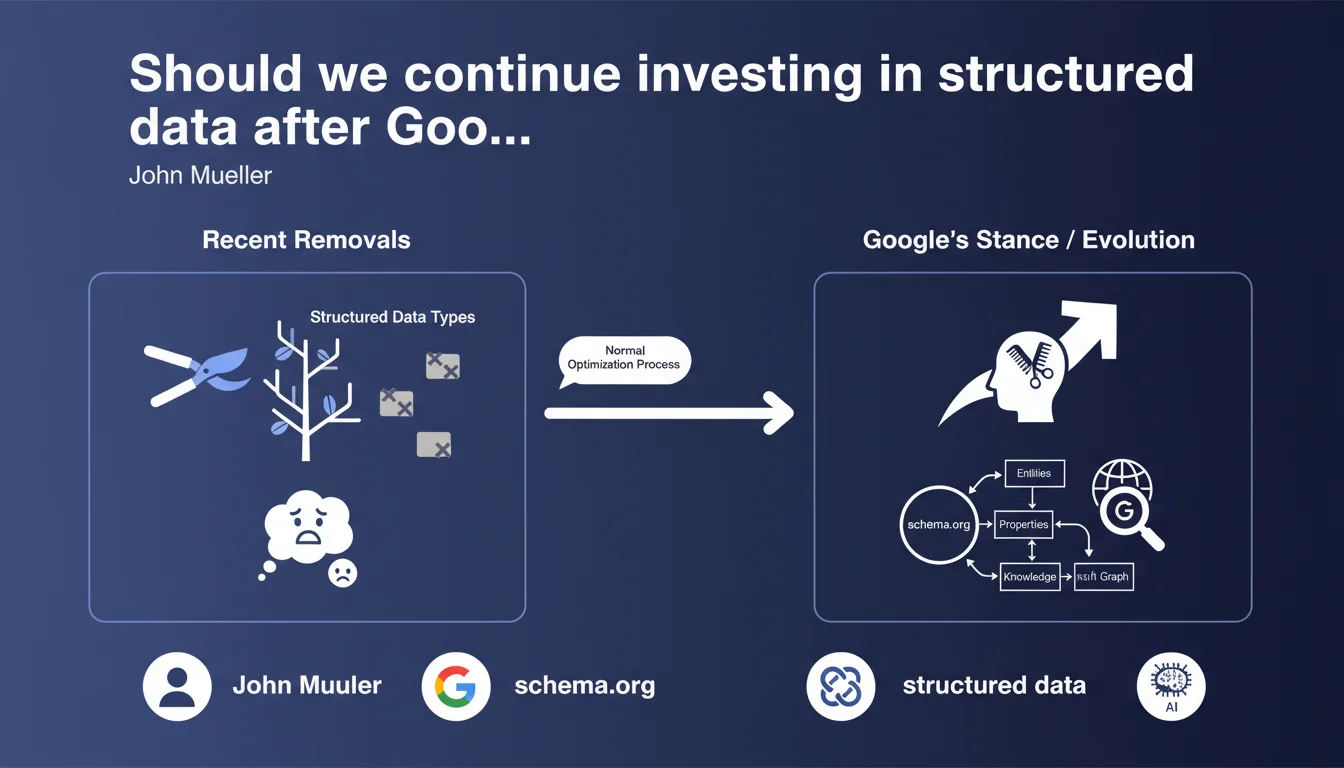
Google recently proceeded with the removal of several structured data types, which triggered a wave of concern in the SEO community. Some professionals feared a gradual abandonment of this fundamental technology for search engine optimization.
The official clarification puts an end to these fears: Google does not plan to abandon structured data or support for the schema.org vocabulary. It is simply a natural process of optimization and evolution of the ecosystem.
This approach is part of a logic of feature rationalization. Google regularly removes markup types that are rarely used, obsolete, or redundant to concentrate its resources on the most relevant formats that are most widely adopted by webmasters.
- Structured data remains essential for Google's understanding of content
- The evolution of support is a normal process, not an announced end
- Some types disappear while new ones are regularly added
- Schema.org continues to be the reference for semantic markup
- Rich snippets and SERP features still heavily depend on these tags
SEO Expert opinion
This clarification is perfectly consistent with the observed evolution of Google's practices in recent years. The company constantly refines its selection criteria for rich results, favoring quality and relevance rather than the multiplication of formats.
An important nuance to add: while Google maintains its general support, this does not mean that all structured data types are equal. Some formats like FAQ, Product, Recipe, or Article continue to generate visible rich results, while others only provide semantic understanding assistance without immediate visual benefits.
Recent removals primarily concern types that were rarely adopted or whose usage was marginal. This frees up space for innovation and the introduction of new formats more aligned with web evolution and user behaviors.
Practical impact and recommendations
In light of this clarification, here are the concrete actions to implement to optimize your structured data strategy:
- Audit your current implementations: verify that the structured data types used are still supported and generate rich results
- Prioritize high-impact types: focus on Product, Article, FAQ, HowTo, Recipe, Event depending on your industry
- Systematically test your tags with Google Search Console's rich results testing tool
- Monitor official announcements regarding new supported types or upcoming deprecations
- Don't remove existing structured data that works, even if it doesn't generate visible rich snippets
- Document your strategy: maintain a list of implemented types and their business justification
- Monitor performance: track the evolution of your click-through rates and rich result appearances in Search Console
- Stay up to date with schema.org: regularly consult new properties and types added to the vocabulary
💬 Comments (0)
Be the first to comment.