
Official statement
Other statements from this video 5 ▾
- 4:58 Are Internal Search Results Draining Your Crawl Budget?
- 10:11 Should you really block internal search result pages with robots.txt?
- 10:41 Is it really necessary to replace robots.txt with noindex to block internal search results pages?
- 17:03 Are internal search result pages still considered spam by Google?
- 20:49 Can internal search results truly harm your Google ranking?
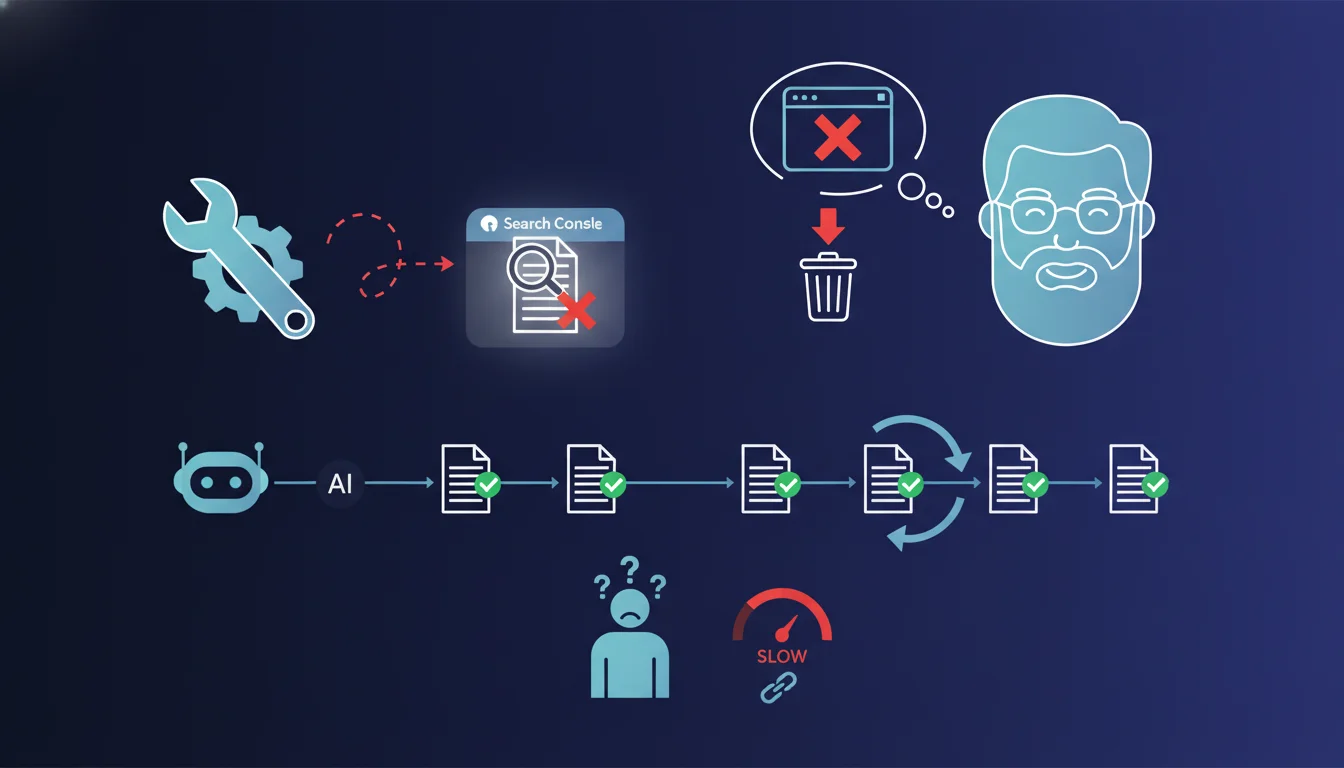
The Search Console removal tool does not block the crawling of pages by Googlebot. It simply temporarily removes URLs from search results. Using it to manage internal search results pages or other dynamic content is a strategic mistake that doesn't resolve issues in the long run.
What you need to understand
What does the removal tool actually do?
The Search Console removal tool acts like a temporary cache that hides URLs in Google search results. It does not send any instructions to the crawler about future crawling of these pages. Googlebot continues to visit them normally as long as they remain accessible.
The confusion arises from the very name of the tool. Many practitioners think that removal equates to a crawl block, similar to what a robots.txt or noindex tag would do. This is incorrect. The effect lasts for about 6 months, after which the URLs reappear if they are still crawlable and indexable.
Why is this clarification needed regarding search result pages?
Internal search result pages (SRPs) present a recurring problem. They multiply infinitely with each combination of filters, generating duplicate or thin content that dilutes the crawl budget. Some SEOs try to remove them via the Search Console tool instead of addressing the root cause.
This approach creates a vicious cycle. The SRPs continue to be crawled, regenerated, and eventually reappear in the index. The underlying technical problem is never resolved, and you waste time replaying the same game every 6 months.
What is the difference compared to real crawling control solutions?
Robots.txt physically blocks Googlebot's access to certain URLs or patterns. The noindex meta tag prevents indexing while allowing crawling. The canonical consolidates variants to a master URL. These three levers act upstream and permanently.
The removal tool intervenes downstream, once Google has already crawled and indexed everything. It is an emergency patch to quickly remove sensitive or outdated content, not a tool for structural site management. Confusing the two means treating symptoms instead of the disease.
- The removal tool does not block Googlebot; it temporarily hides results (maximum 6 months)
- Search result pages require management via robots.txt, noindex, or canonical
- Using the removal tool as a permanent solution creates a time-consuming vicious cycle
- Real crawling control solutions act upstream and sustainably
SEO Expert opinion
Does this statement reflect field observations?
Yes, and it is consistent with what has been observed for years. Sites that misuse the removal tool to manage structural issues see the same URLs return like weeds. Google has even added warnings in the interface to discourage this use.
The real issue is that many CMSs generate SRPs by default without a control mechanism. WooCommerce, Magento, and some improperly configured Drupals churn out thousands of filter combinations. The instinct to manually delete through Search Console quickly becomes unmanageable. [To be verified]: Google has never communicated an exact threshold where misuse of this tool would trigger a penalty, but common sense suggests that massive and repeated use sends a signal of poor technical management.
What are the gray areas not addressed by Mueller?
Mueller does not specify how to manage cases where you want to quickly disindex AND block crawling simultaneously. For example, a content leak in staging or publicly accessible test pages. The best practice combines emergency removal via the tool AND immediate addition of a noindex or a block in robots.txt.
Another unclear point: the impact on crawl budget is not quantified. Indeed, Googlebot continues to crawl removed URLs, but does this penalize the crawling of other important sections of the site? For large sites (100k+ pages), this question is not trivial. [To be verified]: no official data accurately measures this cost.
In which cases does the tool remain relevant?
For sensitive content to be urgently removed: personal information, outdated prices after a promotion ends, legally conflicting articles. The tool acts within hours, whereas a noindex can take several days to be considered depending on crawl frequency.
Also useful for cleaning up after a failed migration where thousands of old URLs persist in the index despite 404s or redirects. But again, this is a temporary fix. If your 301 redirects are clean and you have submitted the new sitemap, Google will eventually clear it naturally.
Practical impact and recommendations
How to correctly handle search result pages?
First step: audit the generation of SRPs. Identify URL patterns (filter facets, sorting, infinite pagination). Use Screaming Frog or Oncrawl to map the extent of the problem. If you have more SRPs than product pages, it is an alarm signal.
Then, decide which SRPs have real SEO value. An internal search for "women's running shoes size 38" is of no interest organically. However, a "women's running shoes" filter page that is well-optimized can capture long-tail traffic. Keep those indexed, block the others via noindex or robots.txt.
What mistakes should you absolutely avoid?
Never block SRPs in robots.txt if they contain links to products or content that you want to index. Googlebot will not follow these links, and you will cut off essential crawl paths. Prefer noindex which allows crawling but prevents indexing.
Avoid the trap of canonicalizing to the homepage or a parent category. Google often interprets this as a soft-404 if the content differs too much. Better to have an explicit noindex, follow that leaves no ambiguity.
How to check that your configuration is correct?
Test your directives using the URL Inspection tool in Search Console. Check that the SRPs to be excluded show "Page excluded by 'noindex' tag" or "Blocked by robots.txt file". If they still appear as indexable, there is a gap in your configuration.
Monitor the index coverage report over 3-6 months. The number of excluded pages should stabilize. If you see recurring spikes of newly indexed SRPs, it means your blocking mechanism has leaks (unmanaged GET parameters, new facets added without updating robots.txt).
- Audit internal search result URL patterns with a crawler
- Identify SRPs with SEO value (keep them indexed) vs those without interest (block them)
- Use noindex, follow for SRPs without value but containing important links
- Never block via robots.txt URLs that contain links to indexable content
- Test each directive using the URL Inspection tool in Search Console
- Monitor the index coverage report over 6 months to detect leaks
Correctly managing search result pages and other dynamic content requires sharp technical expertise. Between robots.txt, noindex tags, canonicals, and URL parameters in Search Console, the combinations are numerous, and mistakes can be costly. If your site generates a lot of this type of content, an audit by a specialized SEO agency can save you months of trial and error and prevent avoidable traffic loss.
❓ Frequently Asked Questions
L'outil de suppression affecte-t-il le crawl budget de mon site ?
Combien de temps dure l'effet de l'outil de suppression ?
Puis-je utiliser l'outil pour gérer des paramètres d'URL inutiles ?
Que se passe-t-il si je supprime une URL qui génère du trafic ?
L'outil de suppression peut-il remplacer un noindex ?
🎥 From the same video 5
Other SEO insights extracted from this same Google Search Central video · duration 28 min · published on 30/07/2026
🎥 Watch the full video on YouTube →
💬 Comments (0)
Be the first to comment.