
Official statement
Other statements from this video 5 ▾
- 4:58 Are Internal Search Results Draining Your Crawl Budget?
- 10:11 Should you really block internal search result pages with robots.txt?
- 11:20 Does the Search Console removal tool really block Google from crawling your pages?
- 17:03 Are internal search result pages still considered spam by Google?
- 20:49 Can internal search results truly harm your Google ranking?
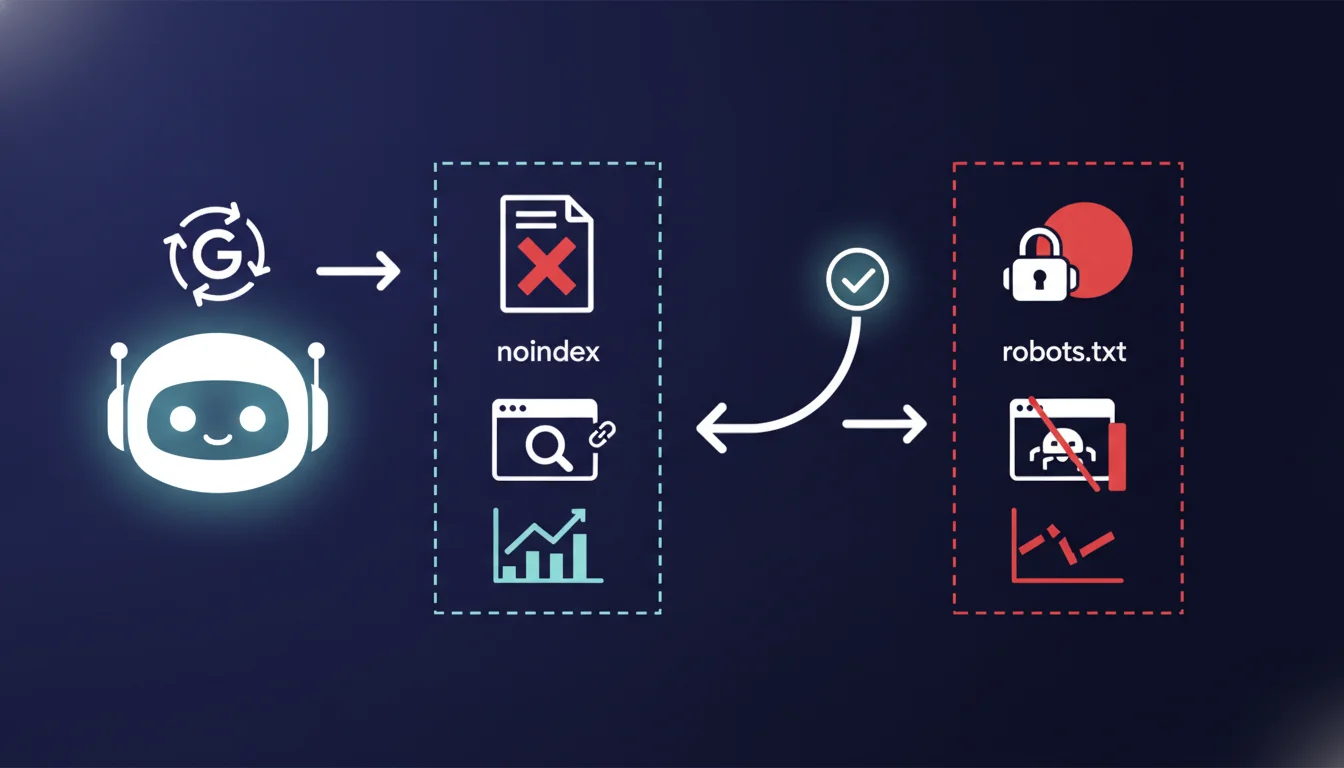
Google suggests using noindex instead of robots.txt to prevent the indexing of internal search results pages. This method allows crawlers to explore these URLs while ensuring they do not appear in the SERPs. The main goal is to preserve the crawl budget on these pages without losing the benefit of the internal linking they generate.
What you need to understand
Why does Google discourage robots.txt for internal search results pages?
The difference between blocking exploration and blocking indexing is not merely a technical nuance. When you use robots.txt, you completely cut off access to Googlebot. The crawler never sees the content, cannot follow the links, and doesn't understand your site's structure in that area.
Internal search results pages (like ?s= or ?search=) pose a specific problem. They often generate thousands of combinatorial URLs that artificially inflate your index. However, fully blocking their exploration via robots.txt also means losing all the internal links they contain to your actual product pages or content.
How is noindex more effective for this use case?
With noindex, you allow Google to explore the page, discover its structure, and follow the links it contains. But you prohibit it from storing it in its index. This is exactly what is needed for internal search results pages: they serve as a navigation hub but have no value as an organic landing page.
In practice, Googlebot will crawl the URL, identify the links to your product sheets or articles, and transmit internal PageRank via those links. But the results page itself will never pollute your SERPs nor cannibalize your actual category pages.
What is the limitation of this approach?
The issue is the volume. If your internal search engine generates 50,000 combinatorial URLs, allowing their exploration can quickly consume your crawl budget. Google will spend time on these pages instead of focusing on your strategic content.
The hybrid solution often consists of combining noindex on pages useful for linking, and robots.txt on absurd variations (sorting by lowest price + multiple filters + deep pagination). But this boundary remains blurred and depends on your architecture.
- Robots.txt blocks exploration: no access to content, no transfer of PageRank via internal links
- Noindex blocks indexing: exploration allowed, links followed, but page excluded from Google's index
- Internal search results pages: zero value in SERPs, but useful as an internal navigation hub
- Crawl budget risk: allowing exploration of thousands of URLs can saturate the crawler's available time
- Hybrid approach: noindex on useful URLs, robots.txt on unnecessary variations
SEO Expert opinion
Is this recommendation consistent with field observations?
Yes, but with a major caveat regarding crawl budget. On sites with fewer than 10,000 pages, allowing exploration of internal search results via noindex works well. Google crawls regularly, follows links, and your internal linking remains fluid.
However, on e-commerce sites with 100,000 items and dozens of combinable filters, I've seen Google spend 60% of its crawl time on worthless results URLs. The Search Console clearly shows the explosion of non-indexed explored pages, while strategic pages are only crawled once a month. [To verify] in your own context before generalizing.
When should robots.txt still be prioritized?
When the volume of generated URLs becomes unmanageable. If your internal search engine produces infinite combinations (multiple facets, sorting, pagination), you cannot afford to let Google explore everything. Even with noindex, simply crawling these pages eats into your crawl budget.
The other case: sites with massive duplication issues. If your results pages display the same content as an existing category, noindex doesn't always suffice. I've seen situations where Google continued to index despite the tag, simply because the signal contradicted other indicators (poorly placed canonical, incoming external links).
What nuance should be considered regarding PageRank transfer?
Google follows links from a noindex page, that’s confirmed. But the weight transmitted depends on the frequency of crawling and the page's depth in the hierarchy. A results page accessible in 2 clicks from the homepage transmits value. A URL buried 8 clicks deep, crawled every 3 months, brings nothing.
The classic mistake is to believe that noindex is a miracle solution that preserves 100% of internal linking without crawl impact. In reality, if Google crawls 500 results pages a day instead of 500 product sheets, you lose indexing freshness on your strategic content. It’s a constant trade-off.
Practical impact and recommendations
What practical steps should be taken on a site with an internal search engine?
Start by auditing the volume of generated URLs. Go to the Search Console, Coverage section, and filter by your internal search patterns (?s=, /search/, etc.). If you see fewer than 500 explored URLs, noindex is more than enough. Beyond 5,000, you need to segment: noindex on high internal traffic queries, robots.txt on the rest.
Technically, place the <meta name='robots' content='noindex, follow'> tag in the head of your results pages. The 'follow' is crucial: it allows Google to follow the links. Add an X-Robots-Tag: noindex, follow in your HTTP headers if you're generating PDFs or non-HTML files through your search engine.
How can you prevent noindex from consuming your crawl budget?
Implement an appropriate crawl delay or use URL parameters in the Search Console (even if Google says it's outdated, it still limits exploration). Monitor the 'Crawl Statistics' report weekly: if the download time increases or the number of pages crawled daily explodes, it's a bad sign.
Another lever: reasoned pagination. If your search engine displays 50 pages of results for a generic query, limit it to a maximum of 5 pages and place the rest as noindex + nofollow (or block via robots.txt). Google has no reason to crawl page 47 of a search for 'shoes'.
What mistakes should be absolutely avoided?
Never mix robots.txt and noindex on the same URL. If you block via robots.txt, Google will never see the noindex tag, and the URL may remain indexed with a message 'Blocked by robots.txt'. That's the worst of both worlds: no crawl, but ghost presence in the SERPs.
The second mistake: forgetting the canonical. On a results page that shows the same products as a regular category, you need to point to the category via canonical in addition to noindex. Otherwise, Google will get lost between contradictory signals and may ignore your noindex.
- Audit the volume of internal search URLs in the Search Console
- Implement noindex, follow on strategic results pages
- Block via robots.txt unnecessary variations (sorting + filters + deep pagination)
- Monitor weekly crawl budget in Crawl Statistics
- Never combine robots.txt and noindex on the same URL
- Add a canonical to the equivalent category if content duplication exists
❓ Frequently Asked Questions
Peut-on utiliser noindex sur des pages de catégories classiques ?
Googlebot suit-il vraiment les liens depuis une page noindex ?
Que se passe-t-il si on bloque une URL par robots.txt alors qu'elle a déjà un noindex ?
Le X-Robots-Tag HTTP est-il équivalent à la meta noindex ?
Comment vérifier que Google respecte bien mon noindex ?
🎥 From the same video 5
Other SEO insights extracted from this same Google Search Central video · duration 28 min · published on 30/07/2026
🎥 Watch the full video on YouTube →
💬 Comments (0)
Be the first to comment.