
Official statement
Other statements from this video 14 ▾
- □ Are ccTLDs really losing their SEO weight for geographic targeting?
- □ Can Google really target geography at the individual page level?
- □ Should you really ignore the HTML lang attribute for multilingual SEO?
- □ Will Google finally automate hreflang tag detection?
- □ Why does Google trust hreflang more than the HTML lang attribute?
- □ Should you really worry about hreflang if only 9% of websites actually use it?
- □ Should you abandon hreflang in sitemaps and switch to HTML or HTTP headers instead?
- □ Does hreflang automatically trigger Google to crawl all your alternative URLs?
- □ Do you really need to include a self-referencing hreflang tag on every page?
- □ Does Google really index your multilingual pages separately with hreflang, or does it only store one version?
- □ Why are your hreflang pages disappearing from Search Console without being deindexed?
- □ Can your x-default hreflang tag really point to any page on your site?
- □ Is hreflang really enough to handle nearly identical pages that only differ by currency or VAT?
- □ Why did Google discontinue its official hreflang validator tool?
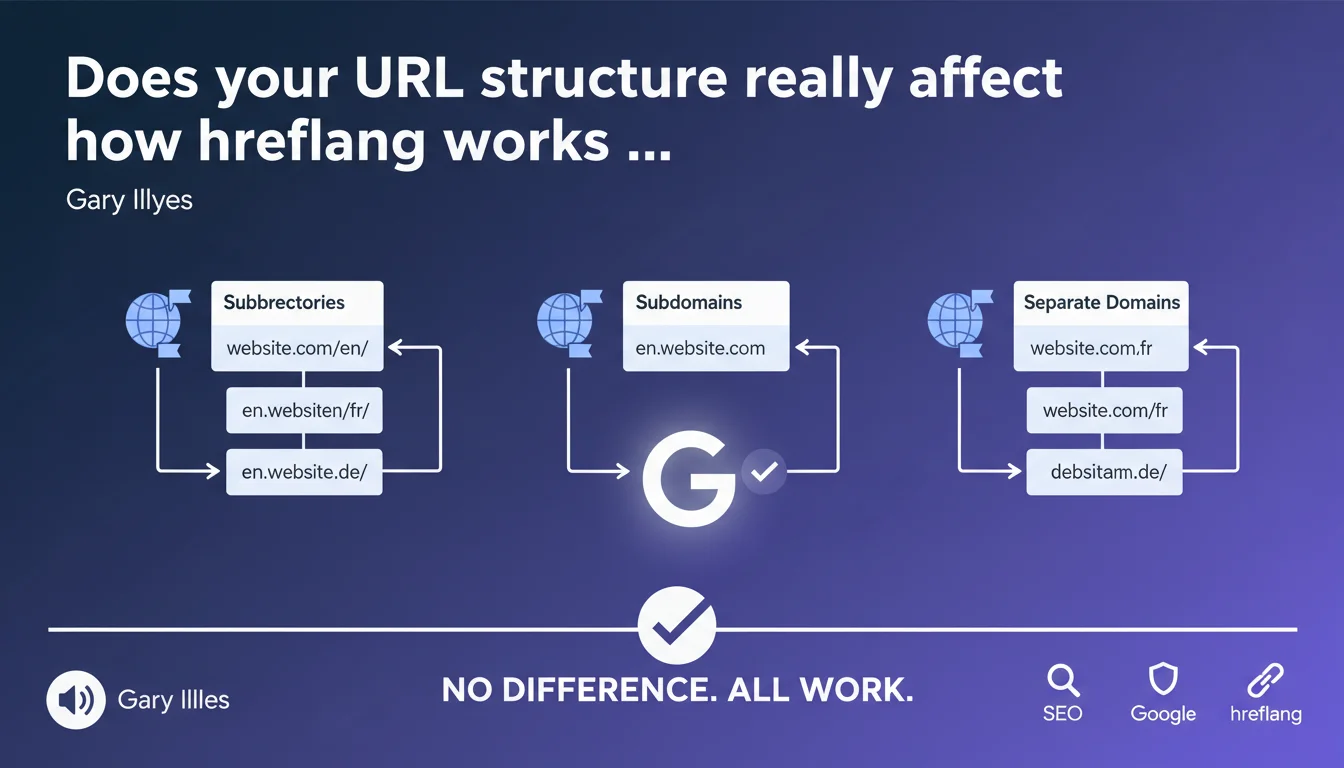
Google states that choosing between subdirectories, subdomains, or separate domains has no influence on how hreflang functions. All three configurations are treated equivalently by the algorithm. Only proper technical implementation matters.
What you need to understand
Why is Google clarifying this now?
This statement addresses persistent confusion in the SEO community. Many still believe that URL structure influences how hreflang signals are transmitted — that subdirectories would be superior to subdomains, for example.
Gary Illyes puts this to rest: from a strictly hreflang perspective, no architecture is favored. The system reads hreflang annotations the same way, whether they point to example.com/fr/, fr.example.com, or example.fr.
What does this mean in practice?
It means your architecture decisions should be based on other criteria: technical infrastructure, content management, budget constraints, and editorial strategy. Hreflang adapts to your choice — not the other way around.
However, this neutrality doesn't excuse you from rigorous implementation. Poorly configured hreflang will fail regardless of URL structure.
What are the real factors that matter for hreflang?
- Annotation reciprocity: each page must reference its language variants, and be referenced in return
- Language code consistency: strict use of ISO 639-1 standards (language) and ISO 3166-1 Alpha 2 (region)
- URL accessibility: all referenced pages must be crawlable and indexable
- Correct tag placement: in the
<head>or via XML sitemap, never both simultaneously
SEO Expert opinion
Is this statement consistent with real-world observations?
Yes, broadly speaking. Tests show that hreflang works on all structures when properly implemented. I've seen subdomain configurations perform as well as subdirectory setups.
But — and this is where it gets tricky — this neutrality only applies to hreflang in isolation. In practice, URL structure impacts other SEO signals that do influence your international performance: PageRank transmission, authority dilution, and crawl budget management across separate domains.
What nuances should be added to this statement?
Google is talking about a "direct" impact on SEO here, and that's important. Hreflang is a geographic targeting mechanism, not a ranking factor. It tells Google which version to show which user — it doesn't boost your rankings.
What Gary doesn't say: subdomains are treated as quasi-separate entities for authority purposes. A subdirectory site benefits from a consolidated root domain. A subdomain site must build authority for each subdomain separately. [To be verified] the extent to which this fragmentation actually affects performance, as Google remains unclear on how it treats subdomains exactly.
When is this rule not enough?
When you're managing markets with radically different content. A separate domain (example.de vs example.fr) can be legitimate if your product catalogs, pricing, or editorial strategies differ significantly.
Hreflang will work technically, but you'll need to compensate for the loss of domain consolidation through more aggressive link-building on each ccTLD. It's a business decision before it's an SEO decision.
Practical impact and recommendations
What should you do concretely to optimize your hreflang?
Focus on implementation quality, not structure. Choose your architecture based on your business and technical constraints, then deploy hreflang correctly.
Use Search Console to track errors: missing annotations, invalid language codes, non-indexable pages referenced. The "International Targeting" reports show you exactly what's broken.
What errors must you avoid at all costs?
Never mix multiple implementation methods. If you opt for HTML tags, don't also add hreflang to your sitemap — Google might receive contradictory signals.
Avoid redirect chains on hreflang URLs. If example.com/fr/ redirects to example.com/fr/home/, your annotation is broken. Hreflang must point to the final URL accessible via a 200 status code.
Don't forget self-referencing pages. Even the English version must contain an hreflang pointing to itself — that's what completes reciprocity.
How do you verify your implementation is compliant?
- Check complete reciprocity: each page must list all its variants, including itself
- Validate language/region codes with a tool like hreflang Tags Testing Tool
- Verify that all referenced URLs return a 200 HTTP status code and are indexable
- Test geographic targeting through geolocation searches or VPN
- Regularly audit Search Console to detect emerging errors
- Document your language-to-region mapping to avoid inconsistencies during updates
❓ Frequently Asked Questions
Les sous-domaines sont-ils désavantagés par rapport aux sous-répertoires pour le hreflang ?
Puis-je mixer plusieurs structures d'URL dans mes annotations hreflang ?
Le hreflang améliore-t-il mon classement dans les résultats de recherche ?
Dois-je implémenter le hreflang dans le HTML ou dans le sitemap XML ?
Que se passe-t-il si mon hreflang n'est pas réciproque ?
🎥 From the same video 14
Other SEO insights extracted from this same Google Search Central video · published on 25/07/2024
🎥 Watch the full video on YouTube →
💬 Comments (0)
Be the first to comment.