
Official statement
Other statements from this video 14 ▾
- □ Does your URL structure really affect how hreflang works on Google?
- □ Can Google really target geography at the individual page level?
- □ Should you really ignore the HTML lang attribute for multilingual SEO?
- □ Will Google finally automate hreflang tag detection?
- □ Why does Google trust hreflang more than the HTML lang attribute?
- □ Should you really worry about hreflang if only 9% of websites actually use it?
- □ Should you abandon hreflang in sitemaps and switch to HTML or HTTP headers instead?
- □ Does hreflang automatically trigger Google to crawl all your alternative URLs?
- □ Do you really need to include a self-referencing hreflang tag on every page?
- □ Does Google really index your multilingual pages separately with hreflang, or does it only store one version?
- □ Why are your hreflang pages disappearing from Search Console without being deindexed?
- □ Can your x-default hreflang tag really point to any page on your site?
- □ Is hreflang really enough to handle nearly identical pages that only differ by currency or VAT?
- □ Why did Google discontinue its official hreflang validator tool?
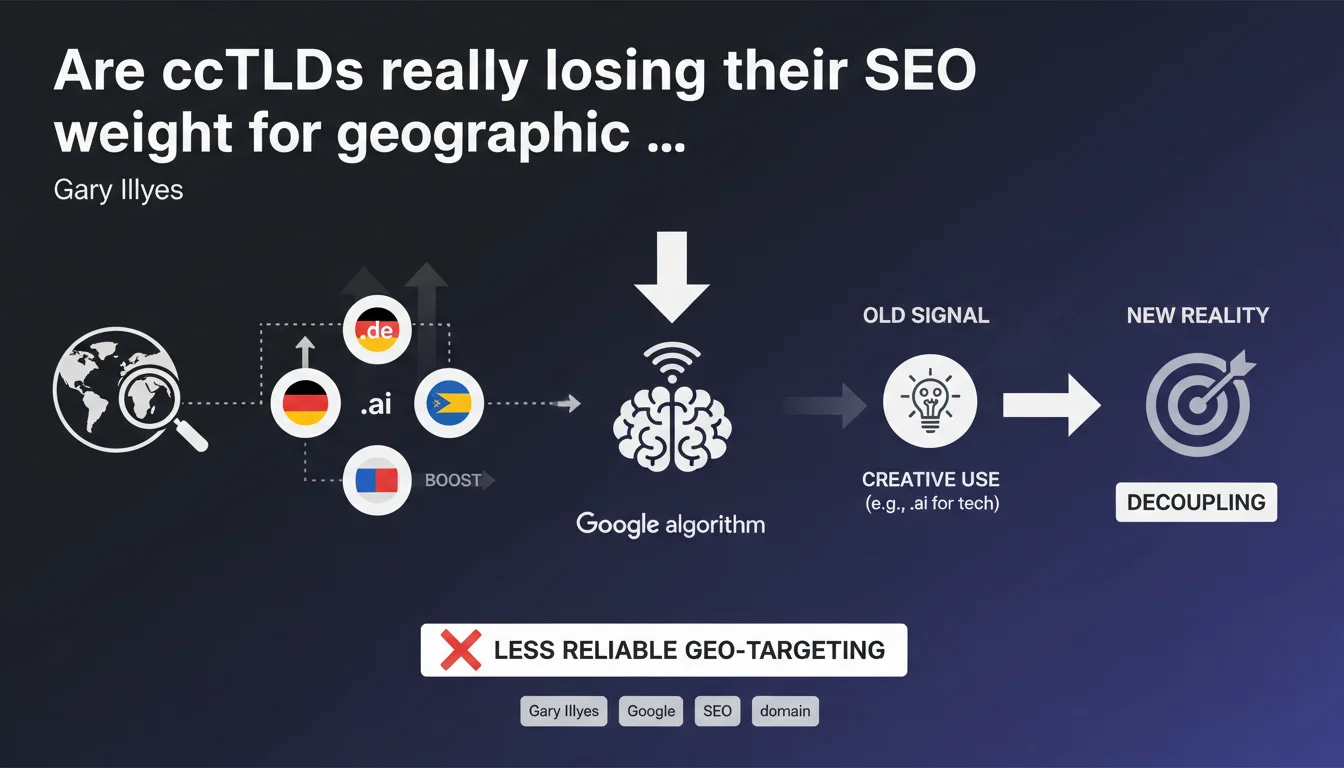
Google is gradually abandoning the geographic boost it once granted to ccTLDs (.de, .fr, .ai, etc.) because these extensions are now used creatively without any connection to their country of origin. The signal has become too unreliable to maintain as a ranking criterion. If you're relying on your ccTLD to rank locally, it's time to rethink your strategy.
What you need to understand
Why is Google reducing the value of ccTLDs?
Historically, Google used country-code top-level domains as a targeting signal: a .de suggested content intended for Germany, a .fr for France. The search engine applied a slight boost in the results of the corresponding country.
The problem? Practices have changed. Extensions like .ai (Anguilla) now serve to brand artificial intelligence startups, .io (British Indian Ocean Territory) for tech SaaS companies, .co (Colombia) as an alternative to .com. The signal became too noisy to be usable.
What's replacing this signal?
Google now relies more heavily on other signals: targeting parameters in Search Console, the physical address displayed on the site, content language, local backlinks, and hosting location (to a lesser extent). The ccTLD becomes one indicator among many, weaker than before.
Search Console allows you to explicitly define a target country for generic domains (.com, .org). For ccTLDs, this option doesn't exist — Google assumes the extension already indicates the country. Except that this assumption no longer holds.
Does this mean a ccTLD is worthless now?
No. A ccTLD remains a signal of local trust for users — a .fr inspires more confidence than a .com in the eyes of a French internet user. But on the algorithm side, the direct SEO advantage is eroding.
- The geographic boost linked to ccTLDs is diminishing because too many extensions have been repurposed from their original use
- Other geographic signals are taking over: Search Console, physical address, language, local links
- User impact remains: a ccTLD can improve click-through rate and local trust
- Google isn't saying ccTLDs are ignored, just that their relative weight is declining
SEO Expert opinion
Was this evolution predictable?
Frankly, yes. For years now, we've seen sites on .io targeting the entire world with no connection to the Indian Ocean, .ai domains with no relation to Anguilla. Google wasn't going to account for such a polluted signal forever.
What's murkier is the scale of the change. Gary Illyes talks about a "slight boost" that's disappearing — but what was its actual weight? [To be verified] because Google has never published quantified data on the impact of ccTLDs. We just know it was one criterion among hundreds.
Which ccTLDs are really affected?
All of them, in theory. But concretely, some are more affected than others. Extensions that are repurposed (.ai, .io, .co, .me) are losing a signal they weren't really exploiting anyway. Extensions still used locally (.de, .fr, .uk) are losing a real advantage.
The paradox: a German site on .de targeting Germany loses a boost, while a California-based site on .ai never had one. The adjustment primarily penalizes those who were playing by the original rules.
Should you migrate your ccTLD to a .com?
Not necessarily. A domain migration is a risky operation (temporary ranking losses, redirects to manage, historical signals to rebuild). If your .fr or .de is performing well and you're targeting a single country, it's probably not worth the effort.
However, if you're planning international expansion, a .com with subdirectories (/fr/, /de/, /uk/) or subdomains becomes more relevant than a collection of ccTLDs. You centralize domain authority and control targeting through Search Console.
Practical impact and recommendations
What should you do concretely?
First, check your Search Console settings. If you're on a .com or other gTLD, make sure geographic targeting is properly configured. If you're on a ccTLD, you don't have this option — so strengthen your other signals.
Next, audit your geographic signals: visible physical address, local phone number, mentions in local directories, backlinks from sites in your target country, content language consistent with your target. These elements now matter more than the extension.
What mistakes should you avoid?
Don't panic and hastily migrate to another domain. A poorly planned migration does more damage than the gradual loss of a minor signal. Calculate the risk/benefit ratio.
Also don't ignore the issue if you're expanding internationally. A .de that wants to rank in France and Spain will struggle — a .com with localized subdirectories will be more effective.
How do you verify that my site remains well-targeted?
Compare your Search Console performance by country. If you see erosion in the country corresponding to your ccTLD with no changes elsewhere, the geographic signal may be weakening. But correlate with other metrics — a decline can have a hundred causes.
Test user perception: does your ccTLD inspire confidence in your target market? If yes, the positive impact on CTR can offset the loss of the algorithmic boost. SEO is also about UX.
- Audit geographic targeting parameters in Search Console
- Strengthen alternative geographic signals (address, phone, local links)
- Verify language/content/target consistency for each site section
- Avoid impulsive domain migrations — calculate ROI before moving
- Monitor performance by country in Search Console over several months
- If expanding internationally: consider a .com + subdirectory architecture
❓ Frequently Asked Questions
Mon site en .fr va-t-il perdre des positions en France ?
Dois-je migrer mon .de vers un .com ?
Comment Google détermine-t-il désormais le ciblage géographique ?
Les ccTLD détournés (.ai, .io) sont-ils pénalisés ?
Faut-il modifier mon architecture internationale ?
🎥 From the same video 14
Other SEO insights extracted from this same Google Search Central video · published on 25/07/2024
🎥 Watch the full video on YouTube →
💬 Comments (0)
Be the first to comment.