
Official statement
Other statements from this video 14 ▾
- □ Does your URL structure really affect how hreflang works on Google?
- □ Are ccTLDs really losing their SEO weight for geographic targeting?
- □ Can Google really target geography at the individual page level?
- □ Should you really ignore the HTML lang attribute for multilingual SEO?
- □ Will Google finally automate hreflang tag detection?
- □ Why does Google trust hreflang more than the HTML lang attribute?
- □ Should you really worry about hreflang if only 9% of websites actually use it?
- □ Should you abandon hreflang in sitemaps and switch to HTML or HTTP headers instead?
- □ Does hreflang automatically trigger Google to crawl all your alternative URLs?
- □ Does Google really index your multilingual pages separately with hreflang, or does it only store one version?
- □ Why are your hreflang pages disappearing from Search Console without being deindexed?
- □ Can your x-default hreflang tag really point to any page on your site?
- □ Is hreflang really enough to handle nearly identical pages that only differ by currency or VAT?
- □ Why did Google discontinue its official hreflang validator tool?
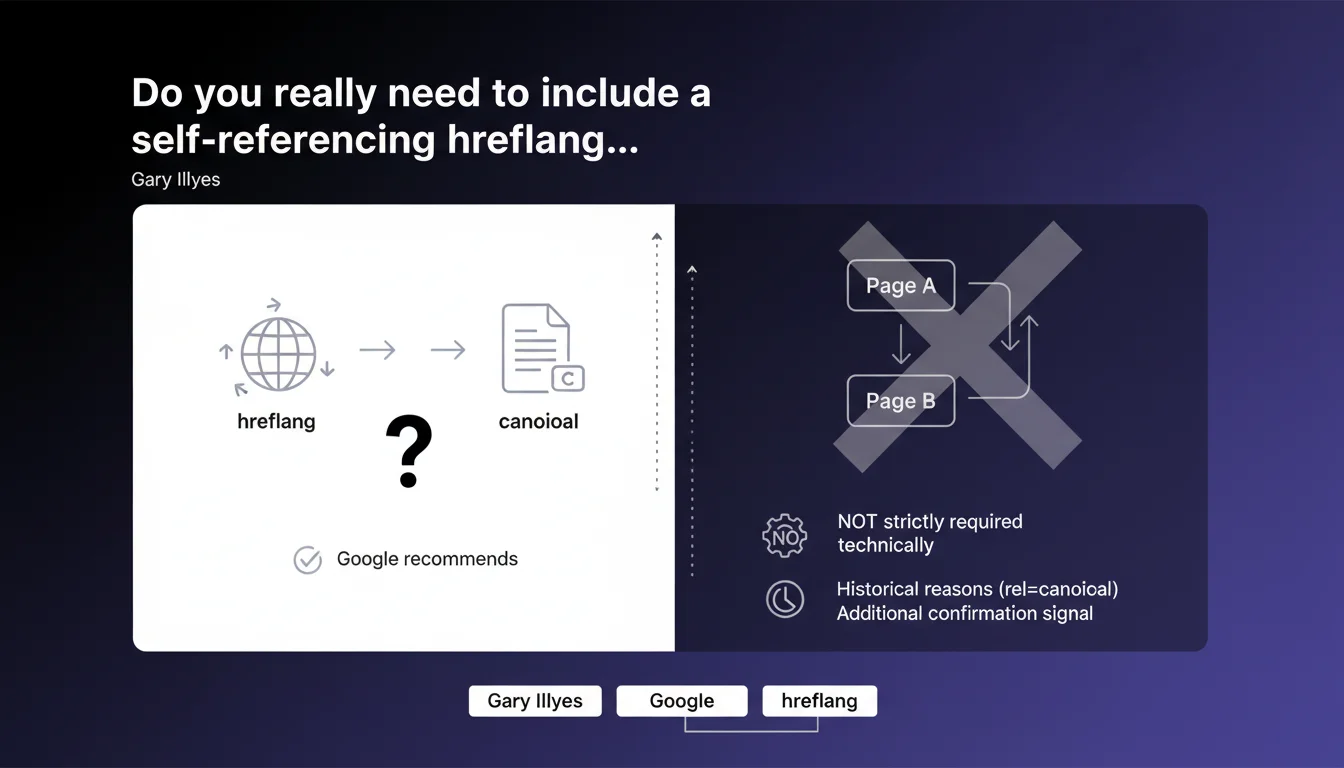
Google confirms that self-referencing hreflang is not technically mandatory, contrary to what many believe. This recommendation persists mainly for historical reasons related to rel=canonical and as an additional confirmation signal. In practice, your implementation can work without it, but Google still prefers that you include it anyway.
What you need to understand
Why this distinction between 'recommended' and 'required'?
Google makes a crucial distinction here. Technically, the algorithm can interpret your hreflang annotations even without self-reference. The search engine understands that a French page points to its English, German, and other variants.
But the recommendation exists to avoid ambiguities. When a page self-references, it explicitly states 'I am the French version'. Without this confirmation, Google must deduce the information from context, which leaves more room for interpretation.
What's the connection to rel=canonical in this story?
The historical origin mentioned by Gary Illyes refers to a frequently encountered implementation problem. Many sites use both hreflang and canonical simultaneously, and the two can conflict if misconfigured.
Self-referencing hreflang helps Google verify consistency: if a French page has a canonical pointing to itself AND a self-referencing hreflang, that's a double confirmation signal. Without one of the two, the engine must choose between potentially contradictory signals.
What does this change for my current implementation?
If your implementation already works without self-reference and you observe good behavior in multilingual SERPs, you're not in danger. Google is processing your annotations.
But be aware — 'it works' doesn't mean 'it's optimal'. The absence of self-reference can slow down Google's understanding of your international signals, especially on complex sites with many language variants.
- Self-reference is not mandatory for Google to process your hreflang
- It serves as a confirmation signal that reduces interpretation ambiguities
- The connection to rel=canonical comes from historical problems with signal consistency
- An implementation without self-reference may work but remains suboptimal
SEO Expert opinion
Does this technical tolerance create a risk of misinterpretation?
Let's be honest: yes. In my audits, I've seen cases where the absence of self-reference combined with contradictory signals (inconsistent HTML lang tags, misconfigured geotargeting in Search Console) has produced display errors in SERPs.
Google can technically handle the absence of self-reference, but its algorithm must then infer rather than confirm. And when it infers, it bases itself on all available signals — which are not always consistent with each other.
Why does Google maintain this recommendation if it's not required?
Gary Illyes' mention of 'historical reasons' is telling. When hreflang was first launched, many sites generated asymmetrical implementations: the FR page pointed to EN and DE, but EN only pointed to FR, forgetting DE.
Self-reference served as a safeguard: it forced developers to think of each page as a complete entity within the multilingual cluster. Without it, partial or inconsistent implementations multiplied.
[To verify] Gary doesn't specify whether this tolerance applies to hreflang sitemaps as well. My field experience suggests that self-reference remains more critical in sitemaps than in header HTML tags, but Google has never officially confirmed this distinction.
In what cases can you reasonably omit it?
If you have a simple bilingual site (2-3 languages max), consistent signals everywhere (HTML lang, geotargeting, content), and you regularly test your displays in the SERPs of each targeted country, the absence of self-reference probably won't cause a catastrophe.
But as soon as complexity increases — regional variants, multiple domains, partially translated content — self-reference becomes an indispensable safety net. The time saved in implementation is not worth the risk of display errors.
Practical impact and recommendations
What should I do if my current implementation doesn't include self-reference?
First, assess the actual impact. Check Google Search Console for any hreflang errors or warnings. Manually test how your pages display in the SERPs of the different countries you target.
If everything works correctly and you don't observe erratic behavior, adding self-reference is not a critical emergency. But plan for it in your next technical iteration — it's a low-cost optimization for a significant robustness gain.
How do you properly implement self-reference?
Self-reference must point to the canonical URL of the page, not to a variant with tracking parameters or session IDs. If your page has a canonical that differs from its actual URL, use the canonical URL in the self-referencing hreflang.
Check bidirectional consistency: if your FR page self-references fr-FR and points to en-US, the EN page must point to fr-FR and self-reference en-US. Asymmetrical implementations create confusion.
- Audit multilingual pages in Search Console to detect existing hreflang errors
- Manually verify display in the SERPs of each targeted country (via VPN or simulation tools)
- Add self-referencing hreflang if absent, using the canonical URL
- Ensure all language signals are consistent (HTML lang tag, GSC geotargeting, hreflang)
- Test bidirectionality: each variant must point to all others AND to itself
- Document the implementation for future updates (adding new languages, migrations)
What errors should you absolutely avoid?
Never mix language code formats. If you use en-US for self-reference, don't use 'en' alone elsewhere. Google may tolerate it, but you're multiplying the risk of inconsistency.
Avoid redirect chains in hreflang URLs. If your FR page redirects to another URL, it's that final URL which should appear in all hreflang annotations, including self-reference.
Self-referencing hreflang is not technically mandatory, but it remains a strongly recommended best practice. Its absence can work on simple configurations, but increases the risk of errors on complex architectures.
The implementation effort is minimal compared to the benefits in robustness and signal clarity. If you manage a multilingual site with several regional variants or complex technical architecture, the support of a specialized SEO agency may prove valuable to audit your current implementation and guarantee optimal configuration that will avoid unpleasant surprises in international SERPs.
❓ Frequently Asked Questions
Si j'oublie l'auto-référence hreflang, mon site sera-t-il pénalisé par Google ?
L'auto-référence doit-elle pointer vers l'URL réelle ou l'URL canonique ?
Cette règle s'applique-t-elle aussi aux implémentations hreflang via sitemap XML ?
Combien de temps faut-il à Google pour détecter un ajout d'auto-référence hreflang ?
Peut-on utiliser x-default sans auto-référence sur les pages linguistiques ?
🎥 From the same video 14
Other SEO insights extracted from this same Google Search Central video · published on 25/07/2024
🎥 Watch the full video on YouTube →
💬 Comments (0)
Be the first to comment.