
Official statement
Other statements from this video 14 ▾
- □ Does your URL structure really affect how hreflang works on Google?
- □ Are ccTLDs really losing their SEO weight for geographic targeting?
- □ Can Google really target geography at the individual page level?
- □ Should you really ignore the HTML lang attribute for multilingual SEO?
- □ Will Google finally automate hreflang tag detection?
- □ Why does Google trust hreflang more than the HTML lang attribute?
- □ Should you abandon hreflang in sitemaps and switch to HTML or HTTP headers instead?
- □ Does hreflang automatically trigger Google to crawl all your alternative URLs?
- □ Do you really need to include a self-referencing hreflang tag on every page?
- □ Does Google really index your multilingual pages separately with hreflang, or does it only store one version?
- □ Why are your hreflang pages disappearing from Search Console without being deindexed?
- □ Can your x-default hreflang tag really point to any page on your site?
- □ Is hreflang really enough to handle nearly identical pages that only differ by currency or VAT?
- □ Why did Google discontinue its official hreflang validator tool?
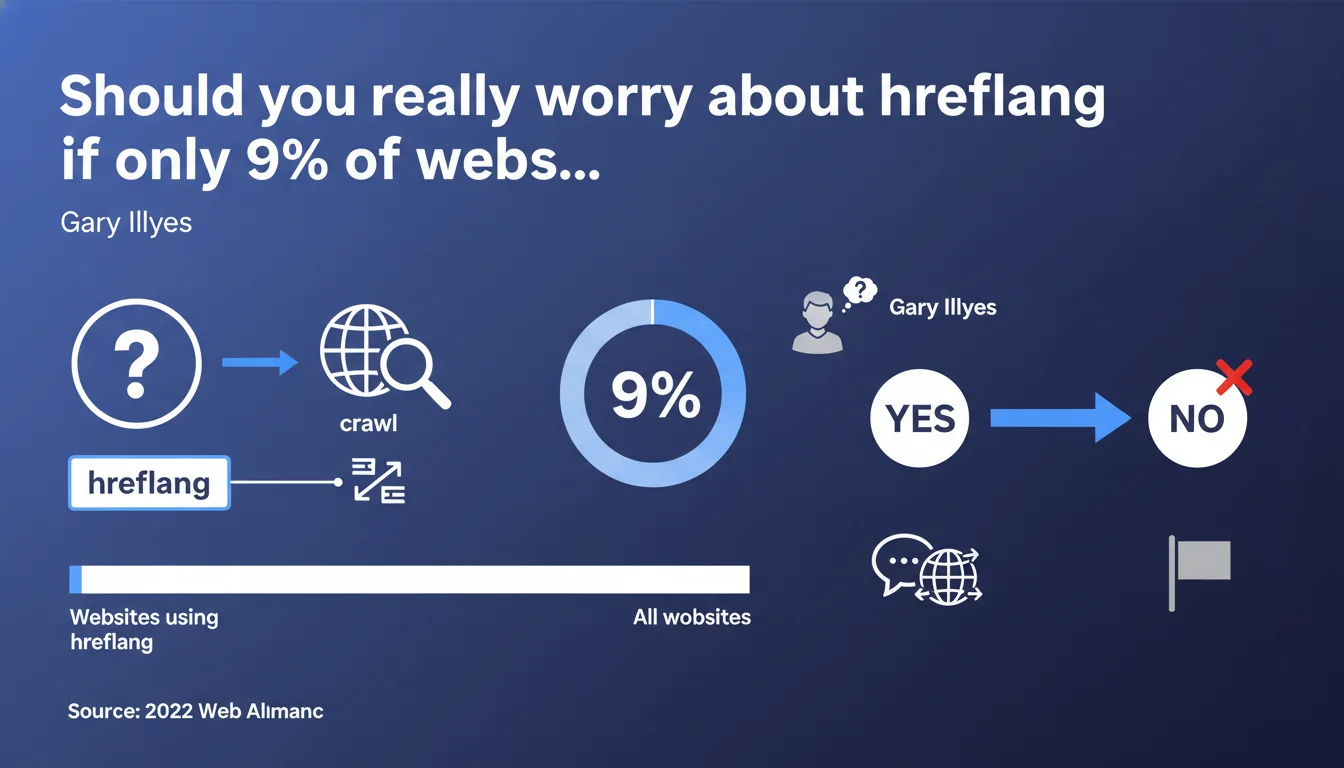
Only 9% of crawled homepage pages use hreflang annotation according to Gary Illyes. This figure doesn't reflect an adoption problem, but rather the fact that the vast majority of websites simply don't need this technical annotation. Hreflang remains essential for multilingual or multi-regional sites, but is unnecessary for others.
What you need to understand
Gary Illyes reminds us of a truth we too often forget: hreflang is not a universal tag. The fact that only 9% of sites use it doesn't reflect widespread ignorance or poor practice.
The vast majority of websites are monolingual and mono-regional. For them, implementing hreflang would be not only unnecessary, but technically absurd.
Why is this 9% figure misleading?
The Web Almanac analyzes homepages, not all sites with an international strategy. A French e-commerce site that only targets the French market has no reason to use hreflang.
This percentage simply reflects the reality of the web: the overwhelming majority of sites are local. Personal blogs, regional SMEs, neighborhood business websites — all make up most of the indexed web.
When does hreflang become truly essential?
As soon as a site offers multiple language or regional versions of the same page, hreflang becomes critical. Without this annotation, Google risks displaying the wrong version to the user: a French person might end up on the English version, a Canadian on the France-French version.
Typical cases: international e-commerce sites, multi-country media outlets, localized SaaS platforms, corporate websites of multinationals. For these players, hreflang is not optional.
- Hreflang only concerns a minority of sites with multilingual or multi-regional presence
- 9% likely represents most of the sites that actually need it
- The absence of hreflang on 91% of sites is not an SEO problem in itself
- Google can often guess the correct version without hreflang, but the annotation remains the only guarantee
SEO Expert opinion
Does this statement hide a more complex reality?
Let's be honest: among the 9% of sites using hreflang, how many implement it correctly? Real-world experience shows that a majority of these implementations contain errors — non-canonical URLs, redirect loops, poorly defined languages, missing reciprocity.
Gary Illyes focuses on adoption rates, but says nothing about success rates. [To verify]: Google could communicate the percentage of valid versus erroneous hreflang annotations in Search Console, but these data remain opaque.
Is the implicit message that Google gets by just fine without it?
Some might interpret this figure as: "Look, 91% of sites do perfectly fine without it". Except Google never said those 91% should have used it. This nuance is crucial.
What's missing from this statement: data specifically about multilingual sites. What percentage of sites with multiple language versions use hreflang? That would be the true adoption indicator. Here, we're mixing apples and oranges — sites that don't need it with those that should need it but don't use it.
Should we conclude that hreflang is overrated by SEOs?
No. That would be a dangerous interpretation. For affected sites, hreflang remains the most reliable tool for controlling which version appears in which country. Google does make efforts to guess, certainly — by analyzing content language, domain extension, geographic targeting in Search Console.
But these signals are imperfect. A .com site with French content can target France, Belgium, Canada, Switzerland — how does Google choose without hreflang? Spoiler: it regularly gets it wrong.
Practical impact and recommendations
How do you know if your site needs hreflang?
The rule is simple: you have multiple different URLs for the same content in different languages or for different regions? You need hreflang. Period.
Concrete examples: example.fr/product and example.com/en/product, or example.com/fr-fr/article and example.com/fr-ca/article. Same content, different URLs, different audiences — hreflang becomes mandatory.
What errors should you avoid in implementation?
The classic mistake: implementing hreflang on a monolingual site "just in case". Result: you add unnecessary technical complexity and risk configuration errors that harm more than they help.
Another frequent pitfall: using hreflang without ensuring reciprocity. If the French version points to the English version with hreflang, the English version MUST point back to the French one. Google ignores non-reciprocal annotations.
- Check in Search Console the "International targeting" section to detect hreflang errors
- Test each implementation with tools like Merkle's hreflang Tags Testing Tool
- Ensure that each URL referenced in hreflang is accessible and not redirected
- Use correct ISO language-region codes: fr-FR, en-GB, es-MX, never make-ups
- Prefer link tags in the HTML head rather than sitemaps for easier debugging
- Systematically include an x-default tag for users outside your targeting
What strategy to adopt if you're not affected?
If your site is monolingual and targets a single country: do nothing. Don't add hreflang "to look professional". Focus on optimizations that have real impact for your context.
Instead validate geographic targeting in Search Console, ensure your content uses the correct language in HTML tags (lang attribute), and that your localization signals are consistent (address, currency, phone number).
❓ Frequently Asked Questions
Est-ce que l'absence de hreflang pénalise mon site monolingue ?
Comment Google fait-il pour cibler géographiquement un site sans hreflang ?
Peut-on utiliser hreflang uniquement dans le sitemap XML ?
Que se passe-t-il si je me trompe dans l'implémentation du hreflang ?
Le x-default est-il vraiment obligatoire ?
🎥 From the same video 14
Other SEO insights extracted from this same Google Search Central video · published on 25/07/2024
🎥 Watch the full video on YouTube →
💬 Comments (0)
Be the first to comment.