
Official statement
Other statements from this video 14 ▾
- □ Does your URL structure really affect how hreflang works on Google?
- □ Are ccTLDs really losing their SEO weight for geographic targeting?
- □ Can Google really target geography at the individual page level?
- □ Should you really ignore the HTML lang attribute for multilingual SEO?
- □ Why does Google trust hreflang more than the HTML lang attribute?
- □ Should you really worry about hreflang if only 9% of websites actually use it?
- □ Should you abandon hreflang in sitemaps and switch to HTML or HTTP headers instead?
- □ Does hreflang automatically trigger Google to crawl all your alternative URLs?
- □ Do you really need to include a self-referencing hreflang tag on every page?
- □ Does Google really index your multilingual pages separately with hreflang, or does it only store one version?
- □ Why are your hreflang pages disappearing from Search Console without being deindexed?
- □ Can your x-default hreflang tag really point to any page on your site?
- □ Is hreflang really enough to handle nearly identical pages that only differ by currency or VAT?
- □ Why did Google discontinue its official hreflang validator tool?
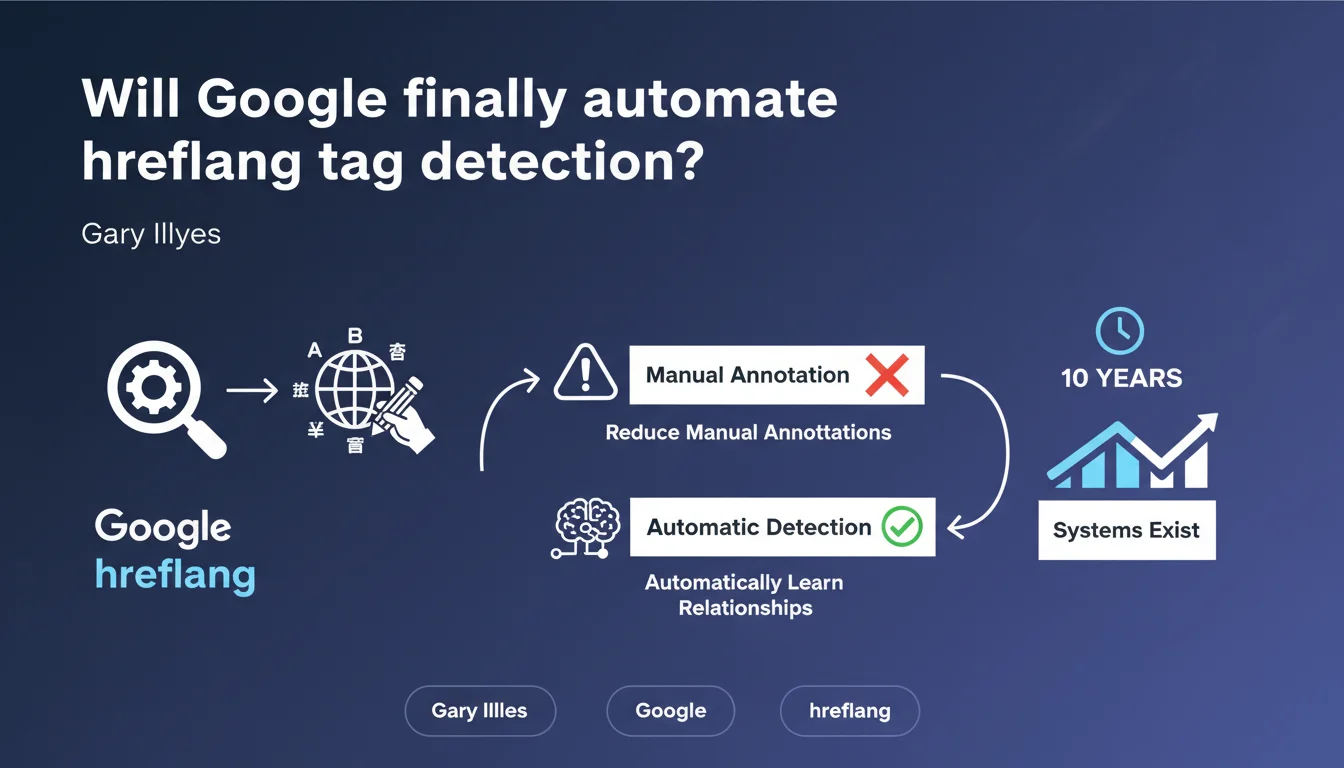
Google wants to reduce reliance on manual hreflang annotations by leveraging machine learning systems capable of identifying linguistic versions of content. These technologies have existed for nearly 10 years, but their widespread deployment remains unclear. For now, manual implementation remains the standard — and the most reliable approach.
What you need to understand
What does this Google statement concretely mean?
Gary Illyes indicates that Google is working to reduce the need for manual annotations for hreflang tags. The idea: let the algorithm automatically detect relationships between linguistic versions of the same page, rather than relying solely on signals provided by webmasters.
In practice, this would mean that Google could identify that a French page on example.com/fr/produit and an English page on example.com/en/product discuss the same subject, without needing us to explicitly tell it via hreflang. An attractive promise for anyone who has already struggled with these finicky annotations.
Do these automatic systems really exist?
Yes. Google claims that technologies capable of automatically detecting linguistic versions have been operational for nearly 10 years. We're probably talking about natural language processing (NLP) systems coupled with machine learning, capable of detecting semantic similarities between multilingual content.
The problem? Google doesn't specify either the reliability rate of these systems or their actual deployment across the entire index. In other words: maybe these tools work internally, but nothing guarantees they're already being used at scale to replace hreflang.
Why does Google want to automate hreflang?
Because manual annotations are a massive source of errors. Incorrect configurations, wrong URLs, improperly formatted lang attributes, missing reciprocity — the list goes on. Google must manage these inconsistencies constantly, and it drains its crawl and indexing resources.
Automating this process would also make the multilingual web more accessible to small sites that neither have the budget nor technical expertise to implement hreflang correctly. But between stated intention and ground reality, there's a gap — which we're about to widen.
- Google wants to reduce manual annotations to limit errors and ease technical burden
- Automatic systems have existed for nearly 10 years, but their deployment remains unclear
- The goal is to enable the algorithm to automatically detect linguistic versions without depending on the webmaster
- No timeline or reliability guarantees provided — caution required
SEO Expert opinion
Is this statement consistent with observed practices?
Honestly? No. Despite these machine learning capabilities, hreflang errors remain a recurring source of indexing problems on multilingual sites. If Google could really reliably identify linguistic versions, we should observe increased tolerance for manual errors — yet, that's not the case.
In practice, sites with defective hreflang implementations continue to encounter geographic targeting issues, content duplication, and cannibalization between languages. This suggests that automation remains marginal or insufficiently performant to be generalized. [To be verified]: Google doesn't specify what percentage of the index already benefits from this automatic detection.
Should we stop implementing hreflang manually?
Absolutely not. As long as there's no official announcement indicating that hreflang becomes optional, continuing to implement it correctly remains the best strategy. Manual signals are still the most reliable way to communicate linguistic relationships to Google.
This statement looks more like a long-term intention than an imminent change. Google is used to announcing evolutions that take years to materialize — sometimes without ever fully doing so. Banking on automation today is taking an unnecessary risk.
What are the likely limitations of this automation?
Even with advanced NLP systems, certain configurations will remain beyond automation's reach. For example: how would an algorithm distinguish that an English page on example.com/en/shoes should target the United States and not the United Kingdom, while another English page on example.co.uk/shoes specifically aims at the British market?
Without explicit signals, Google will have to rely on indirect clues (TLD, content, backlinks, user signals) — which introduces a significant margin of error. E-commerce sites with price differentiation strategies by market, or content slightly adapted by geographic zone, cannot afford this uncertainty.
Practical impact and recommendations
What should you concretely do right now?
Change nothing about your current practices. Continue implementing hreflang correctly via HTML tags, XML sitemaps, or HTTP headers depending on your architecture. This statement is a long-term intention, not an immediate instruction.
If you have a multilingual site in development, plan hreflang implementation from launch. Don't bank on hypothetical automation that could take years to arrive — or never deploy with sufficient reliability for your specific needs.
How do you verify that your hreflang implementation remains solid?
Use Search Console to identify recurring hreflang errors: missing tags, incorrect URLs, reciprocity issues. These errors can harm geographic targeting and create confusion in indexing.
Regularly audit your annotations with specialized tools (Screaming Frog, OnCrawl, Sitebulb) to detect inconsistencies, especially after migrations or redesigns. Hreflang errors accumulate easily over time, particularly on large catalogs with dynamic generation.
- Maintain manual hreflang implementation on all multilingual sites
- Don't rely on hypothetical automation to handle linguistic targeting
- Regularly audit annotations via Search Console and crawl tools
- Immediately correct any reciprocity errors or incorrect URLs
- Document your hreflang architecture to facilitate long-term maintenance
- Train editorial teams on the impacts of multilingual content on SEO
Google's statement on hreflang automation remains vague and without a precise timeline. Manual annotations remain essential to guarantee reliable geographic and linguistic targeting. Until an official announcement confirms a change in practice, continue implementing hreflang according to standard recommendations.
For sites with complex multilingual architecture or strict market-specific targeting requirements, these optimizations can quickly become time-consuming and require specialized technical expertise. If your team lacks resources or specialized knowledge on the topic, enlisting an SEO agency experienced in international challenges can prevent costly errors and ensure robust configuration from the start.
❓ Frequently Asked Questions
Google va-t-il officiellement arrêter de prendre en compte les balises hreflang manuelles ?
Les systèmes automatiques de Google peuvent-ils déjà remplacer hreflang pour mon site ?
Dois-je retirer mes balises hreflang existantes pour laisser Google les détecter automatiquement ?
Quels types de sites bénéficieront en premier de cette automatisation ?
Cette automatisation va-t-elle résoudre les problèmes de duplication de contenu multilingue ?
🎥 From the same video 14
Other SEO insights extracted from this same Google Search Central video · published on 25/07/2024
🎥 Watch the full video on YouTube →
💬 Comments (0)
Be the first to comment.