
Official statement
Other statements from this video 14 ▾
- □ La structure d'URL a-t-elle un impact sur l'efficacité du hreflang ?
- □ Les ccTLD ont-ils perdu leur valeur SEO pour le ciblage géographique ?
- □ Google peut-il vraiment cibler géographiquement chaque page individuellement ?
- □ Faut-il vraiment ignorer l'attribut lang HTML pour le SEO multilingue ?
- □ Google va-t-il enfin automatiser la détection des balises hreflang ?
- □ Faut-il vraiment s'inquiéter du hreflang si seulement 9% des sites l'utilisent ?
- □ Faut-il abandonner le hreflang en sitemap au profit du HTML ou HTTP ?
- □ Hreflang déclenche-t-il automatiquement le crawl des URLs alternatives ?
- □ Faut-il vraiment inclure une balise hreflang auto-référencée sur chaque page ?
- □ Hreflang : pourquoi Google n'indexe-t-il pas vos pages alternatives séparément ?
- □ Pourquoi vos pages hreflang disparaissent-elles de la Search Console sans être désindexées ?
- □ La balise hreflang x-default peut-elle pointer vers n'importe quelle page de votre site ?
- □ Hreflang suffit-il à gérer des pages quasi-identiques qui ne diffèrent que par la devise ou la TVA ?
- □ Pourquoi Google a-t-il abandonné son validateur hreflang officiel ?
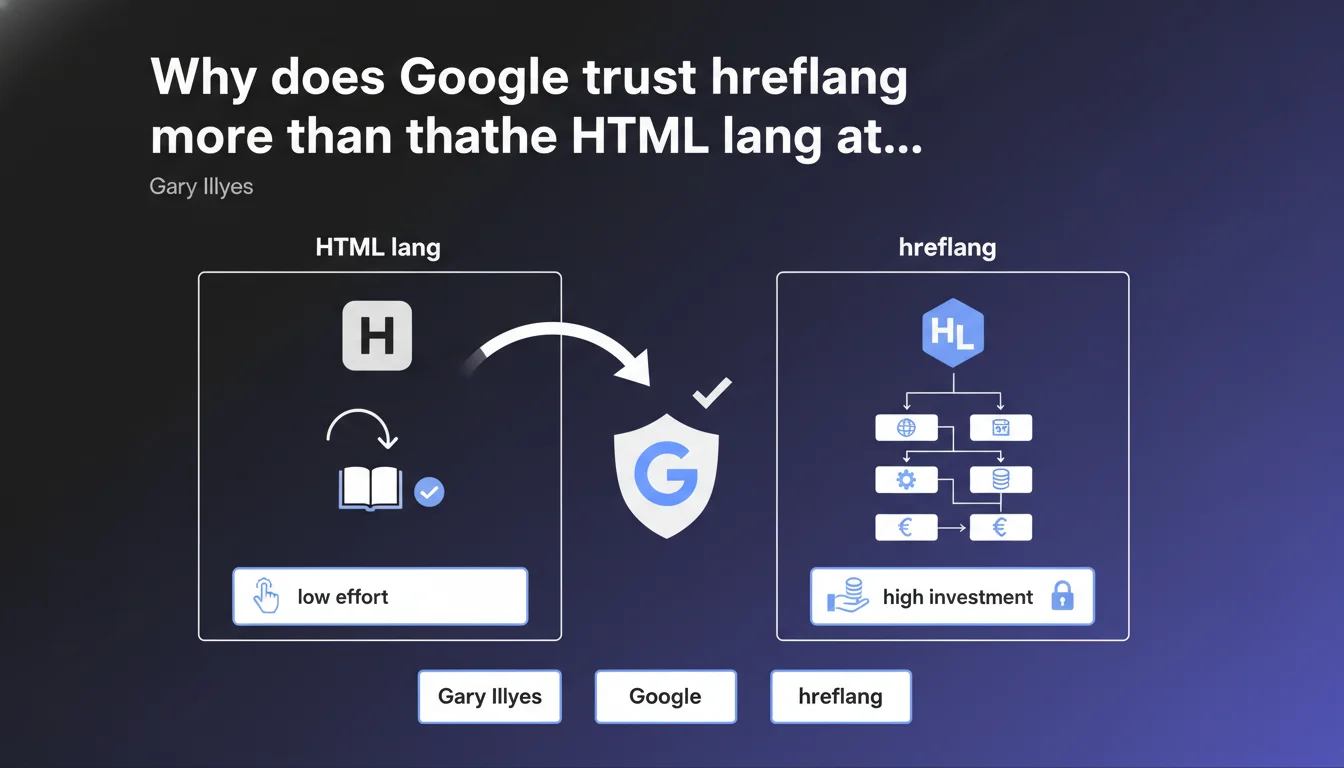
Google considers hreflang more reliable than the HTML lang attribute because its implementation requires significant technical investment. This complexity encourages website owners to ensure their configuration is accurate, unlike the lang attribute which is too easy to add without proper consideration. A reasoning that deserves nuance based on real-world observations.
What you need to understand
What difference in reliability does Google make between hreflang and lang?
Gary Illyes lays out a simple principle: a signal that's difficult to implement is more reliable than a trivial signal. The lang attribute can be added in seconds to the <html> tag without any effort. Hreflang, on the other hand, requires a coherent cross-domain or cross-locale architecture, bidirectional tags, and continuous maintenance.
This complexity would serve as a natural filter. Websites deploying hreflang would statistically have made the effort to verify their language declarations, unlike those simply adding a lang="fr" tag on a whim.
Does this reasoning hold up across all scenarios?
On paper, it's compelling. In reality, poorly configured hreflang remains omnipresent. Reciprocity errors, redirect loops, phantom language versions — all these issues prove that investment doesn't guarantee accuracy.
The lang attribute, even in its simplicity, remains technically correct in 90% of cases. Modern CMSs implement it correctly by default. Hreflang, even on large accounts, accumulates inconsistencies that go uncorrected for months.
Which signal does Google actually prioritize?
Hreflang wins when it's present and consistent. Lang serves as a safety net or secondary confirmation. HTTP Content-Language can also come into play, but Google never discloses the exact weighting between these signals.
What we observe: on multilingual sites without hreflang, Google manages with lang + content analysis + server geolocation. It works, but with more approximations in local SERPs.
- Hreflang = primary signal for language and geographic attribution of versions
- Lang = confirmation signal useful but insufficient alone on multilingual content
- Complexity ≠ accuracy: poorly designed hreflang pollutes results more than simple lang
- Google combines multiple signals — no single one is an absolute guarantee in isolation
SEO Expert opinion
Is this statement consistent with real-world observations?
Partially. Yes, hreflang remains the most powerful lever for controlling geo-linguistic distribution in SERPs. But the correlation "investment = reliability" doesn't hold up against an audit of 50 international e-commerce sites.
We regularly find catastrophic hreflang implementations from players who've spent tens of thousands of euros on development. Conversely, simple single-CMS sites with properly configured lang="de" encounter no targeting issues.
What critical nuance is missing from this assertion?
Google fails to mention that hreflang complexity generates more errors than precision across average deployments. Investment doesn't filter out incompetence — it amplifies errors at scale.
Incorrect hreflang sends massive contradictory signals. Absent or approximate lang allows Google to analyze the content itself, which it's done very well for years. [To verify]: no public data quantifies the actual impact of correct lang versus its complete absence on ranking.
In what cases does this "reliability through investment" logic collapse?
On auto-generated sites. Platforms like Shopify or multilingual WordPress deploy hreflang with a single click via plugin. Zero intellectual investment, random reliability depending on module quality.
Another case: monolingual sites with international content. Adding hreflang "just in case" creates phantom versions that Google indexes poorly. Lang is sufficient and avoids technical bloat.
Practical impact and recommendations
What should you concretely do if you manage a multilingual site?
Start by auditing your current hreflang if you have one. Check link reciprocity, absence of redirect chains, consistency with your actually active versions. Broken hreflang must be fixed or removed — not left as is.
If you don't have hreflang and your architecture is simple (e.g., /fr/, /de/, /en/ on a single domain), verify that the lang attribute is correct on each page. It's a bare minimum that Google will use alongside other signals.
What errors should you absolutely avoid when managing these signals?
Don't deploy hreflang if you lack the resources to monitor it continuously. Every structural change, every new language, every version removal requires an update. Errors accumulate quickly.
Avoid mixing approaches: hreflang in HTTP headers on some pages, in HTML on others, in XML sitemap elsewhere. Choose a single method and stick with it. Google tolerates mixing but it complicates audits and multiplies inconsistency risks.
- Verify hreflang tag reciprocity across all language versions
- Ensure every URL referenced in hreflang returns an HTTP 200
- Confirm the lang attribute matches the main content language
- Avoid hreflang pointing to pages canonicalized to another URL
- Test results display across different Google local versions
- Document your language strategy to facilitate maintenance
How do you verify your configuration is operational?
Use Search Console to spot hreflang errors flagged by Google. Supplement with third-party tools (Screaming Frog, OnCrawl, Sitebulb) to crawl all annotations and detect inconsistencies invisible in GSC.
Manually test by searching from different geolocations (VPN, mobile, Google.de vs Google.fr). If the wrong version appears, your signals contradict each other or Google is ignoring them.
❓ Frequently Asked Questions
Peut-on se passer de hreflang si on a bien configuré l'attribut lang ?
Le hreflang améliore-t-il directement le classement dans les résultats ?
Vaut-il mieux un hreflang incomplet ou pas de hreflang du tout ?
L'attribut lang dans le HTML suffit-il pour un blog multilingue basique ?
Comment Google réagit-il face à des signaux contradictoires entre lang et hreflang ?
🎥 From the same video 14
Other SEO insights extracted from this same Google Search Central video · published on 25/07/2024
🎥 Watch the full video on YouTube →
💬 Comments (0)
Be the first to comment.