
Official statement
Other statements from this video 14 ▾
- □ La structure d'URL a-t-elle un impact sur l'efficacité du hreflang ?
- □ Les ccTLD ont-ils perdu leur valeur SEO pour le ciblage géographique ?
- □ Google peut-il vraiment cibler géographiquement chaque page individuellement ?
- □ Google va-t-il enfin automatiser la détection des balises hreflang ?
- □ Pourquoi Google fait-il davantage confiance au hreflang qu'à l'attribut lang HTML ?
- □ Faut-il vraiment s'inquiéter du hreflang si seulement 9% des sites l'utilisent ?
- □ Faut-il abandonner le hreflang en sitemap au profit du HTML ou HTTP ?
- □ Hreflang déclenche-t-il automatiquement le crawl des URLs alternatives ?
- □ Faut-il vraiment inclure une balise hreflang auto-référencée sur chaque page ?
- □ Hreflang : pourquoi Google n'indexe-t-il pas vos pages alternatives séparément ?
- □ Pourquoi vos pages hreflang disparaissent-elles de la Search Console sans être désindexées ?
- □ La balise hreflang x-default peut-elle pointer vers n'importe quelle page de votre site ?
- □ Hreflang suffit-il à gérer des pages quasi-identiques qui ne diffèrent que par la devise ou la TVA ?
- □ Pourquoi Google a-t-il abandonné son validateur hreflang officiel ?
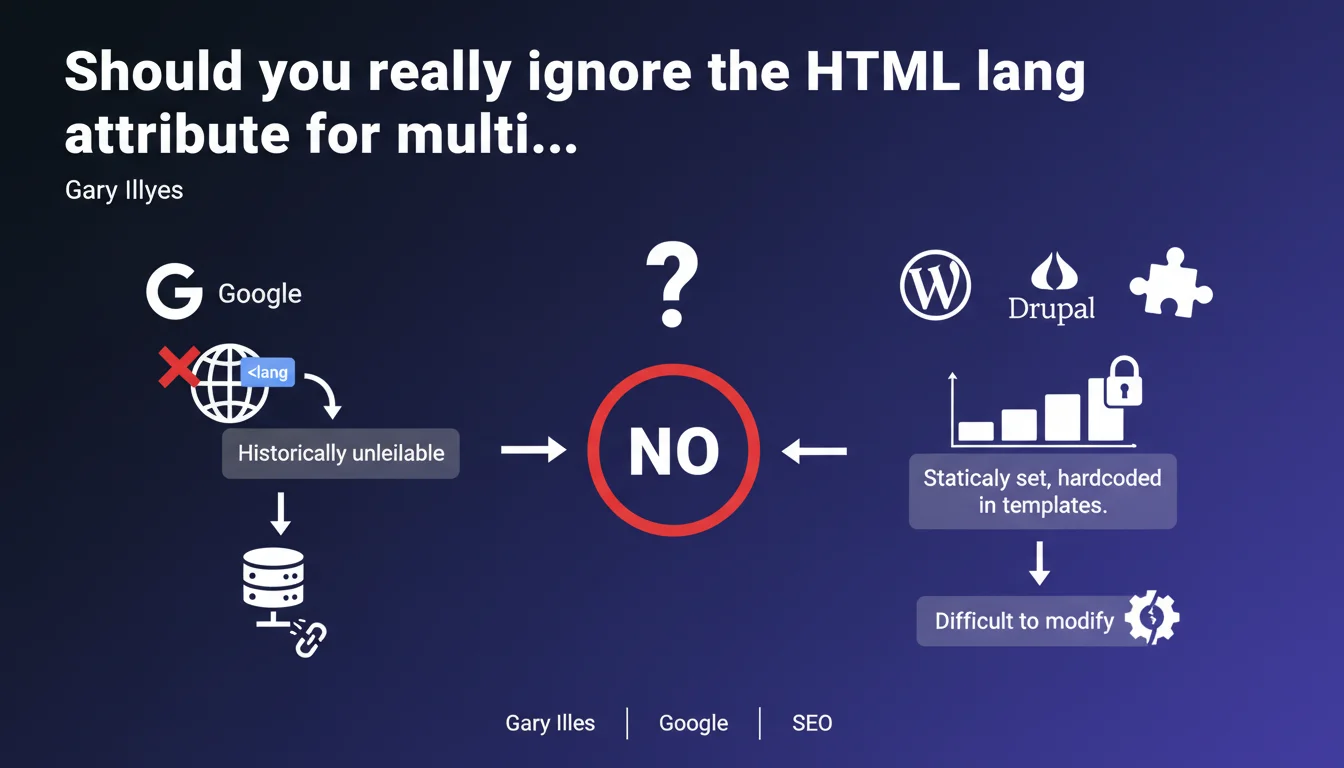
Google does not use the lang attribute of HTML tags to determine a page's language, as this signal has proven historically unreliable. CMS platforms often configured it incorrectly by default. For international SEO, prioritize hreflang tags, visible content, and server geolocation instead.
What you need to understand
Why does Google ignore such a basic signal as the lang attribute?
Gary Illyes' statement is unambiguous: the lang attribute of HTML tags is useless for SEO. Google historically discarded it because this signal proved too noisy and unreliable.
CMS platforms — WordPress, Drupal, Joomla — long defined this attribute statically, often hardcoded in templates. The result: French websites with lang="en-US", German websites with lang="fr-FR". Google eventually deemed this signal unusable at scale.
Which signals does Google rely on to detect language then?
Google primarily analyzes the visible content of the page: text, headings, meta descriptions, link anchors. Natural language processing (NLP) algorithms identify language with far greater accuracy than a declarative HTML attribute.
Other signals include hreflang tags (for language variants), server geolocation, TLD (.fr, .de, .co.uk), and Google Search Console parameters. The lang attribute carries no weight whatsoever in this equation.
Does this mean you should remove the lang attribute from your code?
No. The lang attribute remains useful for accessibility (screen readers, text-to-speech) and certain CSS or JavaScript behaviors. It does not harm SEO — it is simply ignored by Google.
Keep it for web best practices, but do not rely on it to influence your international SEO. It is a signal for browsers and assistive technologies, not search engines.
- The HTML lang attribute is not used by Google to determine a page's language.
- CMS platforms often configured this signal incorrectly, making it an unreliable indicator.
- Google prioritizes visible content analysis, hreflang tags, and geolocation.
- Maintain the lang attribute for accessibility, not SEO.
SEO Expert opinion
Is this statement consistent with real-world observations?
Yes, entirely. I have audited hundreds of multilingual websites and the lang attribute has never been a determining factor in rankings or indexation. Language targeting problems always come from elsewhere: misconfigured hreflang tags, duplicate content between language versions, absence of clear URL distinction.
Gary Illyes' statement merely confirms what practitioners have observed for years. Those who corrected the lang attribute hoping to gain rankings wasted their time.
Why this clarification now?
Because the lang attribute remains a persistent myth in the SEO checklist of many automated tools. Screaming Frog, Sitebulb, and similar platforms still flag "errors" if lang="fr" does not match the detected content language. These alerts create confusion and divert attention from real problems.
Google benefits from clarifying this point to prevent SEO professionals from wasting time on optimizations with zero impact. It is also a reminder that declarative signals (such as meta keywords tags) have often been abandoned in favor of semantic analysis.
What nuances should be applied to this rule?
The lang attribute does not affect rankings, but it can indirectly influence user experience. A screen reader that detects language poorly will mispronounce content, potentially increasing bounce rates for visually impaired users. Difficult to measure, but real.
Furthermore, certain data-scraping bots (Bing, Yandex, vertical search engines) may still rely on this attribute. If your SEO strategy extends beyond Google, do not neglect it entirely. [To verify]: no official Bing or Yandex documentation explicitly confirms the use of the lang attribute, but their documentation remains vague.
Practical impact and recommendations
What should you do concretely if you manage a multilingual website?
Focus your efforts on hreflang tags. Verify they are present in HTML or the XML sitemap, that they point to canonical URLs, and that they form a complete bidirectional mesh. This is the only explicit signal Google uses to understand relationships between language versions.
Next, ensure that each language version contains unique and natural content in the target language. No unreviewed machine translation, no mixed content (French with English blocks). Google detects the dominant language — if it does not match your targeting, you have a problem.
What errors should you absolutely avoid?
Do not rely on audit tools that flag a "wrong lang attribute" as a high priority. That is noise. Invest that time in fixing hreflang tags, disambiguating URLs (subdomains vs. subdirectories vs. ccTLD), and ensuring consistency in geographic targeting in Search Console.
Also avoid mixing signals: if you target France with a .fr domain, French content, and fr-FR hreflang tags, a lang="en" attribute will break nothing — but it reveals negligence in technical setup. Stay consistent on principle, even if the SEO impact is zero.
How can you verify that your international SEO configuration is solid?
- Audit your hreflang tags with a dedicated tool (hreflang Tags Testing Tool, Merkle's hreflang Validator).
- Verify that each page has a hreflang pointing to itself (self-reference).
- Check that canonical URLs match the URLs in hreflang tags.
- Manually test in Google Search Console the geographic targeting of each language version.
- Scan visible content to detect language mixing (menu in French, content in English).
- Ignore tool alerts about the HTML lang attribute — it is not a ranking factor.
❓ Frequently Asked Questions
L'attribut lang a-t-il un impact sur le SEO pour d'autres moteurs de recherche que Google ?
Faut-il supprimer l'attribut lang de mon code HTML ?
Si l'attribut lang est mal configuré, cela peut-il nuire au SEO ?
Quelle est la différence entre l'attribut lang et les balises hreflang ?
Les outils d'audit SEO qui signalent un attribut lang incorrect sont-ils dans l'erreur ?
🎥 From the same video 14
Other SEO insights extracted from this same Google Search Central video · published on 25/07/2024
🎥 Watch the full video on YouTube →
💬 Comments (0)
Be the first to comment.