
Official statement
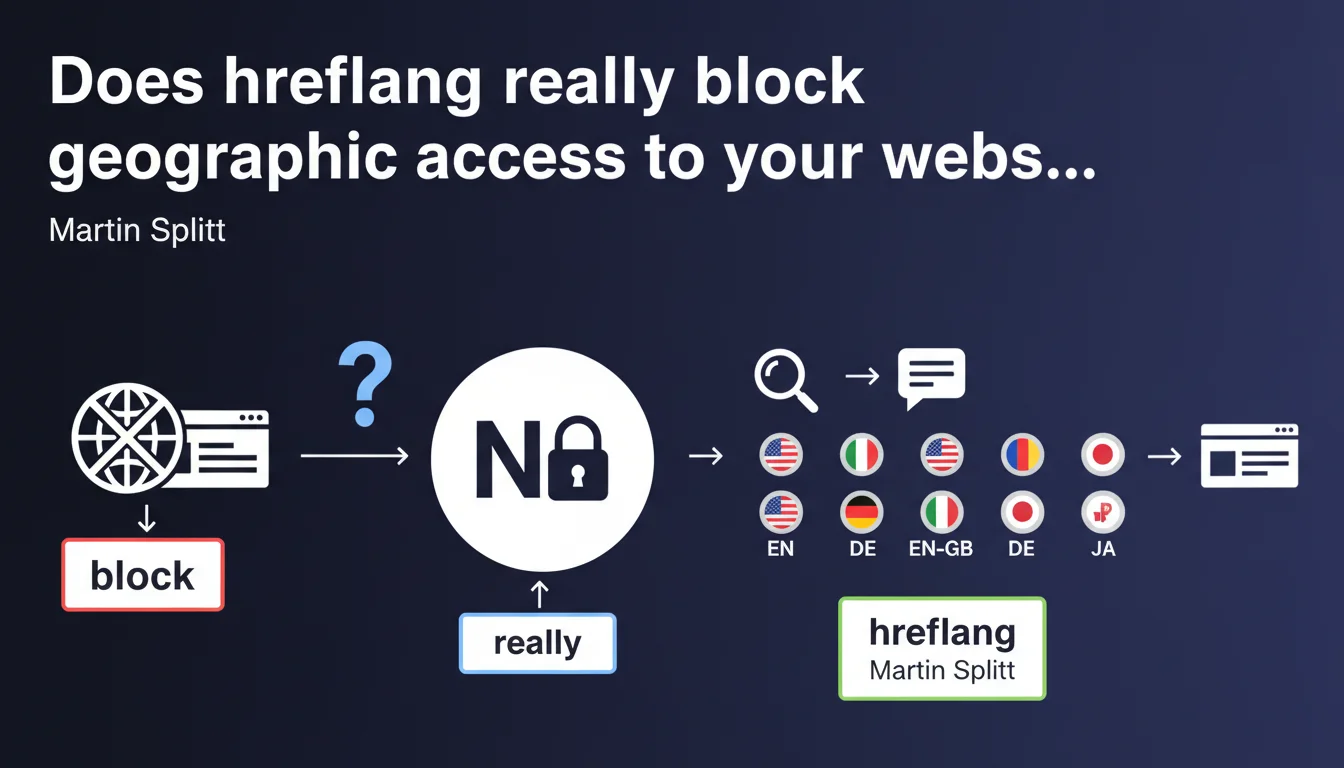
Martin Splitt reminds us that hreflang is merely a signal for language and regional targeting by search engines, not a mechanism for restricting geographic access. Too many sites still confuse preference indication with actual blocking. In practice: if you don't actively geoblocking your content on the server side, a user from any country will be able to access all your language versions, regardless of your hreflang markup.
What you need to understand
Why does this confusion between targeting and restriction persist?
Many SEO practitioners still associate hreflang with a form of access control. This is a conceptual error stemming from a misunderstanding of this attribute's primary function.
Hreflang tells Google which language or regional version of a page to prioritize in search results for a given user. Nothing more. It is neither a geographic lock, nor an automatic redirect, nor an IP filter.
What is the concrete difference between a signal and a block?
A signal is information you transmit to the search engine to help it make an editorial choice in its SERPs. A block is a server-side mechanism (IP, cookie, location detection) that technically prevents access to content.
If you implement hreflang without server-side restrictions, a Japanese user can perfectly land on your French version if they type the URL directly or click on an external link. Google won't prevent it — it will simply prioritize the Japanese version in organic results if it exists and is properly marked up.
What are the practical implications for crawling and indexing?
Google crawls and indexes all language versions declared via hreflang, regardless of its bot's location. It does not limit itself to a single geographic variant.
If you really want to restrict access to certain pages based on geolocation, you need to implement server-side geoblocking (IP detection, 302 redirect, or 403 code). But be careful: this practice seriously complicates crawling and can harm your indexing if misconfigured.
- Hreflang = preference signal for SERPs, not an access lock
- Without server blocking, all your URLs remain accessible from any country
- Google crawls all language variants, not just your primary market
- Technical geoblocking complicates crawling and must be handled carefully
SEO Expert opinion
Is this statement consistent with real-world observations?
Yes, absolutely. We regularly see sites deploying hreflang thinking it's enough to "protect" their regional versions or prevent an American user from accessing the French version. This is false.
The problem is that some CMS platforms and e-commerce solutions create this confusion by coupling hreflang with automatic redirects based on browser language detection. As a result, practitioners think hreflang does the job, when in reality it's the server-side application logic.
What nuances should be added to this official position?
Martin Splitt is right in principle, but he simplifies a bit. In real life, hreflang is often part of a multi-layer strategy that combines SEO signals, conditional redirects, and sometimes geoblocking.
If you manage an e-commerce site with legal constraints (differentiated pricing, country-specific sale restrictions), you'll probably implement geoblocking in addition to hreflang. The two are not incompatible, but they address different needs. Hreflang helps with SEO, geoblocking manages access.
[To verify]: some report that Googlebot may sometimes struggle to properly crawl sites with strict geoblocking, especially when URLs are served as 403 or 302 based on IP. Google recommends using exceptions for bot user-agents, but documentation remains unclear on exact best practices in these edge cases.
In what cases does this rule not apply fully?
If you've implemented aggressive geoblocking that blocks Googlebot or systematically redirects crawlers to a single language version, hreflang is pointless. Google simply won't be able to discover and index your alternative variants.
Another case: sites using JavaScript to detect browser language and dynamically display translated content on a single URL. There, hreflang makes no sense — you need a distinct URL per language for the attribute to work.
Practical impact and recommendations
What should you concretely do to use hreflang correctly?
First, be clear about your objective. If you simply want Google to serve the correct language version in search results, hreflang is enough. If you want to prevent geographic access to certain pages, you need an additional server-side mechanism.
Next, verify that each language variant has a distinct and accessible URL. No dynamic content loaded in JS on a single URL — hreflang only works with different URLs.
What mistakes must you absolutely avoid?
Don't mix hreflang with poorly configured automatic geographic redirects. If you systematically redirect a French user to /fr/ when they arrive on your site, Googlebot may never see the other versions.
Another common mistake: forgetting the reciprocity of hreflang tags. Each variant must point to all others AND to itself with x-default if necessary. Without this, Google often ignores the markup.
Finally, don't rely on hreflang to "hide" content or prevent indexing of a version. If a page is accessible and crawlable, it will be indexed, even if it's not the hreflang target for the market in question.
How do you verify that your implementation is correct?
Use Search Console to detect hreflang errors (missing reciprocity, invalid language codes, non-canonical URLs). Also verify that all your variants are properly indexed and accessible from different countries.
Test your URLs with a VPN or geolocation simulation tool to ensure there are no unexpected blocks or redirects. If Googlebot sees 403 or 302, your hreflang will be pointless.
- Create a distinct URL for each language or regional variant
- Implement hreflang in HTML, HTTP header, or XML sitemap depending on your architecture
- Verify the reciprocity of all hreflang tags (each page points to all others)
- Ensure that Googlebot can freely access all variants without geoblocking or automatic redirects
- Use x-default to indicate a fallback page or language selector
- Monitor hreflang errors in Search Console
- Test URL access from different countries to detect any server-side blocks
💬 Comments (0)
Be the first to comment.