
Official statement
What you need to understand
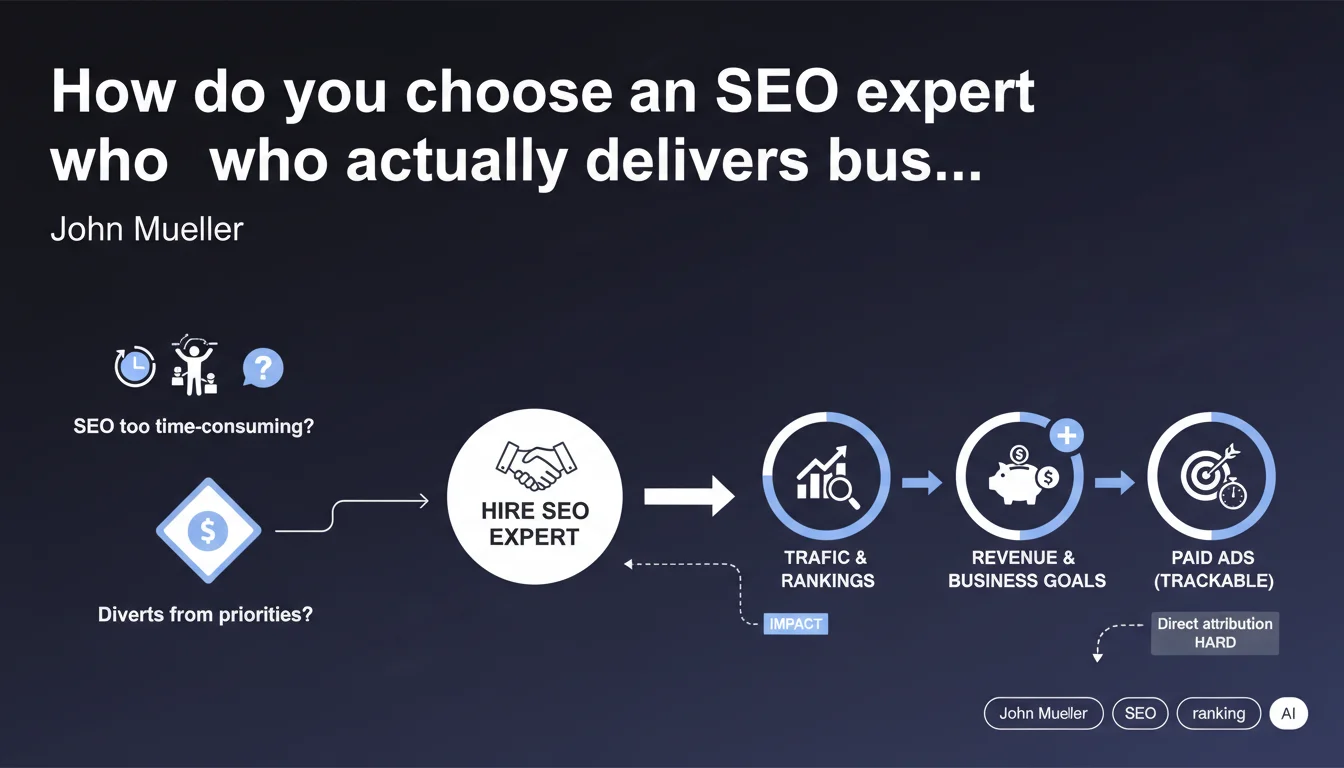
Google officially recognizes that SEO is time-consuming and that there comes a moment when delegating becomes a strategic necessity. This moment arrives when search engine optimization diverts the business owner from their main commercial priorities.
The statement emphasizes a major paradigm shift: measuring SEO by its real business impact rather than by superficial metrics. Traffic and rankings are merely intermediate indicators, the ultimate goal being the contribution to revenue.
Google also warns against unrealistic promises. Ranking factors are largely beyond the control of an SEO provider, which makes any guarantee of specific results fundamentally misleading.
- SEO should be outsourced when it consumes too much management time
- KPIs must reflect the impact on revenue, not just traffic
- SEO attribution is complex and less direct than paid advertising
- No legitimate expert can guarantee specific rankings or traffic
- A provider's quality is measured by their transparency about SEO limitations
SEO Expert opinion
This position from Google is perfectly consistent with field reality. Serious SEO consultants know that algorithms constantly evolve and that hundreds of factors, including competition and user behaviors, influence results.
The important nuance concerns SEO results attribution. While direct attribution is indeed complex, methodologies do exist: multi-touch attribution models, cohort analyses, A/B testing on geographic samples. A good SEO expert must master these approaches to demonstrate their value.
In certain highly technical or local sectors, the impact of SEO on business can be tracked with greater precision thanks to simplified customer journeys. Therefore, we shouldn't completely abandon measurement, but approach it with adapted methodologies.
Practical impact and recommendations
- Assess your time: calculate the hours devoted to SEO and their opportunity cost compared to your direct revenue-generating activities
- Define business KPIs: conversion rate, average order value from SEO, organic customer acquisition cost, lifetime value
- Install advanced tracking: consistent UTM parameters, Google Analytics 4 with custom events, Search Console and Analytics linking
- Create a mixed dashboard: combine SEO metrics (rankings, traffic, authority) and business metrics (conversions, revenue, ROI)
- Question candidates about their limitations: a good expert will explain what they cannot guarantee rather than promise first position
- Request case studies with business results: demand proof of impact on revenue, not just on traffic
- Establish a contract based on deliverables: audits, corrections, content, link campaigns rather than guaranteed rankings
- Plan a test period of at least 6 months: SEO requires time, beware of promised instant results
- Demand transparency on methods: ensure that techniques comply with Google guidelines and are sustainable
Summary of recommendations: Outsource your SEO when it becomes an obstacle to your growth, but choose a partner who measures their impact on your revenue rather than on vanity metrics. Beware of unrealistic guarantees and favor experts who are transparent about the complexity of search engine optimization.
Setting up a comprehensive measurement system and managing a business-oriented SEO strategy represent a substantial methodological investment. For companies that want to structure this approach without excessively mobilizing their internal resources, support from an experienced SEO agency provides access to advanced reporting tools, proven attribution methodologies, and strategic expertise to perfectly align search engine optimization objectives with commercial priorities.
💬 Comments (0)
Be the first to comment.