
Official statement
John Mueller also emphasizes the need to set realistic expectations about targeted keywords. Attempting to rank for queries that are too broad or competitive, such as "bookstore on the internet," is often unrealistic. It's better to target local or specific searches. He reminds us that if a site already achieves its business objectives, it's not necessarily necessary to optimize everything for SEO. The essential thing is that the site functions according to the company's expectations, even if it could theoretically perform even better.
What you need to understand
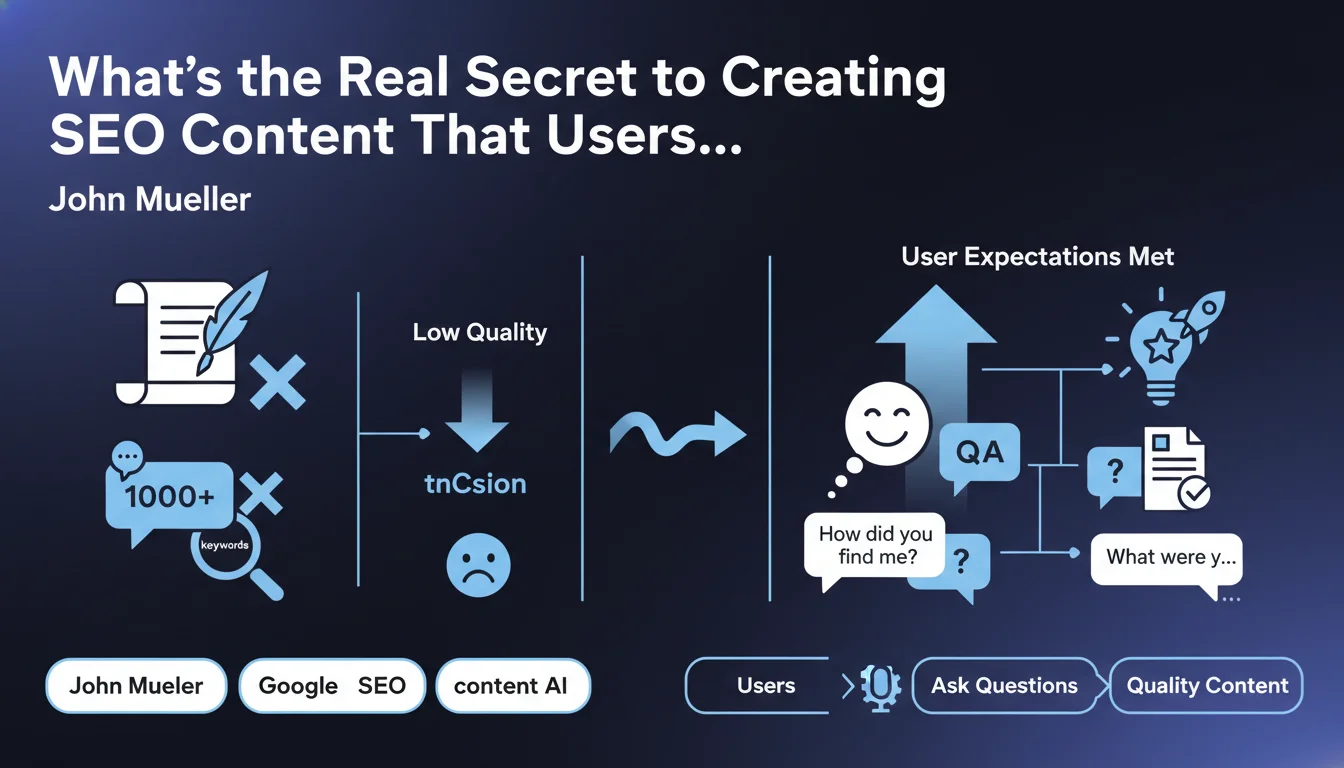
Google reaffirms a fundamental truth: the quality of content is not measured by its length or keyword density, but by its ability to precisely meet user needs. This statement directly targets a practice still too widespread in the SEO industry: the creation of artificially "inflated" content.
John Mueller and Martin Splitt point the finger at the obsession with word quotas and keyword stuffing, which produce verbose and diluted content. These practices harm user experience and, ultimately, ranking in search results.
The central recommendation is to adopt a user-centric approach based on real data. Rather than speculating about what users want, you need to directly ask them about their search intentions and needs.
- Prioritize relevance over length: short, precise content is better than a diluted wall of text
- Directly question visitors to understand their real queries and intentions
- Set realistic goals: avoid targeting keywords that are too broad or ultra-competitive
- Favor niches and local: specific searches offer better positioning opportunities
- Align SEO with business objectives: optimization must serve concrete commercial results
SEO Expert opinion
This statement is perfectly consistent with the algorithmic evolutions we've been observing for several years, particularly with the Helpful Content updates. Google now has behavioral signals sophisticated enough to detect when content "fills space" without providing value.
An important nuance to add: length is not the enemy in itself. Some complex informational queries legitimately require in-depth content of 2000+ words. The problem arises when you artificially lengthen to reach an arbitrary quota, without each section bringing real value.
The recommended approach of questioning users is excellent in theory, but requires a certain analytics maturity. Small sites don't always have the traffic volume allowing statistically significant insights. In this case, analyzing SERPs, PAA (People Also Ask), and specialized forums remains a valid alternative.
Practical impact and recommendations
- Audit your existing content: identify pages where you've artificially "filled" to reach a word quota, and condense them by keeping only high-value information
- Implement a post-visit questionnaire: add simple questions ("Did you find what you were looking for?", "How did you discover us?") to collect qualitative data
- Analyze Search Console queries: identify real queries that generate impressions but few clicks, and optimize content to better address them
- Abandon unrealistic goals: if you're targeting ultra-generic keywords in sectors dominated by giants, redirect your strategy toward niches and long-tail keywords
- Favor local/specific angles: rather than "online bookstore", target "science fiction specialty bookstore Lyon" if that matches your offering
- Establish business KPIs before SEO: define what success means for your business (conversions, leads, revenue) and measure whether SEO actually contributes to it
- Remove the superfluous: eliminate "filler" sections like endless historical introductions that add nothing for the time-pressed user
- Test the question/answer format: structure your content around real questions your users ask
In summary: this Google directive pushes toward a qualitative approach centered on the real user rather than artificial metrics.
Implementing this philosophy requires a potentially deep overhaul of your content strategy, including user analysis tools, substantial rewriting of existing content, and strategic repositioning of targeted keywords.
These transformations can prove complex to orchestrate alone, particularly to align user research, data analysis, and large-scale rewriting. Calling on a specialized SEO agency accelerates this process through proven methodologies, professional behavioral analysis tools, and expertise in restructuring high-value content.
💬 Comments (0)
Be the first to comment.