
Official statement
Other statements from this video 14 ▾
- □ Does your URL structure really affect how hreflang works on Google?
- □ Are ccTLDs really losing their SEO weight for geographic targeting?
- □ Can Google really target geography at the individual page level?
- □ Should you really ignore the HTML lang attribute for multilingual SEO?
- □ Will Google finally automate hreflang tag detection?
- □ Why does Google trust hreflang more than the HTML lang attribute?
- □ Should you really worry about hreflang if only 9% of websites actually use it?
- □ Should you abandon hreflang in sitemaps and switch to HTML or HTTP headers instead?
- □ Do you really need to include a self-referencing hreflang tag on every page?
- □ Does Google really index your multilingual pages separately with hreflang, or does it only store one version?
- □ Why are your hreflang pages disappearing from Search Console without being deindexed?
- □ Can your x-default hreflang tag really point to any page on your site?
- □ Is hreflang really enough to handle nearly identical pages that only differ by currency or VAT?
- □ Why did Google discontinue its official hreflang validator tool?
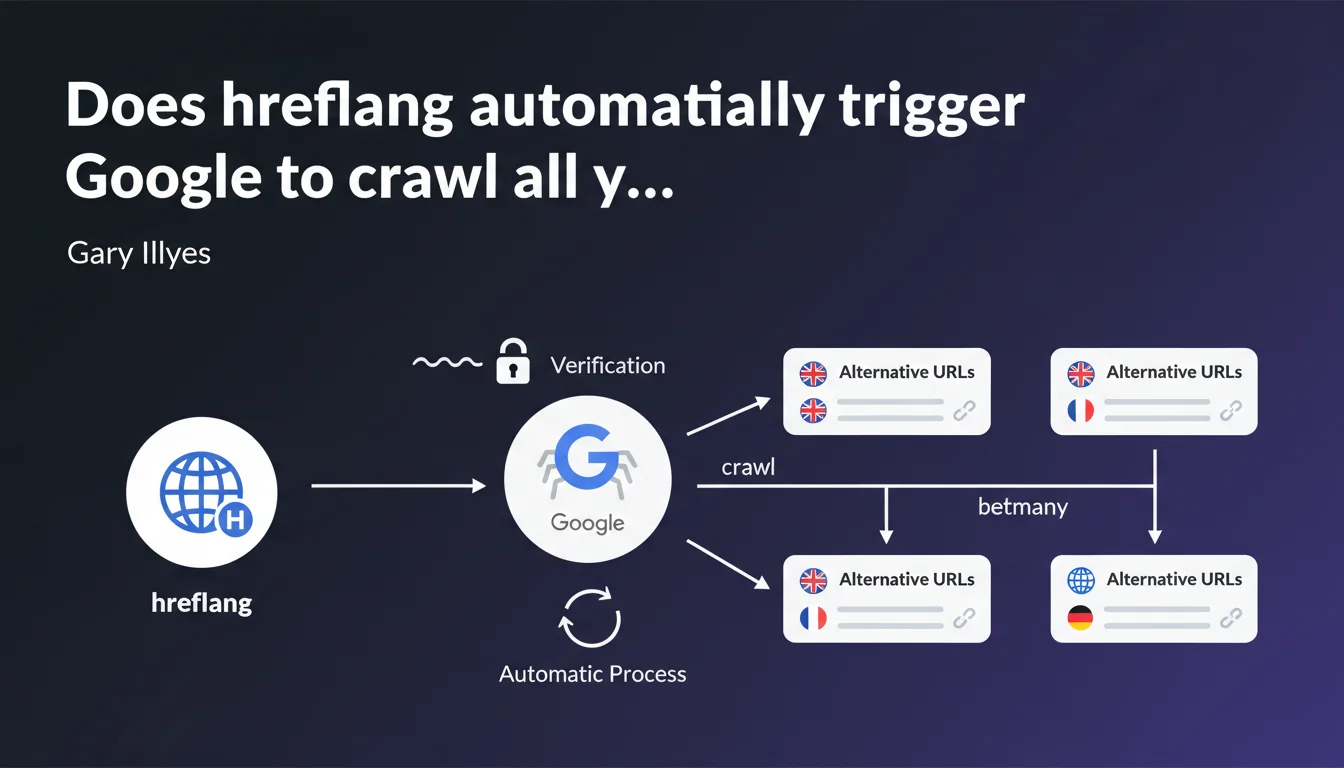
Google automatically crawls alternative URLs as soon as it detects an hreflang annotation to verify they belong to the same linguistic cluster. This dependency verification is not optional—it triggers systematically, directly impacting your crawl budget if your annotations are misconfigured.
What you need to understand
Gary Illyes confirms here a mechanism that is often underestimated: each hreflang tag triggers additional crawling to validate the coherence of the linguistic variation cluster. This verification doesn't wait for the next Googlebot pass—it's automatic and immediate.
Concretely? If your FR page points to 15 linguistic versions via hreflang, Google will attempt to crawl these 15 URLs to ensure they point back to the FR page. It's the reciprocity that validates the cluster.
Why does Google systematically verify hreflang annotations?
Because hreflang relies on a principle of mutual trust: each URL must confirm its relationship with the other versions. If an FR page declares an EN version, but the EN version doesn't return the favor, the cluster is invalid.
Google can't simply read your XML sitemap and assume everything is perfect. It must crawl to validate. This logic explains why hreflang errors in Search Console sometimes persist for weeks: Googlebot waits to be able to re-crawl all affected URLs.
What is the direct consequence on crawl budget?
Each misconfigured hreflang annotation generates unnecessary crawls. If you have 1,000 pages with 10 linguistic versions each, but 3 versions don't respond correctly, you waste thousands of crawls per month.
High-volume multilingual sites are the first to be affected. An incorrect hreflang sitemap can literally saturate your crawl budget with dependency verification that fails in a loop.
- Hreflang triggers automatic crawling of the alternative URLs mentioned
- Verification serves to validate that all URLs belong to the same linguistic cluster
- This reciprocity logic is non-negotiable: without confirmed return, the cluster is rejected
- Hreflang errors consume crawl budget unnecessarily
- The more linguistic versions you have, the more exponential the impact
SEO Expert opinion
Does this statement match real-world observations?
Yes, and it's actually one of the rare Google statements that perfectly aligns with what we observe. When you add an hreflang tag to a page, you quickly notice an increase in crawls on the referenced URLs—often within 48-72 hours.
The problem is that Google doesn't specify the re-verification frequency. Once the cluster is validated, does Googlebot re-crawl on each pass or only if a URL changes? [To verify]: there's no public data on this point.
What errors are most costly in terms of crawl budget?
Loop annotations or poorly reciprocated ones. Classic example: your FR page points to an EN page that itself declares no hreflang. Googlebot crawls, detects the inconsistency, and will repeat on each pass until corrected.
Another frequent case: hreflang URLs that return 404s or 301s. There, you force Google to crawl dead or redirected URLs—so much wasted budget. And if your redirects aren't themselves annotated with hreflang, the cluster remains broken indefinitely.
Should you limit the number of hreflang versions to preserve crawl budget?
Let's be honest: if you have 25 linguistic versions with 100,000 URLs per language, you're already in a critical zone. But the solution isn't to remove valid hreflang—it's to ensure each annotation is clean.
A cluster of 5 well-configured versions consumes less crawl than a cluster of 2 poorly reciprocated versions. Volume is only a problem if technical quality isn't there. Prioritize coherence, not artificial reduction.
Practical impact and recommendations
How do you verify that your hreflang annotations are properly reciprocated?
Crawl your site with Screaming Frog or OnCrawl by extracting the hreflang tags from each URL. Export everything to a spreadsheet and verify that each cited URL declares the source URL in return.
If your /fr/produit page points to /en/product, then /en/product must point back to /fr/produit. If it doesn't, Google considers the cluster invalid and will re-crawl in a loop trying to validate.
What if you have thousands of hreflang errors in Search Console?
Start by identifying the error patterns: is it a pagination issue? URL parameters? Poorly managed redirects? Don't correct URL by URL—look for the systemic cause.
Once fixed, submit the updated XML sitemaps and request a re-crawl via the URL Inspection tool for a few representative pages. But be warned: Google doesn't re-crawl instantly. Allow several weeks for errors to fully resolve.
What configurations should you absolutely avoid?
- Never point to URLs that return 404, 301, or 302 in your hreflang annotations
- Never mix HTML tags and XML sitemaps without verifying coherence—in case of conflict, Google often ignores both
- Never declare an alternative URL that doesn't itself have hreflang tags
- Never use hreflang on non-indexable pages (blocked by robots.txt, noindex, etc.)
- Verify that all linguistic versions are truly crawlable: if Googlebot can't access a cited URL, the cluster remains invalid
- Avoid declaring x-default versions that aren't actually language selection pages—Google treats them as standard alternative URLs
Rigorous management of hreflang annotations is a major technical issue for multilingual sites. Between cluster validation, tag reciprocity, and crawl budget optimization, the pitfalls are numerous.
If your multilingual architecture becomes complex or errors persist despite your corrections, the support of an SEO agency specializing in this area may prove valuable to conduct an in-depth audit of your configurations and implement a tailored strategy.
❓ Frequently Asked Questions
Hreflang consomme-t-il du crawl budget même si les annotations sont correctes ?
Faut-il privilégier les balises HTML ou les sitemaps XML pour hreflang ?
Que se passe-t-il si une URL hreflang renvoie une 301 ?
Peut-on utiliser hreflang pour des variantes régionales d'une même langue ?
Combien de temps faut-il pour que Google corrige les erreurs hreflang dans la Search Console ?
🎥 From the same video 14
Other SEO insights extracted from this same Google Search Central video · published on 25/07/2024
🎥 Watch the full video on YouTube →
💬 Comments (0)
Be the first to comment.