
Official statement
Other statements from this video 21 ▾
- □ Should you update the same page or create a new URL every day for frequently refreshed content?
- □ Should you stop using the manual submission tool in Google Search Console?
- □ Do HTML5 <header> and <footer> tags really boost your SEO rankings?
- □ Should you really rely on the schema.org validator to optimize your structured data?
- □ Does improving page speed really boost your rankings as fast as everyone claims?
- □ Does Google really crawl all your sitemaps at the same pace?
- □ Does Google really keep crawling a sitemap after you remove it from Search Console?
- □ Is Google really refusing to index your pages even though they're crawled regularly and have no technical issues?
- □ Can you safely use bidirectional canonicals between two site versions without any risk?
- □ Can structured data really replace traditional internal linking strategy?
- □ Why is one x-default enough for your entire multi-domain hreflang configuration?
- □ Should you really avoid product structured data on category pages?
- □ Do you really need to pick one primary language per page if you're targeting multiple markets?
- □ Why is Google completely ignoring your desktop version once mobile-first indexing kicks in?
- □ Can commodity content really survive in Google search results?
- □ Should you isolate your FAQs on separate pages to rank better?
- □ Is Google really cutting back on FAQ rich snippets in search results, and what does that mean for your SEO strategy?
- □ Is Google really ignoring 95% of your submitted URLs—and what does that say about your content?
- □ Can you host your XML sitemap on a different domain than your main website?
- □ Does the shift from 'Bad' to 'Medium' on Core Web Vitals really transform your Google rankings?
- □ Does server speed really impact the crawl budget of large websites?
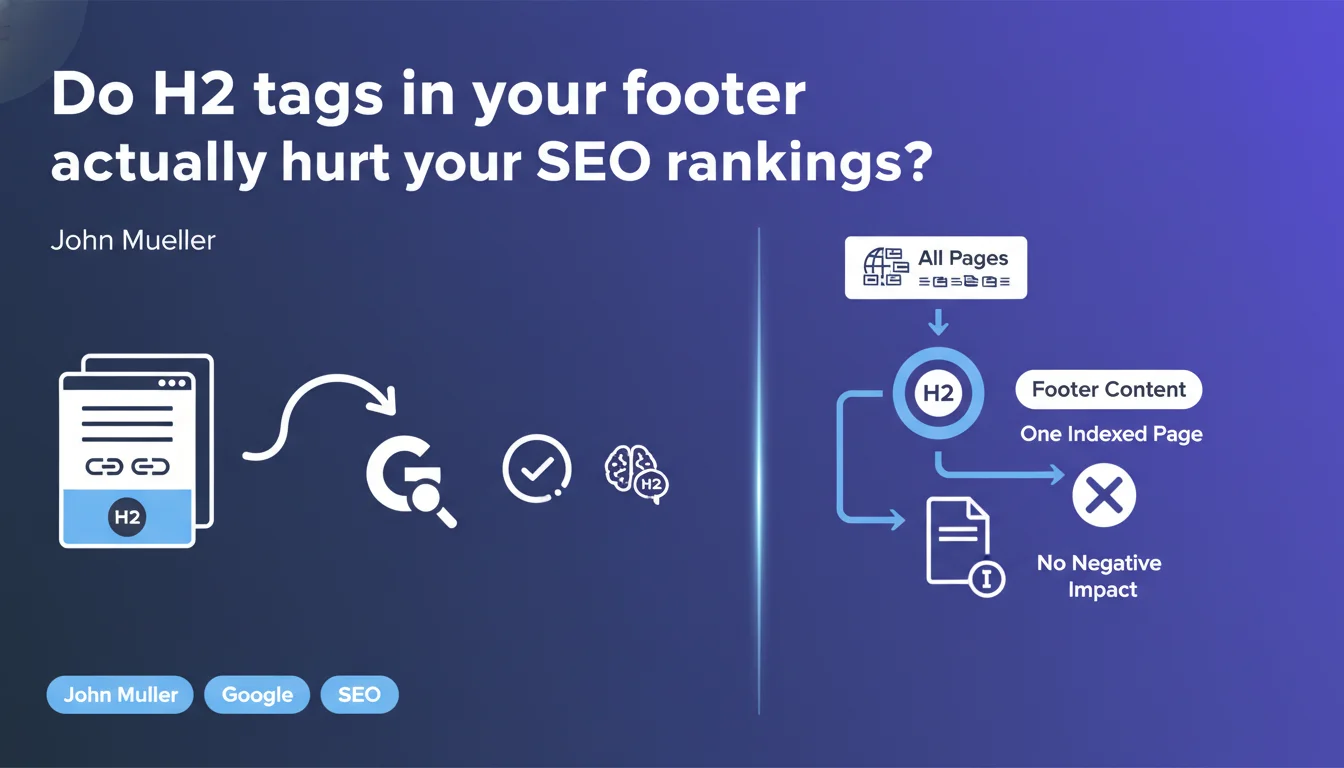
Google automatically de-emphasizes repeated elements that appear on every page (footers, headers, sidebars). Using H2 tags in the footer therefore has no negative SEO impact — Google will simply index one page for this common content without penalizing the rest. Bottom line: stop stressing over heading hierarchy in shared page sections.
What you need to understand
Why does this question keep coming up among SEO professionals?
For years, we've been hammered with the idea that heading tag hierarchy must be followed strictly. One H1 per page, H2s to structure main content, H3s for subsections. It makes sense.
Except this rigid rule becomes problematic when you incorporate common elements like footers or sidebars. If your footer contains three columns with H2 headings ("About Us", "Our Services", "Contact"), these tags repeat on every page. The risk? Drowning your real content H2s in a sea of duplicate headings.
How does Google actually handle repeated elements?
Google states here that it automatically recognizes common zones present across your entire site. Its algorithm identifies the footer, header, sidebar — and treats them differently from unique page content.
Concretely, it will index only one page for the footer text (likely the first one it crawls), then ignore these repetitions when analyzing other pages semantically. Result: your footer H2s don't compete with your editorial H2s. Zero negative impact.
Does this mean you can do anything with heading tags?
No. The nuance is critical. Google says repeated elements are de-emphasized — not that heading hierarchy doesn't matter at all.
For main content, hierarchy remains a signal for topic understanding. But for common zones, you have flexibility: H2, H3, or even plain styled divs work fine. What matters is that your main content is clearly structured.
- Google automatically detects and isolates common elements (footer, header, sidebar)
- Heading tags in these zones don't impact individual page SEO
- Footer indexing happens on just one page, not every occurrence
- Heading hierarchy remains important for unique main content on each page
- No penalty for using H2 tags in footers
SEO Expert opinion
Is this statement consistent with real-world observations?
Yes, and it's actually reassuring. For years, I've observed that sites with H2 tags in the footer suffer no penalty — as long as main content is well-structured. Thousands of WordPress sites use themes with H2 or H3 footers and rank very well.
The real problem emerges when you abuse heading tags in editorial content itself: six H2s with no logic, H3s placed before H2s, etc. Then Google struggles to identify the main topic. But the footer? Google couldn't care less.
Which sections exactly fall under this "common content" logic?
Google intentionally stays vague — as usual. You can reasonably include: footer, header, sidebar, navigation menus, repeated reassurance blocks. [To verify]: are breadcrumbs and navigation trails structured as heading tags also covered? Probably, but Google never explicitly states it.
My advice: if an element appears on more than 80% of pages, it will likely be de-emphasized. However, a "related articles" block that changes by page doesn't fall into this category.
Should you completely ignore HTML semantics in footers?
No, and that's where many make mistakes. It's not because Google de-emphasizes the footer that you should turn it into tag soup. Accessibility, user experience, and even certain SEO analysis tools require clean HTML structure.
Using H2s in the footer remains relevant for UX — screen readers rely on these tags for navigation. But if your CMS forces H3 or H4, it's not an SEO disaster. Put your energy elsewhere.
Practical impact and recommendations
What should you concretely do with your footer heading tags?
First step: change nothing if your footer already works. Seriously. If your pages rank well, your editorial structure is clear, and you have H2s in the footer, leave it alone. That's not where your ranking problems lie.
Second step: focus on main content structure. That's where heading hierarchy actually impacts your SEO. One clear H1 per page, H2s that segment big ideas, H3s for subsections. Simple, logical, effective.
What mistakes should you avoid despite this tolerance?
Don't confuse "Google ignores the footer" with "I can stuff anything in there". Some practices remain counterproductive.
Avoid overloading the footer with 50 internal links stuffed with exact-match keywords. Google de-emphasizes the footer, true, but it also detects manipulation patterns. If your footer looks like a link factory, you risk diluting your link juice — or triggering manual action.
- Verify that your main content uses coherent heading hierarchy (H1 > H2 > H3)
- Ensure only one H1 appears on each page (in main content, not the footer)
- Limit the number of links in the footer (ideally fewer than 20-30)
- Use heading tags in the footer only if they serve accessibility or UX
- Don't repeat your strategic keywords in the footer if you're already using them in main content
- Test footer de-indexing via Google Search Console: search exact phrases from your footer to see if Google indexes them on one page or every page
How can you verify that Google treats your footer as a common element?
Search Google for an exact phrase from your footer, in quotes. Example: "All rights reserved - My Company 2024". If Google returns just one page (or a limited number), it has correctly identified the footer as common. If all your pages appear, it's indexing each occurrence — not necessarily catastrophic, but revealing.
Another test: use the URL Inspection tool in Search Console. Google displays the indexed content as it sees it. If the footer is absent or minimized in this view, that's a good sign.
❓ Frequently Asked Questions
Puis-je utiliser plusieurs H1 sur une même page si l'un est dans le footer ?
Les balises Hn dans la sidebar sont-elles traitées comme celles du footer ?
Faut-il éviter les mots-clés dans les titres de footer ?
Cette règle s'applique-t-elle aux footers différents selon les sections du site ?
Les footers lourds en liens nuisent-ils au crawl budget ?
🎥 From the same video 21
Other SEO insights extracted from this same Google Search Central video · published on 05/03/2022
🎥 Watch the full video on YouTube →
💬 Comments (0)
Be the first to comment.