
Official statement
Other statements from this video 16 ▾
- □ Should you really remove meta keyword tags from your website?
- □ Should you update your sitemap's lastmod date every time you make a minor change?
- □ Should you really separate news sitemaps and general sitemaps to avoid duplicate URLs?
- □ Is Google really ignoring your carefully crafted meta description in favor of something else?
- □ Should you really waste time cleaning up spammy backlinks from your link profile?
- □ Should you still optimize keyword density for SEO in 2025?
- □ Does disavowing toxic backlinks really help you recover your lost rankings after a penalty?
- □ Why do 301 redirects remain absolutely critical when migrating to a new domain?
- □ Can a 404 code targeting Googlebot block the indexing of your pages?
- □ Does Google really require identical content on mobile and desktop for mobile-first indexing to work?
- □ Do you really need to request removal of redirected URLs from Google's index?
- □ Does verifying your site in Search Console really improve your SEO rankings?
- □ Why does Google refuse to index dynamic multilingual content on a single URL?
- □ What happens when your hreflang links fail to validate completely?
- □ How should you properly set up canonical and alternate tags for an m-dot architecture?
- □ Are image EXIF data really useless for SEO?
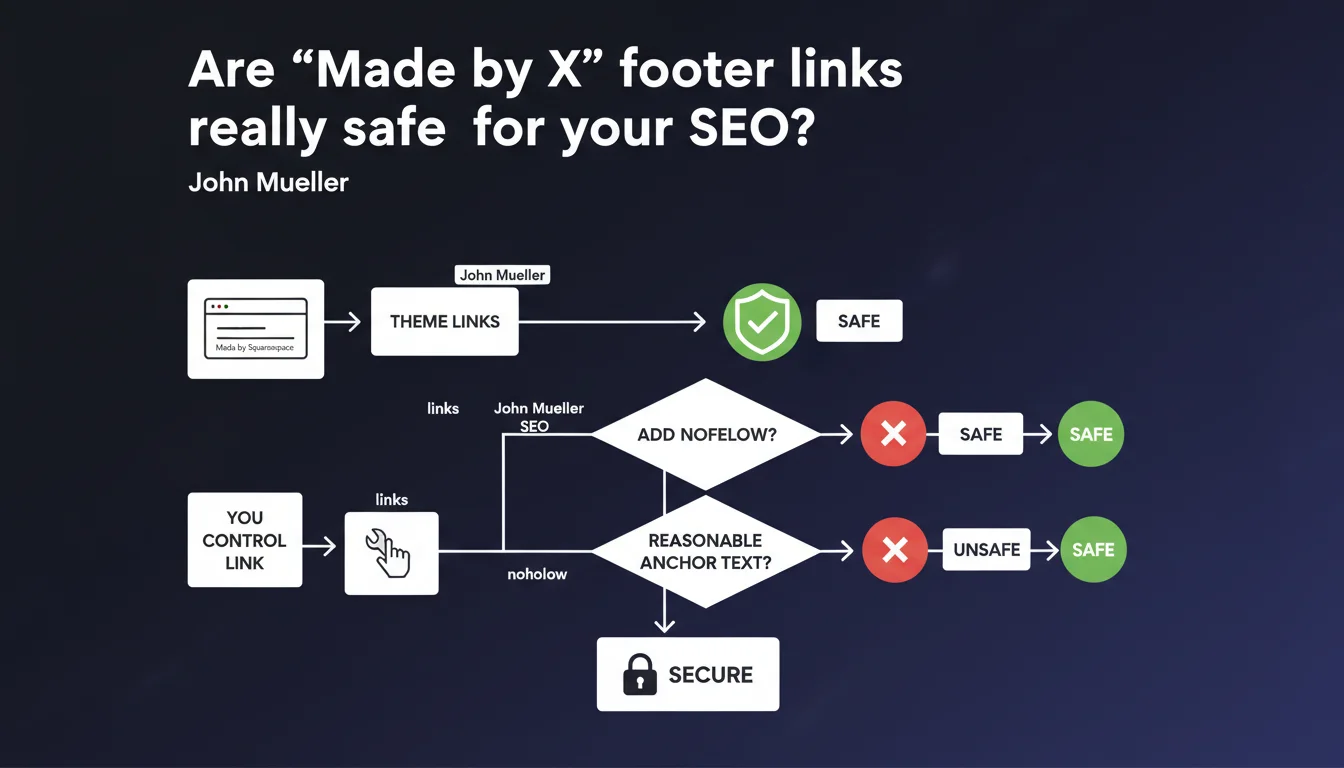
Google confirms that footer links like 'made by Squarespace' built into themes by default pose no problem. If you control this link (theme owner or developer), adding a nofollow attribute and reasonable anchor text is recommended to avoid any ambiguity.
What you need to understand
Why does Google take a stance on creator footer links?
Footer links like "made by" or "powered by" are ubiquitous across millions of sites using commercial CMS platforms or themes. They effectively create massive link building toward theme creators, platforms, or agencies.
Google has always viewed artificially scaled links as problematic. The question that arises: are these links comparable to link spam or are they a legitimate practice?
Mueller clarifies: when the link is native to the theme and you don't control it (simple user), Google holds no grudge. The search engine understands this is a technical signature, not manipulation.
What's the distinction between "imposed" links and "controlled" links?
This nuance is critical. A site owner using Squarespace or WordPress with a commercial theme doesn't control that footer link — it's imposed by the provider. Google won't penalize you for that.
However, if you're a theme developer, plugin creator, or web agency systematically embedding a link to your site, you control that link. And there, the rules change: nofollow is mandatory and anchor text must be neutral.
What qualifies as "reasonable" anchor text in this context?
Google doesn't provide an exhaustive list, but the principle is clear: avoid over-optimized or commercial anchors. "SEO Agency Paris" or "WordPress Expert France" are problematic.
Neutral text like "Site created by [Name]", "Developed by [Agency]" or simply the brand name passes without issue. The idea: display a signature, not inject a keyword phrase.
- Native theme links (outside user control) → no Google penalty
- Controlled links (developer, agency) → nofollow + neutral anchor recommended
- Anchor text: brand name or neutral descriptive phrase, never over-optimized
- Google distinguishes technical signatures from PageRank manipulation attempts
SEO Expert opinion
Is this statement consistent with real-world observations?
Yes — and it's rare for Google to be this clear on a topic. Historically, thousands of sites with "Powered by WordPress" or "Made with Wix" footers have never been penalized. Mueller's position formalizes implicit tolerance.
That said, the line remains blurry for web agencies inserting their link into client projects. Some have done this for years in dofollow with optimized anchors without apparent issue. Others have seen manual actions imposed. Consistency likely depends on the volume and aggressiveness of the anchors.
What nuances should be added to this recommendation?
Mueller says "not problematic", but doesn't clarify whether these links actually deliver SEO juice to the beneficiary. My interpretation: Google probably ignores them or massively devalues them in its algorithm, especially when originating from thousands of sites.
In other words, even in dofollow, a generic footer link lost among hundreds of thousands of identical occurrences has marginal SEO impact. [To verify]: the real effect on a beneficiary site's rankings isn't publicly documented by Google.
In what cases might this rule not apply?
If the footer link is accompanied by other manipulative signals — interconnected site networks, varied but all optimized anchors, absence of real commercial relationship — Google could reclassify the entire scheme as spam.
Similarly, if a manual review is triggered for other reasons (spam content, cloaking), a massive backlink profile via footer could aggravate the case. The rule applies in a "normal" context, not in an already suspect environment.
Practical impact and recommendations
What should you do concretely if you're a site owner?
If your theme includes a footer link you didn't request, nothing. Google won't hold it against you. You can remove it for aesthetic reasons, but no SEO obligation.
If you keep it, verify it's not excessively visible or presented as editorial promotion. A discreet footer is OK, a promotional box at the bottom of each page raises questions.
How should you handle these links if you're a developer or web agency?
Set all your footer links to rel="nofollow" or rel="sponsored" if you're charging for the theme. Anchor text must remain neutral: your agency name, "Website creation" at worst — never "SEO Agency Lyon" or "Certified WordPress Consultant".
Document this practice in your client contracts to avoid any ambiguity. Some clients request link removal: plan for a clause or paid option.
What mistakes should you absolutely avoid?
- Never use over-optimized anchors (commercial keywords) in a systematic footer link
- Don't create a hidden network of sites with cross-linked footers — that's a classic link scheme
- Avoid making the link too visible or prominent (size, color, position) — should remain a discreet signature
- Don't rely on these links to boost your SEO — their real value is close to zero
- Always add nofollow if you're the theme creator and control the link
❓ Frequently Asked Questions
Un lien footer « Powered by WordPress » nuit-il à mon SEO ?
Dois-je obligatoirement ajouter nofollow sur mon lien footer d'agence ?
Puis-je utiliser une ancre optimisée type « Agence SEO » dans mon lien footer ?
Ces liens footer ont-ils vraiment un impact SEO positif pour le créateur ?
Que risque-t-on si on ignore cette recommandation de Google ?
🎥 From the same video 16
Other SEO insights extracted from this same Google Search Central video · published on 31/01/2023
🎥 Watch the full video on YouTube →
💬 Comments (0)
Be the first to comment.