
Official statement
Other statements from this video 16 ▾
- □ Faut-il vraiment supprimer les balises meta keywords de votre site ?
- □ Faut-il modifier la date lastmod du sitemap à chaque mise à jour mineure ?
- □ Faut-il vraiment séparer les sitemaps news et généraux pour éviter les doublons d'URLs ?
- □ Pourquoi Google ignore-t-il votre meta description alors que vous l'avez soigneusement rédigée ?
- □ Faut-il vraiment nettoyer les backlinks spammés de votre profil de liens ?
- □ Faut-il encore optimiser la densité de mots-clés pour le SEO ?
- □ Pourquoi les redirections 301 restent-elles le nerf de la guerre lors d'un changement de domaine ?
- □ Un code 404 ciblé sur Googlebot peut-il bloquer l'indexation de vos pages ?
- □ Faut-il vraiment avoir le même contenu sur mobile et desktop pour l'indexation mobile-first ?
- □ Faut-il vraiment demander la suppression des URLs redirigées de l'index Google ?
- □ Vérifier son site dans Search Console améliore-t-il vraiment son référencement ?
- □ Pourquoi Google refuse-t-il le contenu multilingue dynamique sur une même URL ?
- □ Que se passe-t-il quand vos liens hreflang ne se valident pas tous ?
- □ Les liens footer « Made by X » sont-ils vraiment sans danger pour votre SEO ?
- □ Comment configurer correctement les balises canonical et alternate pour un site m-dot ?
- □ Les données EXIF des images sont-elles inutiles pour le SEO ?
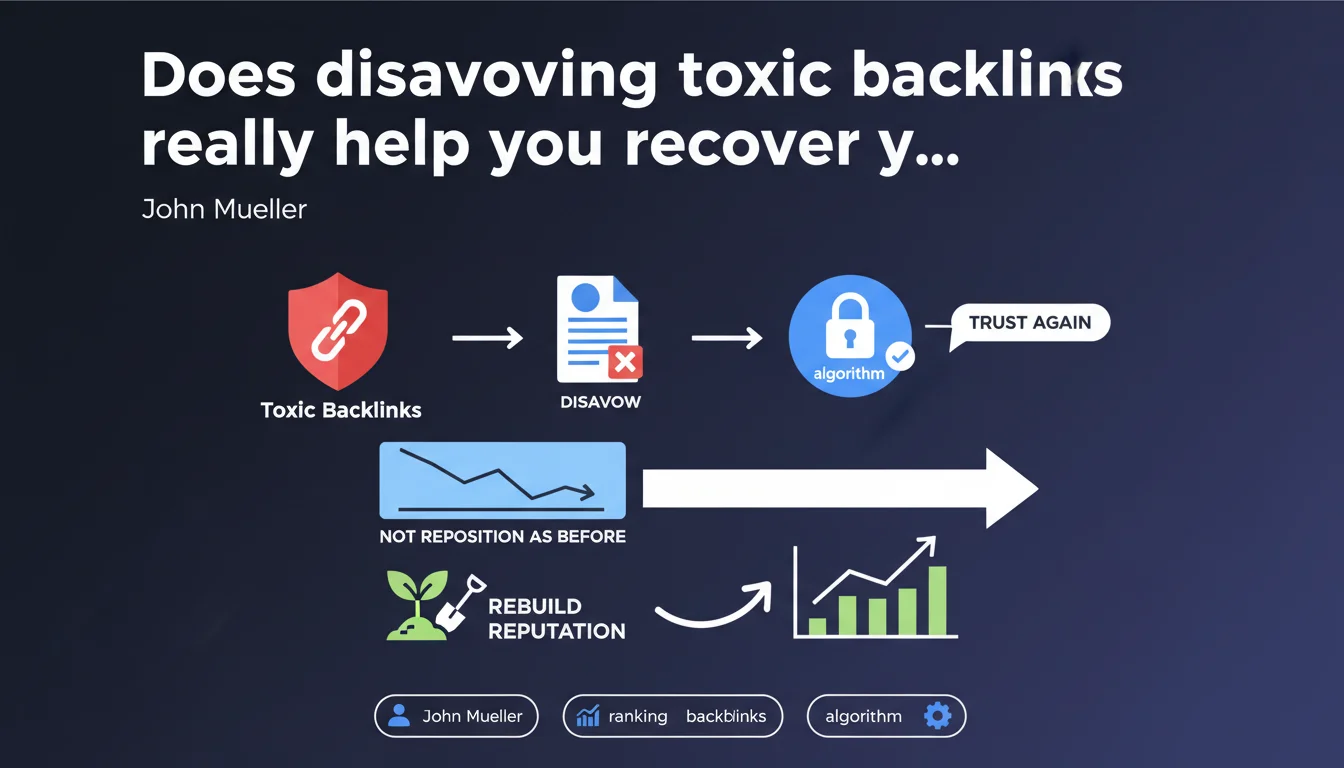
Disavowing toxic backlinks does not automatically restore lost rankings. Google clarifies that this action allows its algorithms to regain trust in your site, but guarantees no return to your initial ranking position. Your reputation must be rebuilt entirely, as if you were starting from scratch.
What you need to understand
Why isn't simply disavowing links enough to regain your rankings?
The disavow file asks Google to ignore certain backlinks pointing to your site. The main objective is to clean up your link profile, especially after a manual action or a drop caused by questionable netlinking practices.
But here's the catch: disavowing toxic links only neutralizes a negative signal. It creates no positive signal. Algorithms will stop penalizing you for those bad links, certainly — but they won't reward you in return.
What does Google mean by 'rebuilding reputation'?
Mueller talks about rebuilding from the beginning. In concrete terms, this means your site must regain algorithmic trust like a new or recently cleaned site would.
You need to prove your value through lasting positive signals: quality content, natural and relevant backlinks, satisfactory user behavior, reinforced topical authority. Disavowal erases the toxic past, but it doesn't rewrite your credibility history.
In what cases is disavowal really useful then?
Let's be honest: disavowal remains a defensive tool, not an offensive one. It mainly serves when you've received a manual action, or when you strongly suspect a questionable link profile is dragging down your site.
Google has also repeatedly stated that its algorithm handles spammy links better and better autonomously. Disavowal becomes especially relevant if you've actively built manipulative links and need to explicitly clean up your history.
- Disavowal neutralizes toxic links, but does not restore lost rankings
- Rebuilding reputation requires active positive signals (content, natural backlinks, UX)
- The tool is defensive: useful against manual actions or clearly polluted profiles
- Google increasingly manages link spam automatically, making disavowal less systematic
SEO Expert opinion
Is this statement consistent with what we observe in the field?
Yes, and we've been seeing it for years. Sites that disavow massively after a drop don't bounce back miraculously. Some recover gradually, others stagnate — the difference lies in the actions taken after disavowal.
Cases of rapid recovery are rare and mostly concern sites that corrected a manual action while continuing to produce solid content and acquire natural editorial backlinks. Disavowal alone changes nothing if the site remains static or mediocre.
What nuances should be added to Mueller's message?
Mueller isn't saying 'never use disavowal'. He's simply saying: don't count on it to automatically recover your rankings. Important distinction.
Disavowal can nonetheless unblock a situation — for example, lifting a manual action or stopping a devaluation spiral. But then, it's up to you to take action. And that's where it gets tricky: many SEOs believe that cleaning up the past is enough. It's not. You need to build the future.
Another point: Google says nothing about re-crawl timelines and reevaluation of your link profile after disavowal. Depending on the crawl frequency of your backlinks and your site's velocity, it can take weeks or even months. [To verify]: no official timeline is communicated, we're navigating blind.
In what cases might this rule not fully apply?
If you've been victim of massive and recent negative SEO, and you disavow quickly before deep devaluation takes hold, you could limit the damage. But that's purely a defensive scenario — not a ranking recovery.
Also, some sites that suffered a sharp drop after an algorithmic update (like Penguin back then) and that disavowed + massively corrected have seen partial recoveries during subsequent refreshes. But never an instant return to the same level. Always a delay, always parallel effort.
Practical impact and recommendations
What concretely should you do after disavowing?
First, don't stop at disavowal. It's a starting point, not an endpoint. Once you submit the file via Search Console, wait a few weeks for Google to process it — but don't stay passive.
Launch in parallel an active reconstruction strategy: content audit, deletion or improvement of weak pages, development of high-value-added content, acquisition of natural backlinks through targeted outreach, press relations, organic mentions.
What mistakes must you absolutely avoid?
Classic mistake: disavowing massively without fine analysis. You risk removing neutral or even positive links. Use tools (Ahrefs, Majestic, SEMrush) to score links, but keep a critical eye — metrics don't replace human judgment.
Another trap: believing that once disavowal is done, Google will instantly re-crawl and reevaluate. It takes time. And during that time, if your site doesn't evolve positively, you won't have gained anything.
Finally, avoid falling back into the same bad habits. If you've disavowed purchased or spammed links, don't do it again. Google has memory — both algorithmic and sometimes manual.
How do you measure the effectiveness of your action?
Track multiple indicators in parallel: organic rankings on your strategic keywords, overall organic traffic, click-through rate in Search Console, evolution of indexed and crawled pages.
Also check your link profile status in third-party tools: the number of toxic referring domains should gradually decrease, and trust signals (Trust Flow, Domain Rating) should stabilize or improve.
- Carefully audit backlinks before disavowing: don't throw the baby out with the bathwater
- Submit the disavow file via Google Search Console and wait several weeks
- In parallel, launch a natural content and netlinking strategy to rebuild authority
- Don't buy or create manipulative links after disavowal: risk of relapse
- Monitor rankings, organic traffic, and link profile evolution over the long term
- Prepare a communication and press relations plan to obtain organic mentions
- Optimize existing content and remove weak or duplicate pages
❓ Frequently Asked Questions
Combien de temps faut-il pour que Google prenne en compte un fichier de désaveu ?
Faut-il désavouer tous les liens à faible qualité ou seulement les plus toxiques ?
Le désaveu peut-il aggraver la situation si mal utilisé ?
Si Google gère mieux le spam de liens, pourquoi désavouer encore ?
Comment savoir si mon site doit reconstruire sa réputation après désaveu ?
🎥 From the same video 16
Other SEO insights extracted from this same Google Search Central video · published on 31/01/2023
🎥 Watch the full video on YouTube →
💬 Comments (0)
Be the first to comment.